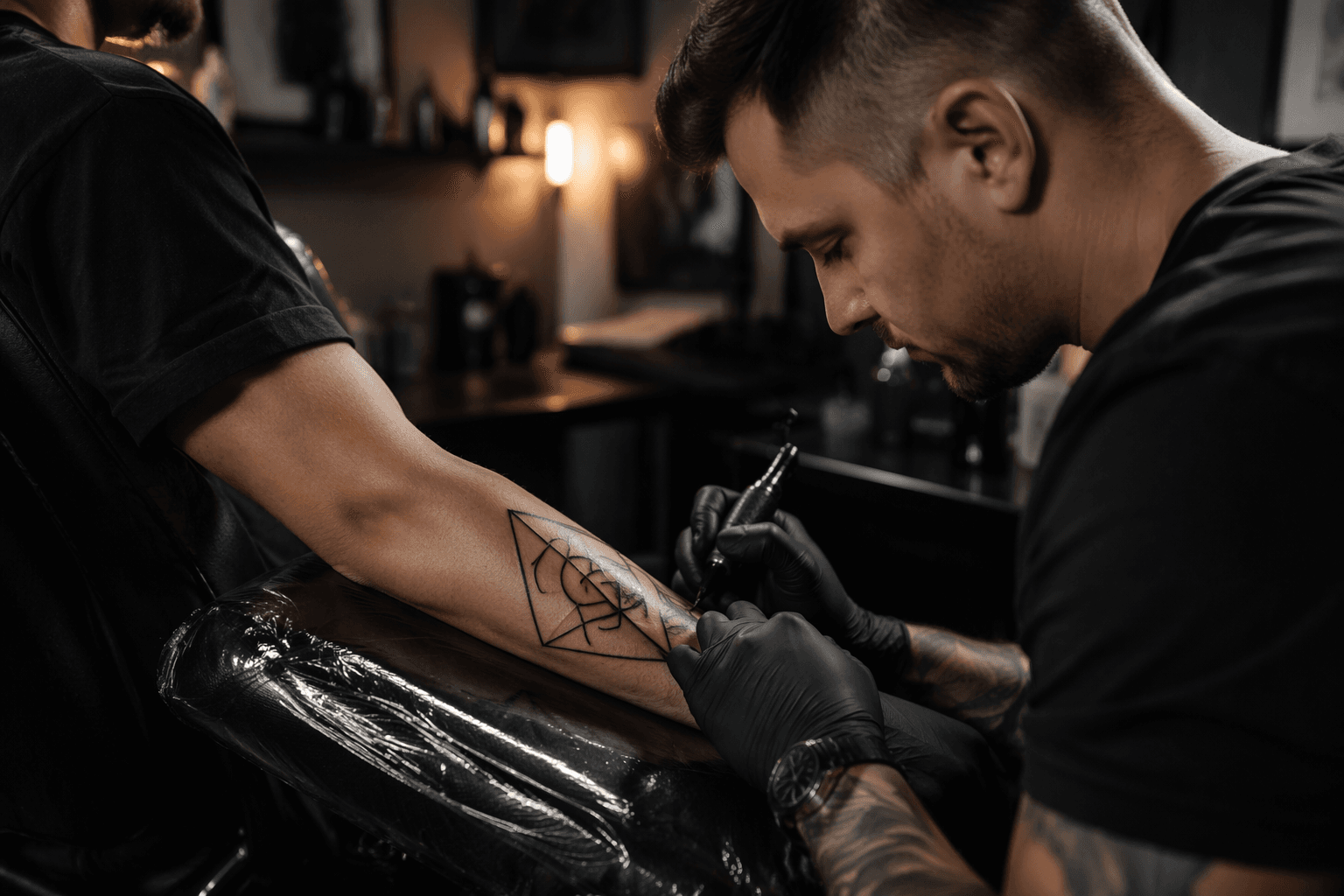
Triangle Tattoos Gain Meaning Through Minimalism, Symbolism, and Geometry
A triangle can read as restraint, belief, memory, or structure, and the right placement and pairing keep it sharp instead of generic.
Triangle tattoos work because the shape never stays still for long. A single triangle can feel like a quiet mark of restraint, but it can also carry spiritual meaning, family symbolism, or the logic of an entire geometric system, which is why it keeps surviving after flashier motifs fade. That flexibility matters in a tattoo culture where, according to Pew Research Center, people often get ink to remember or honor someone or to make a statement about what they believe, and where Forbes reported in 2023 that roughly one-third of Americans already have at least one tattoo.
Minimalism: the triangle as an anchor
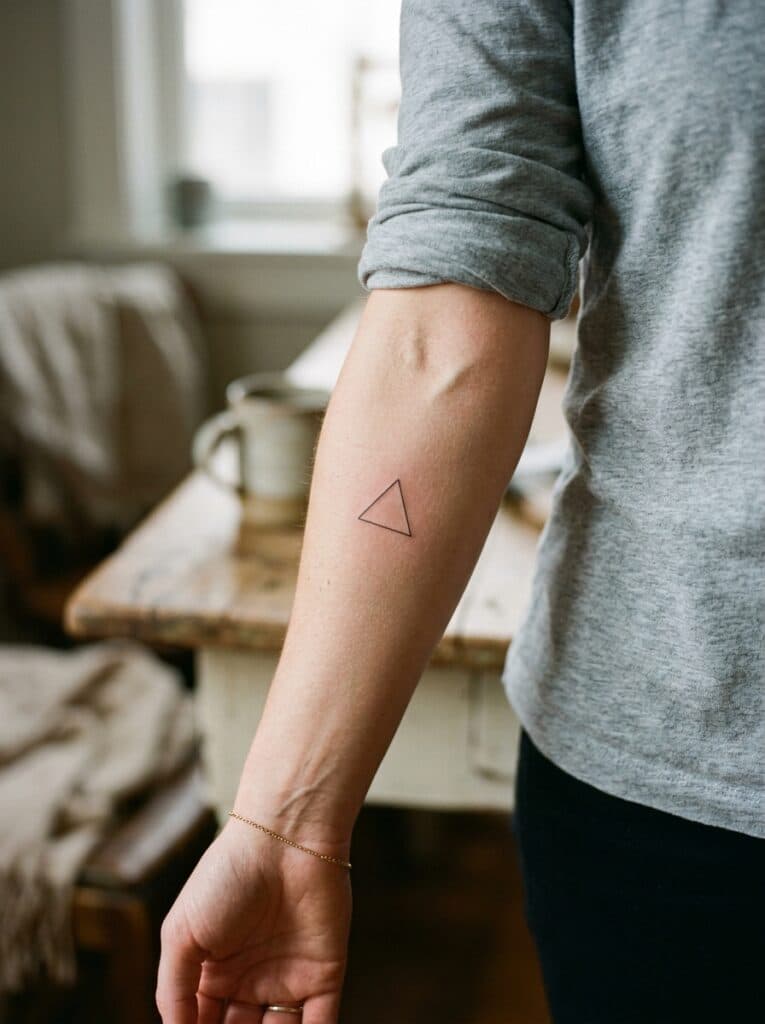
The simplest triangle tattoo is still one of the smartest. A thin-line equilateral triangle gives you the cleanest possible read, with three equal sides and a shape that Britannica defines as a three-sided polygon formed by line segments meeting at vertices. On skin, that kind of geometry feels calm rather than crowded, which is why it works so well for people who want something visible but not loud.
Placement does a lot of the work here. A small triangle behind the ear, on the inner wrist, or near the collarbone reads as deliberate because the scale matches the simplicity of the form. Put the same triangle on a broad forearm or back panel without giving it room to breathe, and it can start to look like a placeholder instead of a decision.
When the triangle turns spiritual
Triangle tattoos also endure because religious symbolism has long used visual forms as keys to convey complex beliefs, and the triangle is one of the most recognizable of those forms. In Christian iconography, the three equal sides have been used to express Trinitarian symbolism, where one shape can stand for one God in three persons. That gives the triangle a rare kind of compression: a minimal design that can still carry doctrine, devotion, and identity at once.
Two versions in particular keep showing up in meaningful triangle work. The Shield of the Trinity turns the idea into a diagram, making the triangle feel structured and theological rather than decorative. The Eye of Providence, often shown as an eye inside a triangle, adds another layer of watchfulness and divine presence, and its appearance on the Great Seal of the United States and the U.S. one-dollar bill has pushed it deep into modern visual culture. When this kind of tattoo is drawn with clean spacing and restrained linework, it reads as intentional symbol rather than conspiracy-board clutter.
Triangle as a relationship metaphor
Once you start pairing triangles, the shape becomes less about singular identity and more about relationship. Two opposing triangles can suggest balance, polarity, or elemental duality, and that makes the design feel more conversational than a lone outline. The effect is strongest when the triangles are kept simple, with mirrored angles or a deliberate gap between them that lets the negative space do some of the talking.
The same logic applies to more familiar geometric variations. A mountain silhouette is still a triangle at heart, but it shifts the meaning toward endurance, distance, and adventure. That works best when the peak is clean and spare, because too many added details turn a strong symbol into scenery.
A related historical version is the pink triangle. HISTORY traces it to Nazi Germany, where the downward-pointing pink triangle marked gay prisoners in concentration camps, and to its later reclamation by LGBTQ+ activists as a sign of pride and resistance, especially from the 1960s onward and more widely during the 1980s AIDS crisis. That history matters: a triangle tattoo is never just a triangle once color, direction, and context enter the picture.
Triangle as a mathematical and structural mark
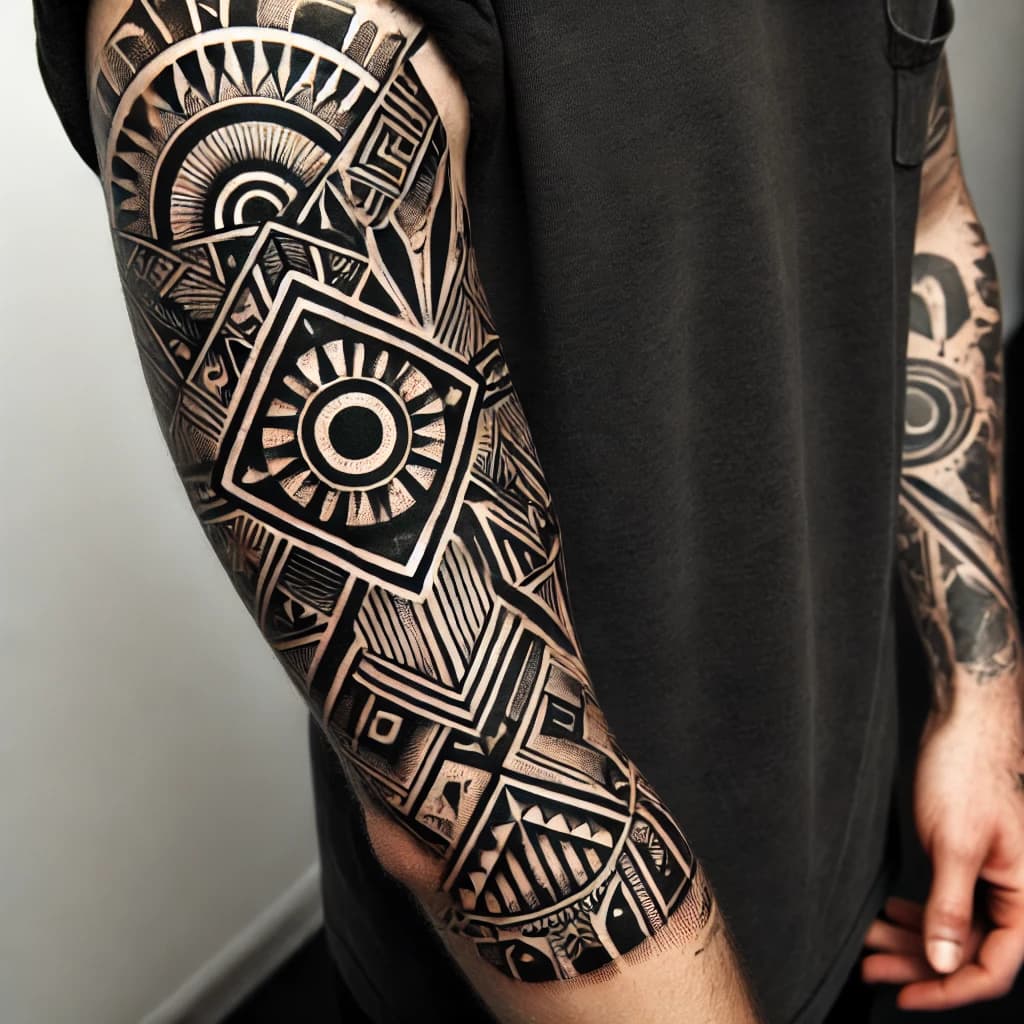
For collectors who like their ink to feel precise, the triangle’s mathematical and architectural pedigree gives it real weight. Britannica defines the shape in pure geometric terms, but the reason it shows up so often in design is structural, not just visual. Triangles distribute force efficiently, which is why they have been foundational in engineering and architecture for so long.
That structural logic is not abstract. Anne Tyng drafted a high-rise space-frame tower in 1953 using the triangle as a basic structural unit, showing how the shape can move from diagram to built form. The Smithsonian Institution’s triangle collections also point to its long life in drawing instruments and measurement tools, which makes the tattoo feel connected to drafting tables, compasses, and the history of making things accurately. For people who want their ink to suggest order, precision, and design intelligence, the triangle has a stronger pedigree than most simple shapes.
Sacred geometry, alchemy, and elemental codes
The triangle becomes even more layered when it enters sacred geometry and alchemical traditions. The Metropolitan Museum of Art notes that early modern alchemy blended medicine and the manufacture of chemical products with theory and transformation, which helps explain why triangle symbols took on such a wide range of meanings. Oxford’s Cabinet says alchemical triangle diagrams could represent the tria prima, soul, spirit, and body, while the Unicode alchemical symbols chart maps fire and air to upward-pointing triangle forms and water to a downward-pointing triangle form.
That gives triangle tattoos a kind of built-in code. A fire triangle can feel active and ascending, while a downward triangle can suggest calm, receptivity, or a more grounded elemental reading. Interlocking triangle forms push the design into sacred-geometry territory, where repetition and symmetry matter as much as the symbol itself.
How to keep the design intentional
The triangle stays strong when the composition matches the meaning. Small and simple versions work best when they are allowed to remain small and simple, while more layered symbols need space, symmetry, and cleaner line control. If you want the design to feel intentional rather than clichéd, the placement should support the idea, not fight it.
- Behind the ear, the inner wrist, and the collarbone suit single-line triangles and other minimal marks.
- The forearm, chest, and back give sacred-geometry layouts, paired triangles, and symbolic compositions room to settle.
- Upright, downward, mirrored, and interlocking orientations all change the read, so direction should be chosen with the meaning in mind.
- Dense additions, like eyes, flames, or extra linework, work best when the base triangle is still easy to read from a distance.
There is also historical baggage worth respecting. Britannica notes that the valknut is made of three interlocking triangles and that its meaning remains debated, which is a reminder that triangle imagery can sit in contested symbolic territory. That uncertainty is part of the shape’s power: the triangle can be spare, sacred, structural, or politically charged, often all at once.
That is why triangle tattoos keep working. They give you a compact form with room for memory, belief, geometry, and tension, and on skin that combination rarely goes out of style.
This article was produced by Prism’s automated news system from verified source data, official records, and press releases, then run through automated quality and moderation checks before publishing. The system is built and supervised by the people who set the standards it runs under. Read our full AI policy.
Did this article answer your question?