Why stippling density makes or breaks mandala tattoos
Mandala dotwork lives or dies by stippling density. If the dots crowd each other, petals blur into gray, while roomy spacing on larger placements stays crisp for years.
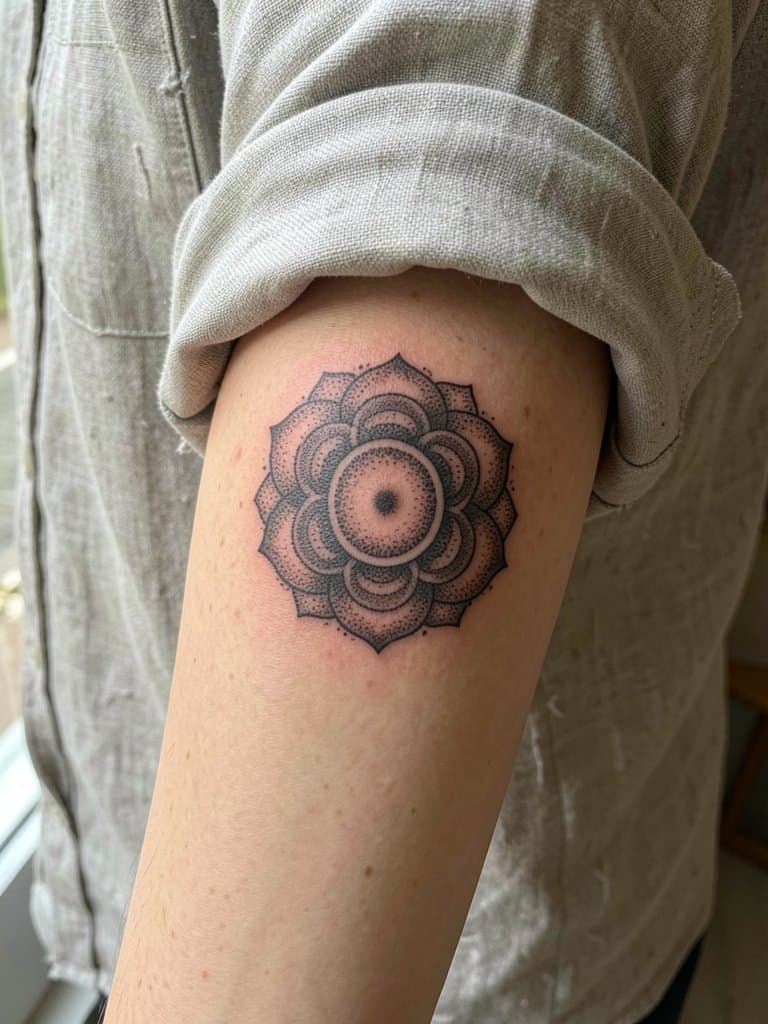
The first thing that ruins a mandala tattoo is not a bad idea, it is overcrowding. When dot clusters are packed too tightly, the healed piece stops reading as petals, rings, and negative space and starts collapsing into a soft gray mass, especially on skin that bends, rubs, or gets worked hard every day. That is why stippling density is the make-or-break variable in mandala dotwork: the right spacing gives the design room to breathe, and the wrong spacing turns precision into mud.
Stippling density is the whole game
Mandala work looks calm from a distance, but it is a demanding way to build an image. The geometry depends on repeated radial structure, so every ring has to land with enough separation for the eye to read the layers after healing. If the artist crowds the center or pushes the dot fields too close together, the outer petals and inner bands stop feeling distinct, and the negative space that makes the mandala feel architectural gets swallowed.
That is why a good dotwork mandala often looks slightly more open on day one than a rushed client might expect. The best healed pieces are the ones that still show clean transitions between dark and light areas after the skin settles. In practice, that means the artist is not just drawing a pretty circle, they are controlling scale, ring spacing, and the amount of empty space between structures so the tattoo can age without losing its rhythm.
The visual calm of dotwork is not the same thing as low effort. Patience and consistency matter here, because every dot contributes to the final density. If the structure is forced into a too-small space, the whole design loses the discipline that makes mandala work feel spiritual, modern, and architectural at the same time.
Choose a placement that helps the geometry hold up
The roundup’s practical advice points toward larger, more forgiving placements, with the forearm as the obvious starting point. That is not just a convenience choice. A mandala needs enough surface area for its radial structure to stay legible, and a placement that gives the artist room to space the rings properly will always age better than a design squeezed into a cramped zone.
High-friction areas are where the trouble shows up first. Tiny centers on skin that moves a lot can merge into a gray blur after a few years, even when the tattoo looked sharp fresh. The same dotwork, given enough breathing room, can stay crisp for a decade, which is exactly why scale matters before ink ever touches skin.
The most reliable placements are the ones that let symmetry read cleanly without fighting constant motion. If the design has to wrap too hard or compress too much, the radial pattern starts working against the body instead of with it. A forearm gives that structure a better shot, because the eye can follow the rings without the distortion that comes from squeezing the motif into a smaller, more active surface.
What healed crispness actually looks like
A healed mandala tattoo should still separate cleanly into bands, petals, and negative space. You want to see where one ring ends and the next begins, not a continuous fog of stipple that only looks detailed under fresh ink. The crispest healed dotwork reads as deliberate spacing, not as a field of dots that happened to survive.
The warning sign is usually density, not style. If the center is already packed so tightly that the dark areas close up on paper, the healed tattoo has little chance of holding the same clarity on skin. That is especially true when the design is trying to force too much detail into a small radius, because the eye needs those gaps to understand the pattern.
For a buyer, the most useful question is simple: does this design still read if the dots soften a little over time? If the answer is no, the tattoo is probably overbuilt. The goal is not maximum detail at all costs, it is readable structure after healing.
Before you book, look for these warning signs
- The stencil or mockup looks crowded before it ever reaches skin.
- The center is so dense that the petals already blend into the ring behind them.
- The design has been squeezed down instead of scaled to the body.
- There is almost no negative space left for the eye to separate the layers.
- The artist is treating a complex radial pattern like a small fill-in job.
Those are the tells that a mandala may look good in a screenshot but age badly in real life. Dotwork rewards restraint, and it punishes overpacking faster than most styles because the structure is so dependent on separation.
Aftercare is part of the design
The longevity question does not end when the tattoo is finished. The American Academy of Dermatology says petroleum-based products such as petroleum jelly can cause ink to fade, and UV light can fade some tattoo inks. It also recommends broad-spectrum, water-resistant sunscreen with SPF 30 or more, which matters a lot for ornamental work built on fine contrast.
That advice is even more important with mandalas because the whole style depends on preserving the difference between dark and light. The AAD also notes that tattoo reactions can happen immediately or years later, and that tattoos can make early skin-cancer signs harder to see. In other words, the same skin that makes your dotwork look crisp can also hide changes if you stop watching it.
Peer-reviewed research by Cristian D. Gonzalez, Barbara J. Walkosz, Robert P. Dellavalle, and colleagues makes the sun-safety piece feel very practical. Tattoo studios are a useful place to teach skin-cancer prevention, and most tattoo artists already promote sun protection for new tattoos, but many are not fully informed on broader sun-safety recommendations. That gap matters because a mandala that starts out balanced can lose its edge fast if you treat aftercare like an afterthought.
The bigger tattoo safety picture
The FDA says about 30% of all Americans and 40% of people ages 18 to 34 have at least one tattoo, which tells you how mainstream this has become. It also says permanent tattoos are designed to last a lifetime and are difficult to remove, so the stakes are not small when you pick a style that depends on fine structure. In the FDA’s view, tattoo inks and pigments fall under cosmetic oversight, while the actual practice of tattooing is regulated locally.
That same agency has warned that contaminated inks have caused infections and allergic reactions, and that even unopened sealed inks can harbor bacteria or other microorganisms. It also reported more than 150 adverse reactions tied to certain permanent makeup shades in 2003 and 2004, and later said a firm voluntarily recalled several tattoo ink colors and sizes in the fall of 2017 because of microbial contamination identified through an FDA survey. The agency’s Safety Advisory on May 15, 2019 warned consumers, tattoo artists, and retailers about using or selling certain inks contaminated with microorganisms.
All of that lands squarely on the same point: a mandala tattoo is only as good as the spacing behind it. The ornamental tradition has deep roots, from the geometric and symmetric black shading of contemporary pointillism back to the Neolithic Iceman in the Alps, who carried 61 tattoos, many of them lines and dots. But the lesson still feels modern. If you want the petals, rings, and empty space to survive the healing process, give stippling density the respect it demands, because that is where the tattoo either stays sharp or turns to blur.
This article was produced by Prism’s automated news system from verified source data, official records, and press releases, then run through automated quality and moderation checks before publishing. The system is built and supervised by the people who set the standards it runs under. Read our full AI policy.
Did this article answer your question?