How to train your dog to settle calmly on patios
Patio time works best when you treat it like an impulse-control drill: pre-exercise, a mat cue, short windows, and an exit plan before arousal spikes.

Servers carrying food, nearby dogs, crowded tables, sudden noises, and smells can pull even a seasoned hyper dog out of orbit on a restaurant patio. It is a live-fire impulse-control test, not a reward for a dog who has already gone over threshold. The dogs that make it through calmly usually did not get lucky. They were prepped for the job.
Start with the work before you sit down
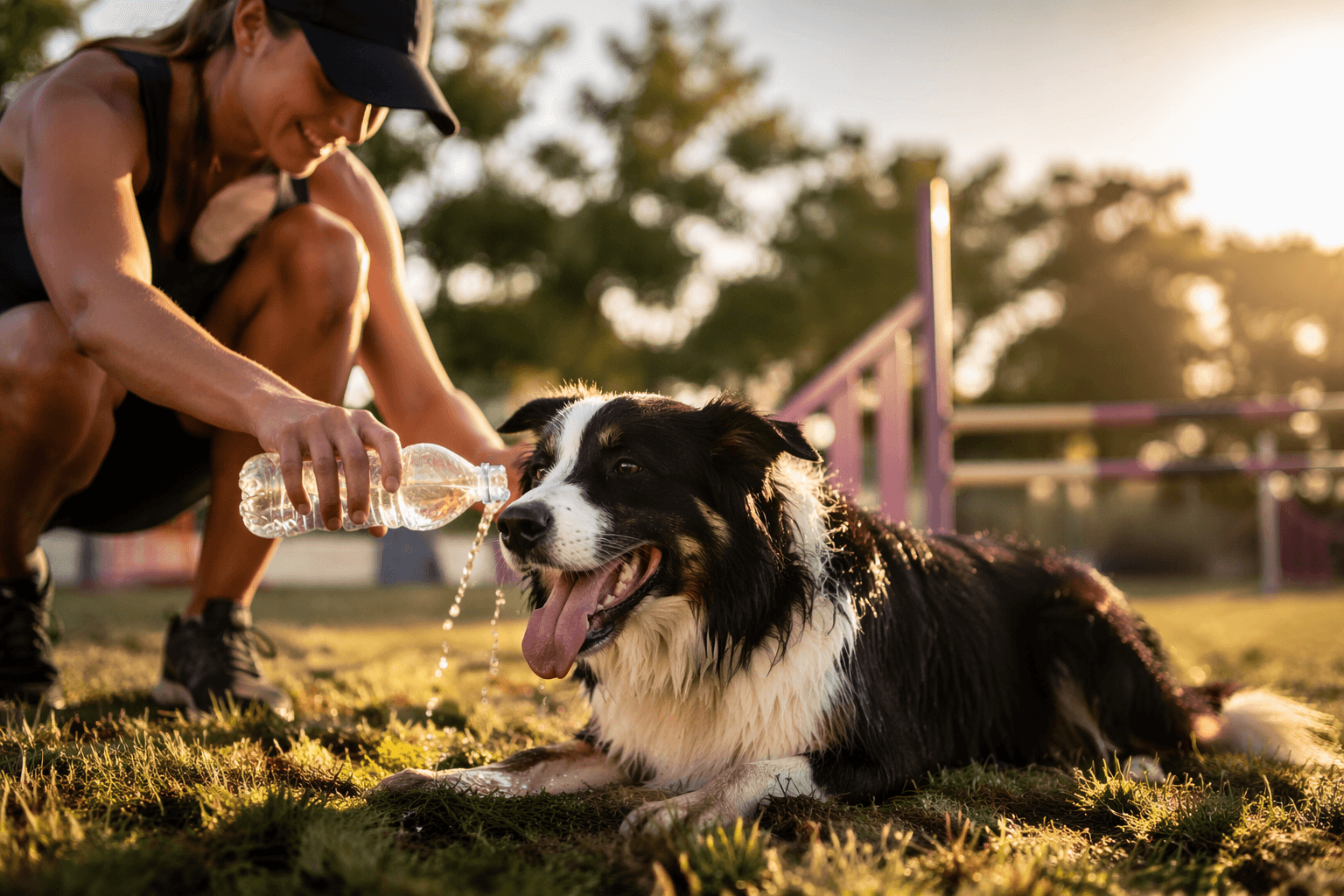
If you want patio manners to hold, begin with a dog that is already a little tired, a little practiced, and a lot clearer about the assignment. That means pre-visit exercise, then a short, realistic outing window, not a long lunch with the hope that your dog “settles into it.” The whole point is to reduce the first-wave surge of energy before you ask for stillness in a place full of moving parts.
Settling is a learned behavior. Positive reinforcement can teach a dog how to settle and relax on cue, and the goal is not just a body that stops moving. You are building genuine emotional relaxation, the kind that lets your dog remain present without spinning up every time a plate passes or another dog looks over.
Make the mat the job
The core skill is a settle or station behavior on a mat or towel. That mat is more than gear. It gives your dog a clear boundary and a predictable place to work from, which matters a lot more than people expect when the patio gets busy. The American Kennel Club recommends teaching your dog to go to a specific place, pairing it with a release word, and using it to replace problem behaviors with a clean, repeatable task.
Begin indoors in a quiet room, where the win can be as simple as stepping onto the mat and getting rewarded for it. From there, shape the behavior into a down-stay, then into a calm settle, then into a longer hold with distractions added one at a time. That gradual build is what turns “place” into a real public skill instead of a cue that only works when nothing is happening.
Choose gear that can actually travel
A patio mat has to survive real life, not just a training demo. It should be easy to carry and durable enough for repeated use, with waterproof material, padding for older dogs, and a compact folded size. Those details matter because a good mat should be simple enough that you bring it every time, not only on the days when you feel prepared.
Think of the mat as a portable safe place or happy place. That kind of place training is especially useful for service dogs, but it also helps hyperenergetic pets learn that public space does not have to mean permanent vigilance. When your dog understands that the mat is the station, the patio becomes less of a free-for-all and more of a defined task.
Keep the session short enough to succeed
Short visit windows are not a compromise; they are the whole strategy. A calm patio dog is usually a dog that leaves before arousal climbs past the point of recovery. If the ears are forward, the body is glued to every passerby, the breathing is quickening, or the dog keeps breaking the settle to scan the room, you are no longer practicing calm. You are rehearsing escalation.
This is where structured impulse control pays off. You are not asking your dog to be bored in public. You are asking for a repeatable pattern: arrive after exercise, step to the mat, settle, get rewarded, and leave while the dog can still do the job cleanly.
Build in enrichment, not just obedience
For dogs with big engines, patio manners are only part of the picture. Regular enrichment helps dogs engage in natural behaviors like sniffing, chewing, playing, chasing, and scavenging, and that kind of outlet supports physical, emotional, and mental satisfaction. If a dog struggles to settle on a patio, the answer may be more than obedience drills. It may be a richer daily routine that gives the nervous system somewhere else to put all that energy.
Patio calm is often the byproduct of a dog whose needs are being met elsewhere. A dog that gets to sniff, chew, and problem-solve more often at home is less likely to treat a restaurant patio as the one place to explode with curiosity.
Know the rules, and know the limits
The Food and Drug Administration updated its Food Code guidance in 2022 and 2023 to allow dogs in outdoor dining areas when state and local laws, and the restaurant itself, permit it. The 2022 Food Code was the first to include guidance allowing dogs in outdoor dining spaces if approved by the local regulatory authority.
By 2023, 23 states had laws or administrative regulations allowing pet dogs in outdoor dining spaces. At the same time, the ADA makes a separate rule clear: businesses generally must allow service animals where the public can go, even when pets are not allowed. Pets are still governed by state and local rules, so the category your dog falls into matters before you walk through the door.
Make the patio easier for everyone
Keep dogs leashed tightly, post clear signs, and do not let dogs on tables. Sanitation lives in those details, and so does the difference between a dog that blends into the space and one that turns the whole patio tense. Public reaction is mixed, with diners, restaurants, and public-health concerns all pulling in different directions.
A well-trained dog reduces friction for staff, keeps the leash from becoming a tangle, and gives you a clean exit before the room turns too hot. If the patio starts to feel like a crowding, noise-heavy job interview for your dog, you already know the signal: the environment is too stimulating, and it is time to leave while the mat work is still intact.
This article was produced by Prism’s automated news system from verified source data, official records, and press releases, then run through automated quality and moderation checks before publishing. The system is built and supervised by the people who set the standards it runs under. Read our full AI policy.
Did this article answer your question?