Victorian leathercraft guide reveals ornamental designs, tools and techniques
Revell’s leatherwork manual treats hide like a decorative medium, from floral moulds to velvet-backed frames, and that widens what leathercraft can be.
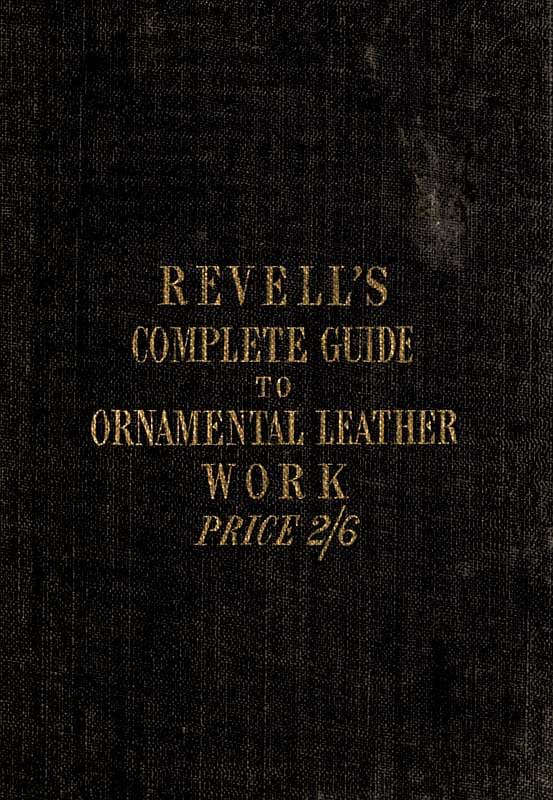
Panels, screens, frames, and household objects fill James Revell’s *A Complete Guide to the Ornamental Leather Work*, a Victorian manual that treats leather with the same seriousness other makers gave to carving or gilding. It preserves a fine-art branch of leatherwork that still offers usable ideas at the bench today.
Leather as a decorative medium
Revell’s book appears in Project Gutenberg as a practical art publication aimed at hobbyists and crafters, for people making for pleasure, display, and the home. The Boston edition, in an Internet Archive record, is dated 1854 and identified as a reprint of the London edition, a reminder that ornamental leatherwork moved through a transatlantic pattern-book culture rather than sitting in one workshop tradition. The book is built around repeatable methods, named materials, and clearly described forms, not one-off showpieces.
Revell’s world fits the broader Victorian appetite for surface pattern and handwork. The Arts and Crafts movement emerged in late Victorian England as a reaction to industrialization and mechanization, and William Morris, born March 24, 1834 and died October 3, 1896, became one of the movement’s defining figures as a designer, craftsman, poet, and early socialist. Ornamental leatherwork belongs in that same atmosphere of revived craftsmanship, where the value of a thing came from visible making as much as from function.
The kit Revell actually names
Revell does not speak in generalities. He names basil leather and skiver leather, oak varnish stain, spirit stain, Shaw’s liquid glue, stiffening, a small hammer, brushes, tacks, nippers, a veining tool, hard steel pens, a bradawl, scissors, a leather-cutting knife, grape moulds, and moulds for passion flowers. The list shows a decorative practice that depended on both surface treatment and modeling tools, not just cut-and-stitch construction.
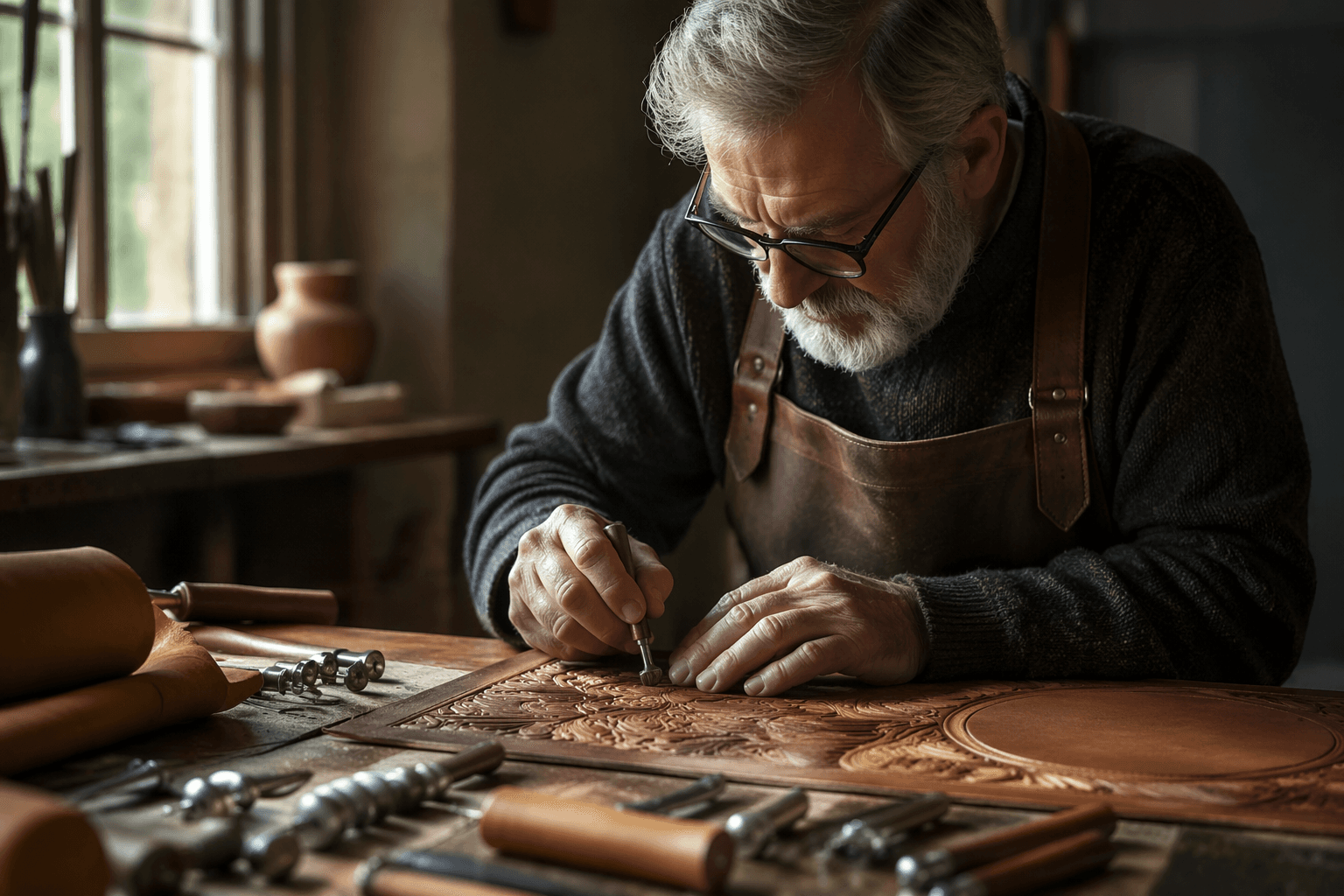
Leather for leaves and flowers must be wetted and modeled while wet, which puts this squarely in the world of forming and sculpting, not flat decoration. Making some flower parts in one piece adds strength and solidity.
The techniques worth stealing now
The floral work is the clearest entry point. A veining tool and hard steel pens give you line, ribbing, and botanical definition, while grape moulds and passion-flower moulds show how Victorian makers leaned on repeatable forms to build a recognizable design language. Adapted today, the logic is not to copy a whole period object, but to build a leaf or petal in relief, give it a visible vein structure, then repeat it across a panel so the pattern reads as intentional rather than busy.
Revell also points to a richer, more dramatic finish: gold leather work on blue or crimson velvet grounds, especially for frames and fire-screens. That combination gives you several adaptable ideas straight away:
- wet-model leaves and flowers so the relief holds after drying
- build petals or flower clusters in one piece when you need strength
- use moulded botanical repeats, like grape or passion-flower forms, to keep a panel coherent
- pair gilt or burnished leather with a dark velvet ground for high contrast
- add tonal depth with oak varnish stain or spirit stain instead of relying only on dye color
Victorian taste made the medium worth the effort
Embossed leather was already tied to elite interior decoration long before the Victorian period. At the Metropolitan Museum of Art, a late 15th-century Venetian leather box survives as one of the finest examples of Italian leatherworking, and the museum’s broader records show leather used for prestige surfaces from painted wall panels in Spain to a leather workshop established in Amsterdam by 1611. Victorian makers inherited that visual language and reworked it for domestic display.
Embossed leather showed up in wealthy circles, especially in men’s studies, where it carried the weight of expensive taste. Leather was costly, which made it luxurious, and its cost made ornamental use culturally legible. Revell can move so comfortably from floral modeling to pulpits, glasses, and goblets as surfaces worthy of leather ornament.
At the Victoria and Albert Museum, the study of plants and flowers is treated as a popular Victorian pastime, especially among women, with botanical subjects carrying both instruction and pleasure. That helps explain why Revell’s repeated lilies, grape forms, and passion flowers feel so natural in the book’s visual vocabulary.
Why the old manual still expands your bench
In Revell, leather does more than carry, protect, or fasten. It can stand in for carved relief, painted ornament, and gilt surface all at once, which is why the book’s range reaches from frames and fire-screens to pulpits and vessels. The same logic that made cast-iron ornament more reproducible through molds in the nineteenth century is at work here: templates, repeated forms, and a ready-made decorative vocabulary make ornament teachable.
This article was produced by Prism’s automated news system from verified source data, official records, and press releases, then run through automated quality and moderation checks before publishing. The system is built and supervised by the people who set the standards it runs under. Read our full AI policy.
Did this article answer your question?