California lockpicking guide explains when tools cross into legal trouble
California treats picks as ordinary gear until intent changes the story. For meetup bags, car trunks, and roadside encounters, the safest move is to keep permission and purpose obvious.
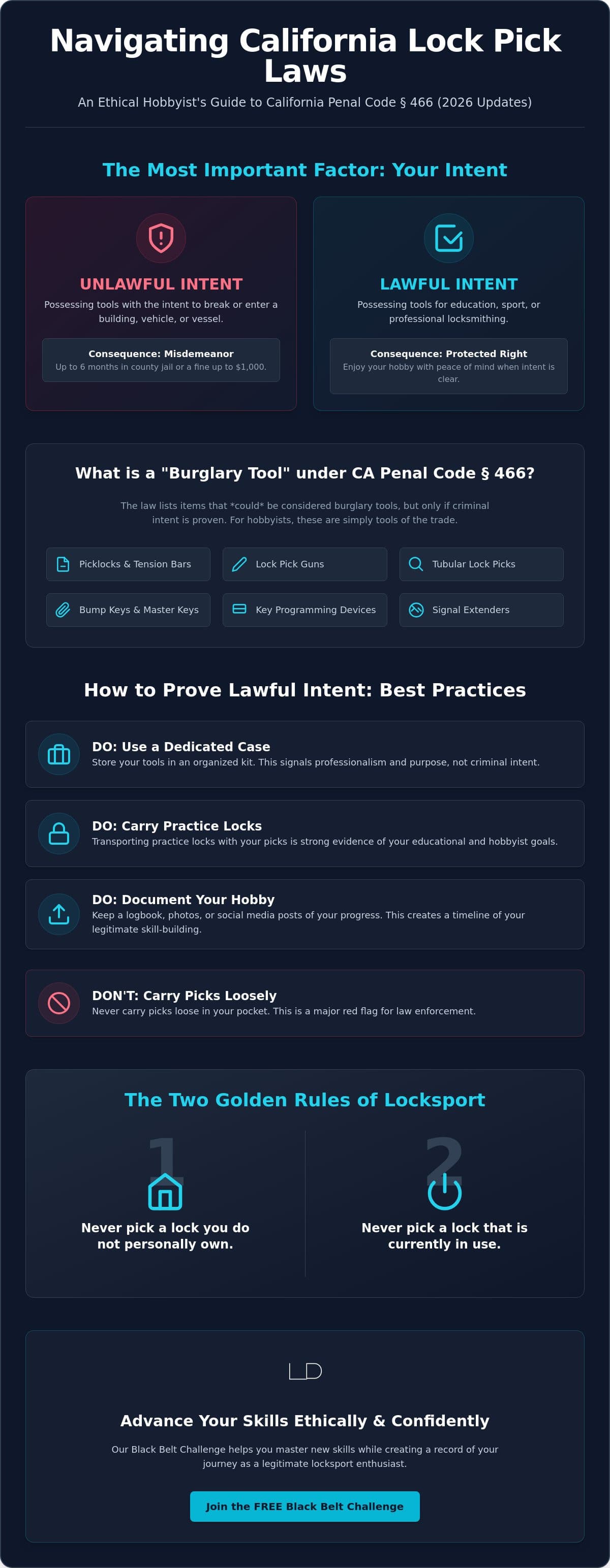
California Penal Code 466 can turn a set of picks, tension bars, bump keys, or shims into evidence when the intent is to feloniously break or enter, or to make or alter a key or instrument without permission. Those tools can sit lawfully in your kit, but for anyone hauling a case to a meetup, leaving gear in a car, or explaining a kit during a police stop, the real risk is whether your conduct, your destination, and your explanation all point to a legitimate locksport purpose.
Where possession crosses the line
It makes possession of listed tools, including lock picks, a misdemeanor when the intent is to feloniously break or enter a building, railroad car, aircraft, vessel, trailer coach, or vehicle. The same section also covers knowingly making, altering, or attempting to make or alter a key or similar instrument so it will fit or open a lock without being requested by someone with the right to open it.
It also reaches making, altering, or repairing an instrument or thing when you know, or have reason to believe, it will be used in a misdemeanor or felony. California looks at what you were doing with it, who asked for the work, and what you knew the tool would be used for.
Why context matters as much as the kit
For recreational pickers, locksmith trainees, and security researchers, the same bag can look completely different depending on the setting. A clearly organized kit headed to a locksport meetup or training session reads one way. The same kit tossed loose in a car with no obvious reason to be there can invite a very different interpretation if an officer is trying to read intent from the surrounding facts.
A person practicing non-destructive entry on owned locks is in a very different position from someone carrying picks alongside damaged property, burglary tools, or conflicting explanations. Legal use and unlawful intent can turn on those surrounding facts.
How to carry tools without making your life harder
The smartest move is to make your lawful purpose obvious before anyone asks. If you are heading to a meetup, workshop, or paid job, keep the tools with the rest of the paperwork and gear that support that purpose. For hobbyists, that means being able to point to a locksport event, a training session, or owned practice locks instead of improvising a story on the spot.
- Keep the kit together, clean, and clearly hobby-focused, not mixed with anything that looks like a burglary loadout.
- Transport tools to an actual destination that matches your explanation, such as a locksport gathering, a locksmith class, or a work site.
- Make sure you can explain the lock or the lock body you are practicing on, especially if it is your own property or you have permission to work on it.
- Do not treat a car trunk like legal armor. A hidden kit is still judged by context if the rest of the circumstances look wrong.
A few practical habits help:
What California does with sales and transfers
California also regulates the retail side. Penal Code 466.1 requires sellers or providers of certain lock tools, including lock picks, tension bars, lock pick guns, tubular lock picks, and floor-safe door pullers, to collect identifying information from the buyer. That information includes the buyer’s name, address, telephone number if any, date of birth, and driver’s license or ID number if any.
The state requires a paper trail for those transactions. If you buy, sell, or hand off gear in California, the transaction itself can carry compliance duties. For hobbyists who trade tools at meets or buy replacements for a practice set, the safer assumption is that some transactions are regulated, not just the final use of the tool.
Locksmith work sits in a separate regulatory lane
California also has a formal locksmith regulatory system through the Bureau of Security and Investigative Services, which sits under the Department of Consumer Affairs. BSIS offers a Locksmith Company License Application Packet, a fee schedule, FAQs, and a public license search tool that shows whether a license is current or subject to discipline.
Once locksport bleeds into paid work, rekeying, or opening locks for someone else, licensing and business compliance can matter as much as criminal law. A person who treats every opening task as “just a favor” can end up ignoring the boundary between recreational picking and regulated locksmith activity.
What the locksport community gets right
The broader hobby has always tried to separate controlled practice from malicious use. The Open Organisation Of Lockpickers promotes public meetings, lectures, training sessions, sporting events, and ethical standards for the hobbyist community. Locksport is recreational, social, and competitive defeating of locking systems without destructive intent.
In California, that means keeping the activity educational, keeping permission explicit, and keeping the practice locks, the event invites, and the locksmith paperwork aligned with what you are actually doing.
This article was produced by Prism’s automated news system from verified source data, official records, and press releases, then run through automated quality and moderation checks before publishing. The system is built and supervised by the people who set the standards it runs under. Read our full AI policy.
Did this article answer your question?