Campus door hardware, often overlooked, can determine accessibility and lockdown safety
A classroom door can look compliant and still fail under stress. The difference often comes down to whether its indicator hardware can be read fast, by anyone, in a lockdown.
The part of campus safety people keep missing
Campus security conversations love the visible stuff: ramps, elevators, stair lifts, lights, automatic operators. Door hardware usually gets treated like a footnote until a code inspector asks about it, or until a drill exposes how much confusion a bad trim package can create. That is the real tension here, accessibility versus security, and classroom doors sit right on the fault line.
The 2010 ADA Standards for Accessible Design set the minimum enforceable accessibility rules for newly designed and altered state and local government facilities, public accommodations, and commercial facilities. The U.S. Department of Justice published the revised ADA regulations and those 2010 Standards on September 15, 2010. In other words, compliance is the floor, not the finish line, and on a campus door that distinction matters more than most facility teams want to admit.
Why indicator hardware is not a cosmetic choice
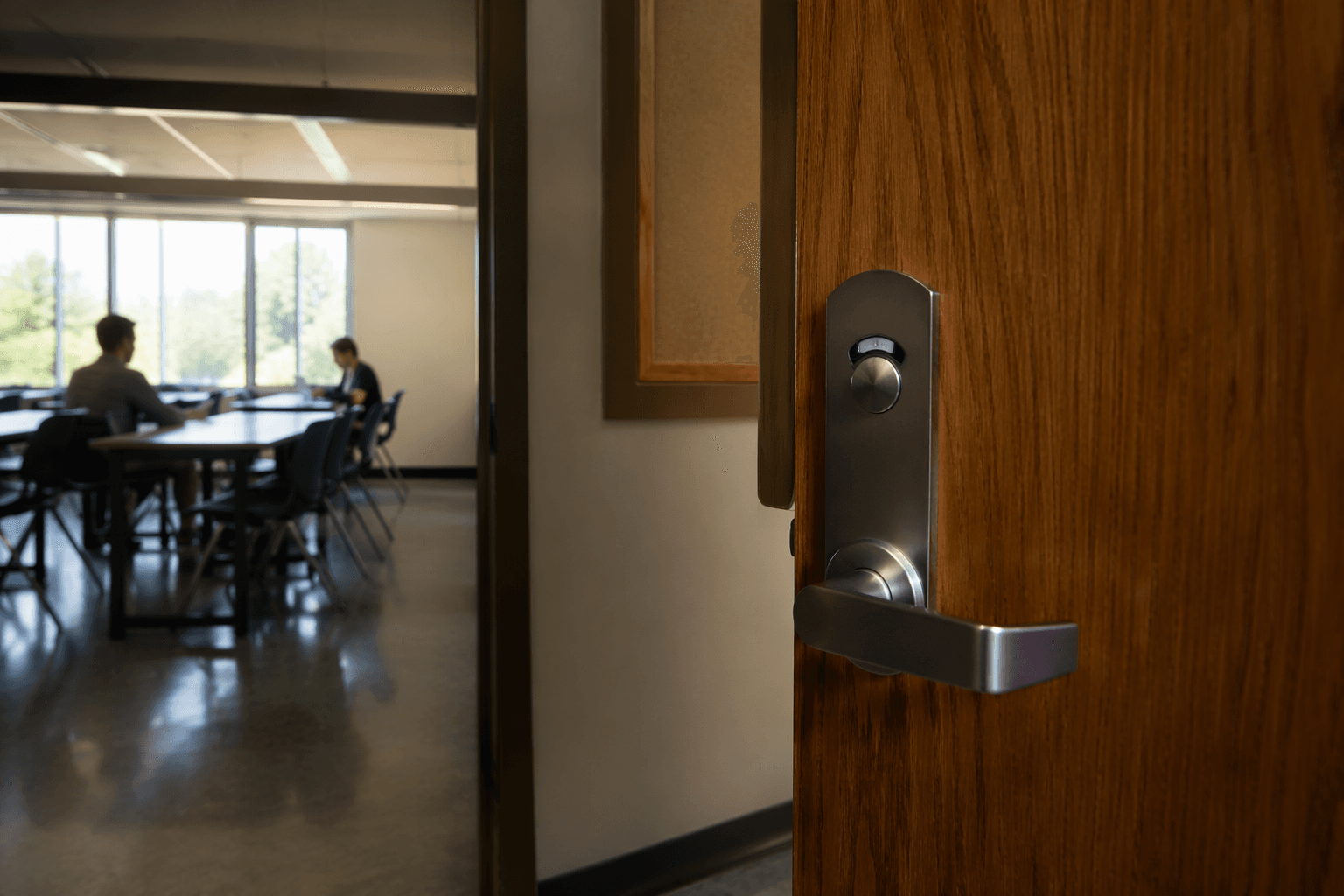
An indicator lock or indicator trim is supposed to answer one simple question fast: is this door secured or not? In a classroom, that answer has to be obvious to a teacher at the threshold, a student in a hallway, a custodian moving between buildings, or a responder arriving under pressure. If the hardware forces people to squint, interpret tiny text, or guess at a barely visible flag, it is failing at the one job that matters in an emergency.
That is why the International Building Code language matters so much. In the 2018 IBC, certain key-operated locking devices are allowed only if the locking device is readily distinguishable as locked and a visible sign is posted on or adjacent to the door. The sign requirement is specific: 1-inch, or 25 mm, lettering on a contrasting background. That is not decorative language. It is the code acknowledging that, in real use, visibility is part of life safety.
What stress does to ordinary people
The accessibility argument is not just about wheelchair users or code checklists. It is about cognition under pressure. If the indicator hardware lacks strong contrast, large text, symbols, or oversized windows, people with disabilities, visitors, and even regular occupants can miss the status of the door for precious seconds. Those seconds are where confusion turns into delay.
That delay matters most when the building is noisy, the lights are bad, and everyone is already keyed up. A small window or tiny legend that looks fine in a showroom can become useless in a hallway full of moving bodies. In practical terms, the better trim is the one that reads instantly from a few steps away, without requiring a second look or a spoken explanation.
Lockdowns changed the baseline
This conversation would be different if lockdowns were rare. They are not. According to the U.S. Department of Education, 98 percent of public schools reported written procedures for active shooter drills in the 2023-24 school year. RAND and other researchers describe active shooter drills as nearly universal in U.S. public schools, while also noting that implementation varies widely and can range from routine to high-intensity, even harmful.
That reality helps explain why door hardware has become more than a minor building component. The National Center for Education Statistics reported that the share of public schools with at least one security staff member present at school at least once a week rose from 43 percent in 2009-10 to 65 percent in 2019-20, then settled at 61 percent in 2021-22. Schools are plainly layering procedures, staffing, and hardware together. If the door cannot communicate its status instantly, the rest of that system loses efficiency right where speed matters most.
NFPA’s view is basically the lockpicking world’s practical reality
The National Fire Protection Association has long tried to balance two demands that often collide: keep egress clear in a fire, but do not ignore security needs. Its Life Safety Code aims to prevent locked door assemblies in means of egress during a fire while balancing those security concerns. NFPA also notes that hostile events have increased the use of security features on door assemblies within means of egress.
That balance is where campus hardware gets interesting. The door has to open when people need to leave, but it also has to present a clear, secure status when the room is sheltering in place. This is not a theory problem. It is a hardware problem, and hardware problems are solved with better visibility, better labeling, and better thinking at the spec stage, not after installation when everybody is already upset.
What the research on lockdowns says the door is doing
The Rockefeller Institute of Government and the Regional Gun Violence Research Consortium have pointed to a simple fact: locking the door is the first step in lockdown procedures. Their research on real-world school mass shootings found that lockdowns were associated with 59 percent fewer total casualties and 63 percent fewer deaths overall. That does not mean every door solution is equal, but it does show why the first move in a crisis is often just as mechanical as it is procedural.
That is also why the best indicator hardware has become more user-centered. Corbin Russwin markets status indicators with clear visual confirmation and large viewing windows, which is exactly the kind of practical improvement a school corridor needs. Allegion pushes indication solutions for education settings, color-blind users, and quick recognition in lockdown situations. Those are not gimmicks. They are answers to a very specific campus problem: how to make a locked door understandable in one glance, to as many people as possible.
What to look for when you spec or replace it
When you are choosing classroom or campus door hardware, do not stop at lock strength or brand familiarity. Look at whether the status is obvious from the egress side, whether the sign or window has enough contrast, and whether the label can still be read by somebody who is tired, stressed, or standing at an angle. The hardware should work for the staff member doing a morning walk-through and for the student who is trying to make sense of the door during a drill.
The best campus door hardware does two jobs at once. It supports accessibility under normal conditions, and it gives immediate, unmistakable status during a lockdown or evacuation. That is the entire lesson hidden inside a classroom lock: if the trim can communicate clearly when people are most stressed, it is not a small detail anymore, it is part of the safety system that keeps the room readable when the building is anything but calm.
This article was produced by Prism’s automated news system from verified source data, official records, and press releases, then run through automated quality and moderation checks before publishing. The system is built and supervised by the people who set the standards it runs under. Read our full AI policy.
Know something we missed? Have a correction or additional information?
Submit a Tip