LockPick Pros guide carbon fiber picks for longer, more precise sessions
Carbon fiber won't open hard locks by itself, but it can make feedback cleaner and long sessions less punishing for pickers already past the basics.
Carbon fiber picks are not a magic key to harder locks, and that is exactly why the argument around them matters. The real pitch is simpler: less hand fatigue, cleaner feedback, and a tool that stays readable when you are sitting on a stubborn cylinder for a long run. If you are past your first beginner set and already care about tension feel, wrist strain, and how much information comes back through the shaft, this is the kind of upgrade worth evaluating on its own terms.
What carbon fiber changes in the hand
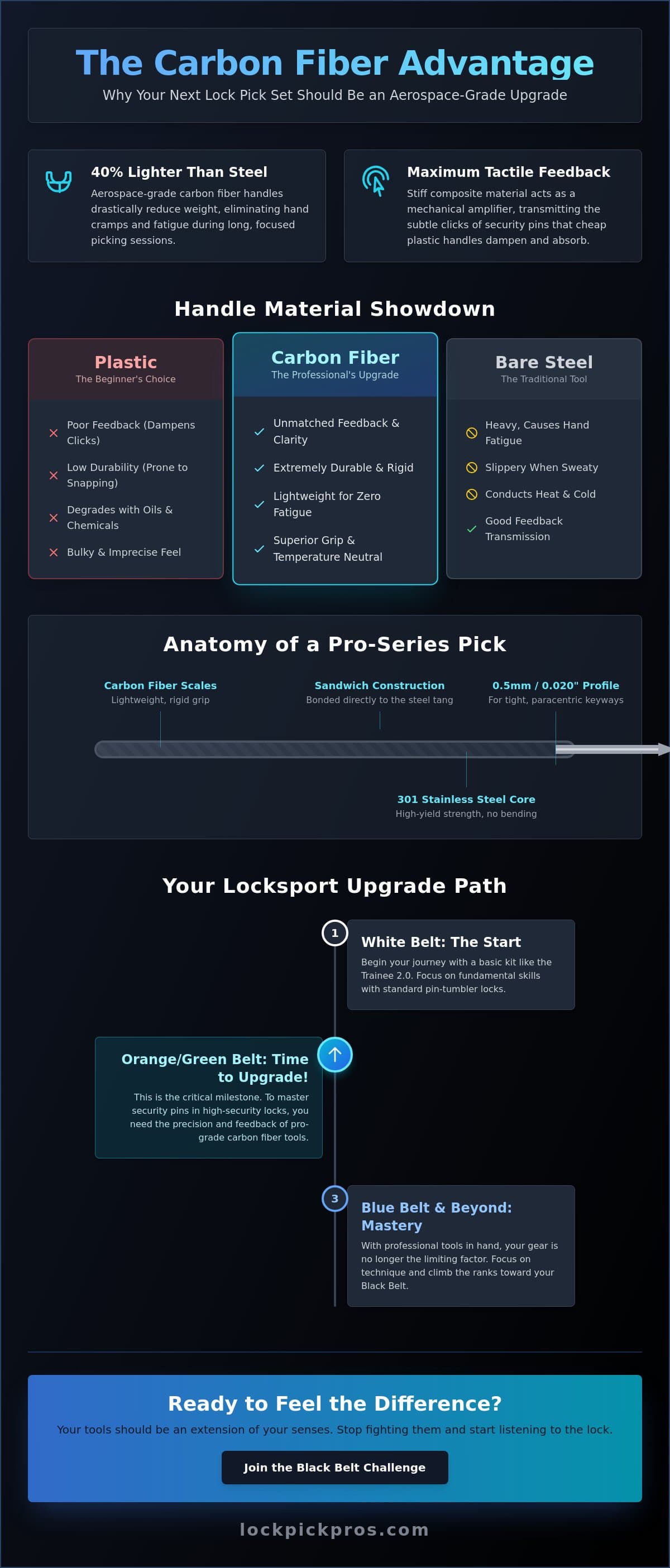
The LockPick Pros guide frames carbon fiber as a practical alternative to standard steel or plastic-dipped tools, built for longer, more precise sessions on tighter, higher-security locks. The promise is not brute-force advantage; it is better information transfer. In other words, the pick is supposed to help you hear and feel what the lock is telling you, while asking less of your fingers and wrist over repeated attempts.
That matters because lockpicking lives or dies on subtle feedback. You are not muscling your way through a lock so much as reading tiny changes in binding, set, and counter-rotation. A lighter composite tool can feel less punishing during those repeated resets, which is why carbon fiber reads as an ergonomics story first and a performance story second.
Why the old debate never went away
This is not a new argument dressed up in a modern materials package. A 2008 Lock Picking 101 forum post said carbon fiber was mainly useful for reducing detection by metal detectors, and that metal remained the best material for picks. By 2014, another Lock Picking 101 post had shifted the conversation toward feel, arguing that carbon fiber could help transfer feedback from the lock to the hand, and pointing to a carbon-fiber folding pick set weighing 1.5 oz.
That back-and-forth has been part of the hobby for years, and it has traveled through the broader locksport conversation for a long time. Pickers have argued the same material questions in the orbit of Zeefeene, Marc Tobias, Douglas Chick, Matt Blaze, Bary Wels, Dominic Villeneuve, Squelchtone, and emt1581, which says less about fashion than it does about how seriously this community treats tool behavior. When you spend hours listening for tiny irregularities, even a few ounces and a change in flex can become a real opinion.
Carbon fiber versus steel: where the difference shows up
On tactile response, carbon fiber’s selling point is clarity with less fatigue. The LockPick Pros framing treats it as a way to work longer without losing fingertip sensitivity, especially when you are pushing into higher-security cylinders and need to keep your tension hand honest. Steel still has the reputation for being the dependable reference point, but carbon fiber tries to lighten the load without making the tool feel vague.
On profile thickness, carbon fiber’s advantage is more about the whole package than a dramatic change at the tip. The guide describes aerospace-grade composite scales replacing traditional, heavy handles, which means the pick can feel slimmer and less clunky in the hand than a conventional steel setup. That is useful when you want more precise control, but it is not the same thing as a thinner or more delicate working end.
Durability is where the romance runs into reality. A 2026 Lock Picking 101 thread reported a finished carbon-fiber pick with good vertical strength but weaker horizontal strength, and the tool broke on a second use. That is the warning label you should keep in mind: carbon fiber can feel excellent until the wrong kind of stress exposes its limits, especially if you are twisting, flexing, or storing the tool badly.

What the community’s training tools say about skill progression
The broader locksport ecosystem already treats progression as a measured climb, not a shopping spree. TOOOL describes itself as a 501(c)(3) nonprofit dedicated to advancing public knowledge about locks and lock picking through teaching, research, and competition, and it says it has researched the laws relevant to lock picks in all 50 U.S. states. Its learning material explains that lockpicking works because of small irregularities in lock manufacturing and component alignment, which is a useful reminder that technique comes before any material hype.
That same logic shows up in the belt-ranking system used by the community, maintained by Lock Pickers United and used to categorize skill and lock difficulty. TOOOL’s progressive picking locks are built for that exact ladder, helping you move from simpler one-pin practice toward more difficult one- through six-pin scenarios. If you are still learning how to read feedback on those stages, a carbon fiber pick may help with comfort, but it will not replace the discipline of clean tension control.
Steel still dominates the bench for a reason
Look at what the market actually sells and the picture gets clearer. TOOOL’s store currently leans hard into steel and titanium, including the Our EDC Favorite Titanium Bogota EDC Lock Pick Set and the Necessary Nine Lock Pick Set v2. JimyLongs, meanwhile, markets ergonomic lock picks and modular tools in 0.015-inch and 0.019-inch stainless steel. That is not a market rushing away from metal. It is a market where steel still sets the standard and carbon fiber has to earn its place as a specialized comfort and feedback play.
The anti-forensics angle is not a clean escape hatch either. A Lockwiki anti-forensics document shows that a carbon fiber lockpicking tool can still leave tool-mark evidence on a lock, including light scratches and polishing on pin bottoms. So if the appeal is “invisible,” that case is weaker than the old forum chatter made it sound. The stronger case is that the right pick can make your hand happier and your read on the lock sharper.
Who should actually buy into the shift
If you are still learning the difference between bad tension and a false set, stay with a proven steel kit and use the money on practice locks. If you already know how to read a cylinder, spend long sessions on tighter pins, and want a tool that feels lighter without feeling mushy, carbon fiber starts to make sense. If you are chasing pure durability and do not want to think about horizontal stress, steel still looks like the safer daily driver.
That is the real story behind the upgrade guide: carbon fiber is not replacing steel so much as carving out a niche for pickers who have enough skill to notice ergonomics in the first place. Once the basics stop being the hard part, the question is no longer whether the pick can open the lock. It is whether the tool lets you stay precise long enough to hear the lock answer back.
This article was produced by Prism’s automated news system from verified source data, official records, and press releases, then run through automated quality and moderation checks before publishing. The system is built and supervised by the people who set the standards it runs under. Read our full AI policy.
Did this article answer your question?