Commander precons are too strong, too interesting to ignore
Commander precons are no longer just starter kits. With Brackets changing how games get matched and Strixhaven offering five distinct decks, the right buy is a real deck choice.
Commander’s new buying problem
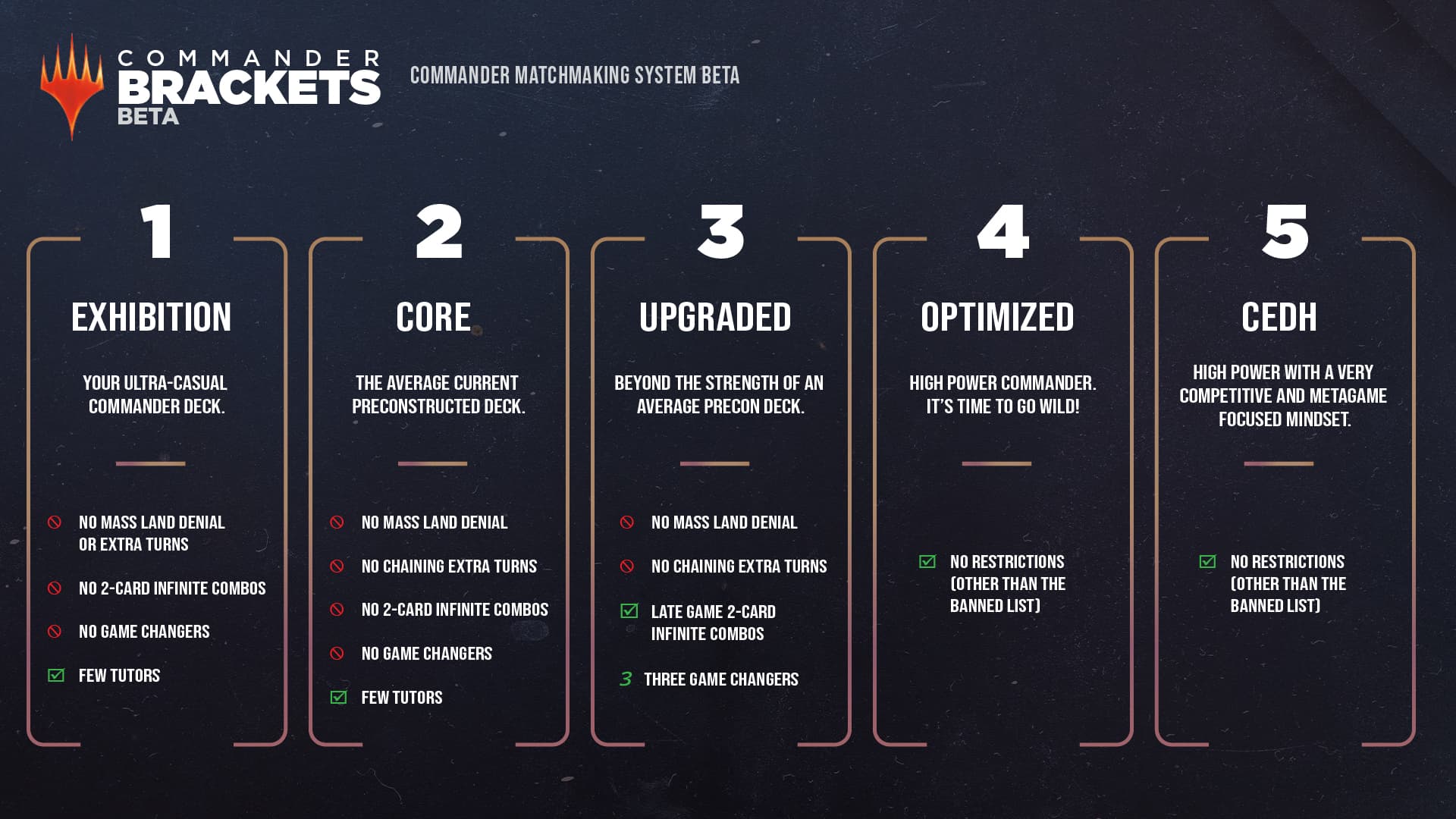
Commander precons used to be the easy answer when someone asked what to buy first. That is not how the format feels anymore. Wizards introduced Commander Brackets as a beta matchmaking system on February 11, 2025, explicitly to replace the old “power level 1-10” shorthand with a clearer way to find balanced games, and by October 21, 2025 it said the system had already been used for nine months and through three MagicCons, with survey data suggesting it was helping players find games.
That matters because Commander is now Wizards’ largest format, serving everyone from highly casual theme decks to cEDH. Gavin Verhey said on February 9, 2026 that the format felt good overall, but still had familiar design problems, including card wordiness, redundant effects, and “self-solving commanders.” In practice, that is why precons have become impossible to dismiss: they are no longer just intro products, they are real starting points for a deck you might play straight out of the box, strip for staples, or tune into something much sharper.
What makes a precon worth your money now
The best Commander buys are the ones that give you a clean plan on turn one and a meaningful upgrade path after that. That is the core shift in the market. Sealed Commander products are priced not only for how well they play, but for how collectible they are, and the current demand around these decks reflects both sides of that equation.
Wizards’ own history explains the change. It first published dedicated Commander decklists in 2011, and by 2020 it was already saying that since 2011 it had released one dedicated Commander product a year, usually preconstructed decks. That cadence helped turn precons into a real part of the format’s economy, not just a side shelf item. It also explains why a modern Commander guide has to answer a practical question: which deck actually fits what you want to do with your money and your playtime?
Secrets of Strixhaven is the clearest test case
Secrets of Strixhaven is the current example of how far precons have come. Wizards released the Commander decks on April 24, 2026, and the set includes five different decks: Silverquill Influence, Prismari Artistry, Witherbloom Pestilence, Lorehold Spirit, and Quandrix Unlimited. Each one is a ready-to-play 100-card Commander deck with 10 new-to-Magic cards, two foil commanders, 10 double-sided tokens, a reference card, and a deck box.
That deck construction is exactly why the product matters to shoppers. You are not buying a random pile with a commander stapled on top. You are buying a fully packaged list with a defined lane, which makes it easier to choose based on how you actually like to play.
The best fit for a brand-new player
If you want the cleanest on-ramp, Silverquill Influence and Witherbloom Pestilence are the easiest decks to explain at the table. Silverquill Influence, led by Killian, Decisive Mentor, is an aura-and-combat-control shell, which means the deck wants to suit up creatures and pressure the board instead of hiding behind complicated combo lines. Witherbloom Pestilence, led by Dina, Essence Brewer, leans into sacrifice and life gain, a familiar Commander rhythm that teaches resource management without burying you in rules text.
That is where the Brackets conversation becomes useful. A newer player does not need a deck that is trying to solve the format on its own, they need something that can find fair games and still do its job. Both of these decks have obvious lanes, which makes them easier to pilot, easier to upgrade, and easier to understand after one shuffle.
The best out-of-box power
Lorehold Spirit is the cleanest pick if you want the deck that looks most likely to matter immediately. Quintorius, History Chaser turns the graveyard into a Spirit engine, then closes games with double strike, which gives the deck a built-in way to move from value to damage without needing a pile of extra cards. That kind of line is exactly why precons now get treated like real decks rather than teaching tools.
Quandrix Unlimited is the other deck that rewards a strong first impression. Zimone, Infinite Analyst points you toward X-spell gameplay, which usually means the deck scales well when you draw the right mix of mana and payoffs. If you like a precon that feels like it can break parity and actually end a game instead of just participating in one, this is the style to watch.
The best upgrade ceiling
Prismari Artistry is the obvious deck for anyone who likes tinkering. Rootha, Mastering the Moment puts you in instant-and-sorcery territory, which is the kind of shell that gets better every time you tune the mana, trim the filler, and upgrade the interaction. Spell-based Commander decks usually age well because they offer more possible directions than a creature pile with one obvious path.
Lorehold Spirit also has a strong ceiling because graveyard and Spirit synergies tend to reward careful tuning. You can keep the core intact and still make it much nastier with targeted upgrades, which is why these kinds of precons often become long-term projects instead of one-night experiments. If you want a deck you can live with for months, not just sleeve for a weekend, this is where the real value lives.
The best singles-value angle
If you are shopping with an eye on sealed value, Secrets of Strixhaven has the right ingredients. Five separate decks mean five different lanes of demand, and each one comes with 10 new-to-Magic cards plus two foil commanders, which is the kind of packaging that keeps collectors and players paying attention. Current pricing on Commander products usually tracks playability and collectability together, so the deck that looks strongest on table is not always the one that ages best in a box.
That is also why Commander product lines now stretch far beyond the old “buy a beginner deck” mindset. Wizards has built the format into a broad ecosystem, from standard Commander decks to Secret Lair Commander decks, and even Commander Masters was billed as the first Masters set built for Magic’s most popular format. The message is simple: these products are meant to be played, upgraded, and judged like real releases.
How to shop the line without overthinking it
If you want the safest buy, start with the deck that already matches your favorite game pattern. Pick Silverquill Influence if you want the cleanest creature-combat lesson, Witherbloom Pestilence if you like sacrifice engines, Lorehold Spirit if you want the most obviously explosive graveyard plan, Prismari Artistry if you enjoy spells, and Quandrix Unlimited if you want scaling X-spell turns.
That is the modern Commander precon story in one sentence: the best decks are no longer the ones that merely teach you the format, but the ones that give you a real place in it. Once you accept that, shopping stops being about whether precons are too strong and starts being about which one is too interesting to pass up.
This article was produced by Prism’s automated news system from verified source data, official records, and press releases, then run through automated quality and moderation checks before publishing. The system is built and supervised by the people who set the standards it runs under. Read our full AI policy.
Did this article answer your question?