Felhide Spiritbinder quietly becomes a dangerous Commander copy engine
Felhide Spiritbinder is only a cute copy creature until you give it reliable untaps. With the right board, it flips into a real Commander combo piece, including a clean infinite line with Ondu Spiritdancer.
The forgotten three-drop that turns mean fast
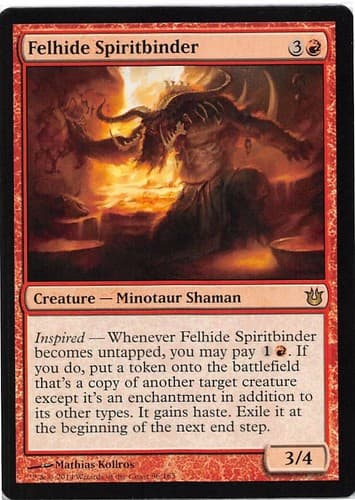
Felhide Spiritbinder looks like draft chaff until you put it on a Commander table that knows how to untap creatures on demand. It is a three-mana red Minotaur Shaman from Born of the Gods, a 165-card set released on February 7, 2014, and that old frame is exactly why so many players still read past it in deckbuilding.

The card’s real text is the trapdoor. Whenever Felhide Spiritbinder becomes untapped, you may pay {1}{R}; if you do, you create a token copy of another target creature, except it is also an enchantment, it gains haste, and it gets exiled at the beginning of the next end step. That means the card does not need to attack to matter, and it does not even need to copy your own best creature. It can target an opponent’s creature too, which is where the card stops being “cute value” and starts becoming a table problem.
Why the setup matters more than the body
Spiritbinder is only explosive when you stop treating it like a normal combat creature. If you attack with it and hope it survives, you are asking for removal and getting very little back. The cleaner line is to give it a safe way to tap, then untap it repeatedly so the Inspired trigger keeps coming online.
That is why cheap tap outlets matter. Springleaf Drum and Paradise Mantle are the kind of cards that quietly turn Spiritbinder from awkward to functional, because they let you tap it without exposing it to combat math. Once you can guarantee that first tap, every untap becomes another chance to pay {1}{R} and make another copy.
From there, the card scales with whatever the board already has going on. Copying Etali, Primal Conqueror turns every token into more spells. Copying Deadpool, Trading Card can get downright disgusting because the text-box exchange line pushes the card into rules-mess territory that most tables are not prepared to untangle on the fly. And if the best creature at the table belongs to someone else, Spiritbinder is perfectly happy to make their threat worse for them.
The exact combo that makes people sit up
The cleanest two-card line is Felhide Spiritbinder plus Ondu Spiritdancer, and this is where the card stops being a fair value engine and becomes a combo piece.
Ondu Spiritdancer says that whenever an enchantment you control enters, you may create a token copy of it, but only once each turn. Spiritbinder gets around the “fairness” of that wording because the token it makes is itself an enchantment. So the board state you want is simple: Felhide Spiritbinder tapped, Ondu Spiritdancer on the battlefield, and {1}{R} available.
Here is the sequence:
1. Spiritbinder untaps.
2. Its Inspired ability triggers, and you pay {1}{R}.
3. You create a token copy of Ondu Spiritdancer.
4. That token is an enchantment, so Ondu Spiritdancer triggers again.
5. The new token becomes the next trigger in the chain.
EDHREC lists that interaction as a two-card combo that produces infinite ETB triggers and infinite creature tokens, and that is exactly why the line matters. The “only once each turn” clause does not save you here because each new Spiritdancer token is the next object entering the battlefield and the next trigger in sequence. It is a tiny rules wrinkle with a very big payoff.
Why the token text makes this card even stranger
Felhide Spiritbinder’s token is not just a copy. Official rulings clarify two important details that make the card hit harder than it first appears. If the copied creature is a token, Spiritbinder copies that token’s original characteristics, and any enters-the-battlefield abilities of the copied creature still trigger when the token enters the battlefield.
That is the part that makes Spiritbinder so dangerous in token-heavy and ETB-heavy shells. You are not just making bodies. You are repeatedly replaying the best entrance on the table, sometimes from a creature you did not even control in the first place. Once you start copying creatures that already do something on entry, every untap starts to look like a value spell stapled to a copy effect.
How to keep the temporary copies from disappearing
The obvious drawback is that Spiritbinder’s tokens are temporary, since they get exiled at the beginning of the next end step. If you are building around the card, you need to decide whether you are using the token as a throwaway burst of value or trying to keep it around.
For the keep-it-around plan, Sundial of the Infinite and Obeka, Brute Chronologist are the cleanest tools because they let you end the turn and sidestep the exile clause. The Master, Multiplied gives you another angle by shutting off the sacrifice-style downside, and Ghired, Mirror of the Wilds points the whole plan toward a more permanent copy strategy instead of a one-turn spike.
That makes the card more flexible than most copy creatures. You can build it as a burst engine, a combo piece, or a token-control shell that tries to turn every temporary copy into a lasting advantage.
Where it belongs if you are building on a budget
If you want the most natural homes, start with commanders that already care about tokens, copying, or turn-skipping tricks. Ghired, Mirror of the Wilds is a great fit because it already points you toward a board full of copies. Obeka, Brute Chronologist is the nastiest glue card if you want to keep the temporary tokens. The Master, Multiplied gives you a similar angle with a more oppressive finish. Deadpool, Trading Card also leans into the absurd end of the card, especially if you like stealing text boxes and turning someone else’s commander into your problem solver.
The budget angle is part of the appeal. Felhide Spiritbinder is an old, overlooked card, and the shell around it can start with cheap, functional pieces like Springleaf Drum, Paradise Mantle, and straightforward untap support. If your deck already plays Freed from the Real with land-untapping creatures like Palinchron, Great Whale, or Peregrine Drake, Spiritbinder is the kind of extra engine that turns a mana loop into a real win condition instead of just a lot of resources.
Felhide Spiritbinder is not a nostalgia pick. It is one untap away from becoming a board-wide headache, and the people still reading it as a harmless three-drop are the ones most likely to lose to the first clean setup.
This article was produced by Prism’s automated news system from verified source data, official records, and press releases, then run through automated quality and moderation checks before publishing. The system is built and supervised by the people who set the standards it runs under. Read our full AI policy.
Did this article answer your question?