Five underappreciated Commander precons deserve a second look
These five precons aged better than their launch hype, with commanders and upgrade paths that still make them worth a real look.

Commander precons are supposed to be ready-to-play decks, but the ones that age best are the ones with a real command-zone plan and enough useful cardboard to matter after the shrink wrap comes off. That is why a few releases from Kaldheim through Doctor Who deserve a fresh look right now, especially with preorder gaps and sealed-product swings making some decks look worse than they actually play. When a precon can be undervalued because the face commander looked awkward on preview, another deck from the same set stole the spotlight, or the best cards only clicked once the format moved on, the value calculus changes fast.
Divine Convocation
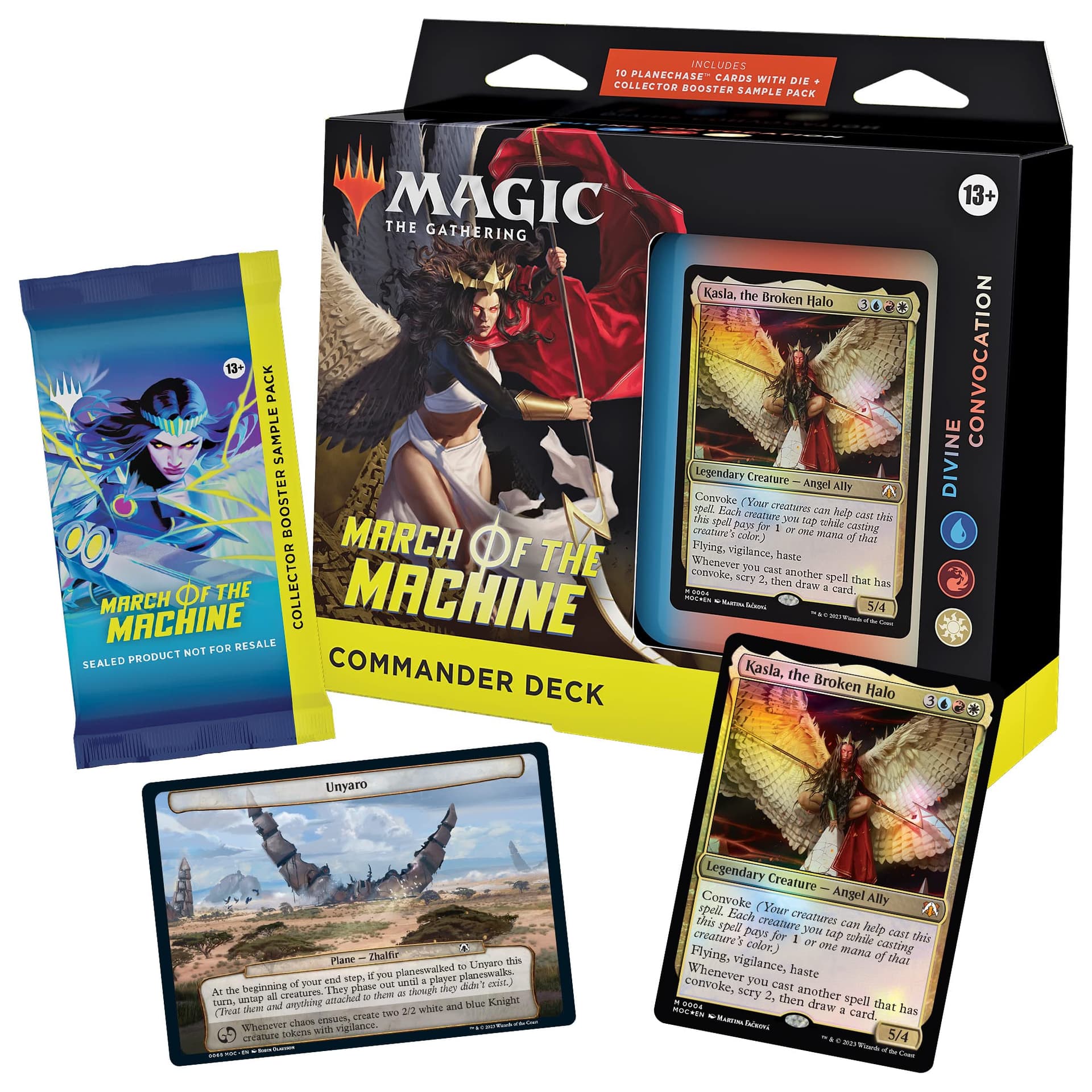
March of the Machine arrived on April 21, 2023 with five Commander decks, plus Planechase cards, double-faced tokens, and planar die support, which already made it one of the line’s more packed releases. Divine Convocation was not the smoothest shell in that group, though, and EDHREC’s primer pinned the problem on a high average mana value plus weak ramp and card draw. That makes this a deck you buy for Kasla, the Broken Halo and then decide how much of the list you actually want to keep.
If you like a commander that can be rebuilt into something sharper, this one is worth reconsidering. Out of the box, it asks for patience; as a parts box, it gives you a starting point with a command zone that can justify the whole project. That is the kind of precon that looks ordinary on the shelf and suddenly becomes interesting once you stop treating it like a finished list.
Elven Empire
Kaldheim’s Commander decks released alongside the set on February 5, 2021, and each of the two decks came with eight all-new cards. Elven Empire, the green-black build around Lathril, Blade of the Elves, is the one that kept its reputation for a reason: the commander still does real work, and the tribal structure gives you a clean path whether you are tuning lightly or rebuilding from the ground up. EDHREC still tracks the deck with thousands of references, which says plenty about how long Lathril has stayed relevant.
This is the precon I would hesitate to cannibalize first, because the core experience is already coherent. If you want an elf deck that can be upgraded without losing its identity, Elven Empire still makes sense as a base rather than a donor pile. The deck’s real selling point is not nostalgia; it is that Lathril remains a commander you can sit down with and trust to pull weight.
Lorehold Legacies
Commander (2021 Edition) landed on April 23, 2021 alongside Strixhaven: School of Mages, and Lorehold Legacies gave red-white artifact players Osgir, the Reconstructor. That pairing still matters because Osgir is the kind of face commander that rewards you for seeing value in objects most decks would throw away. If your favorite part of Commander is turning stray artifacts into pressure, this deck has a commander that keeps the idea honest.
Lorehold Legacies is also one of the easier precons to evaluate as a rebuild platform. You can strip it for artifacts and support pieces if you want to build your own list from scratch, but the commander itself is strong enough that the box does not feel like a mere parts warehouse. That balance is why Osgir keeps getting a second look from players who care more about long-term utility than launch-week buzz.
Party Time
Commander Legends: Battle for Baldur’s Gate introduced four Commander decks and brought Commander Draft back into the mix, and Party Time is the one that still stands out for how cleanly it plays. Built around Nalia de’Arnise, it earned the rare compliment of being a “really well made deck,” which is exactly the sort of praise that matters when you are deciding whether a precon needs a full teardown or just a few smart swaps. The internal synergy is already doing a lot of the heavy lifting.
That makes Party Time one of the easiest recommendations for someone who wants immediate table play without first spending an evening gutting the list. You can upgrade it gradually and still keep the deck’s identity intact, which is not something every precon can claim. Some decks want to be rebuilt from the command zone out; this one is already close enough to functional that the tune-up feels rewarding instead of obligatory.
Rebellion Rising
Phyrexia: All Will Be One released on February 10, 2023, with two Commander decks, and Rebellion Rising was the one that aged into its role better than its launch reputation suggested. Neyali, Suns’ Vanguard gives the deck a real token commander, and EDHREC’s primer is blunt about why she matters: she rewards attacking with tokens and hands you card advantage for doing it. That is the kind of text box that keeps paying you back as long as Commander remains a combat format.
If you are looking for a precon that benefits from upgrades without losing its engine, this is an easy one to revisit. It has enough structure to play cleanly out of the box, but Neyali also gives you a clear reason to push the deck harder if you want more explosiveness. The result is a precon that makes sense as a purchase whether you plan to keep it whole or mine it for a better token shell.
The larger lesson is simple: Commander products have been released every year since 2013 as 100-card precons, and that long run is exactly why launch-week consensus is such a bad judge of value. By the time Doctor Who arrived on October 13, 2023, with Paradox Power pairing the Twelfth and Thirteenth Doctors in green-blue-red, the line had already proven it could hide real sleepers inside loud releases. The decks that look merely fine on day one are often the ones that end up feeling like smart buys once the format, and the price tags, finally catch up.
This article was produced by Prism’s automated news system from verified source data, official records, and press releases, then run through automated quality and moderation checks before publishing. The system is built and supervised by the people who set the standards it runs under. Read our full AI policy.
Did this article answer your question?