Sanar, Unfinished Genius pushes tight instant and sorcery deckbuilding
Sanar rewards precise sequencing, not pile-the-best-stuff deckbuilding. If you want an Izzet spells commander that turns every cast into Treasure and every tutor into tempo, this is it.
Core game plan
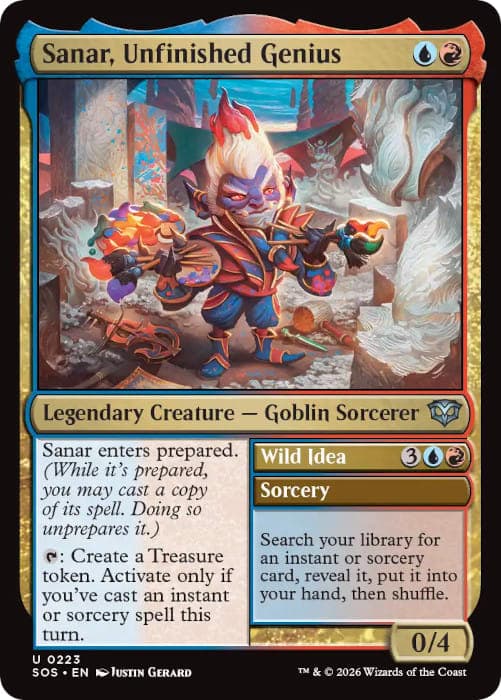
Sanar, Unfinished Genius is the kind of commander that asks you to play tight from the first turn and pays you back for every clean sequence. At two mana, the Izzet Goblin Sorcerer comes down early, enters Prepared, and starts turning every instant or sorcery you cast into a Treasure token. That Treasure matters more than it looks at first glance, because it helps you recoup part of the cost of the deck’s paired spell, Wild Idea, a five-mana sorcery that tutors an instant or sorcery card into your hand.

That setup tells you exactly what Sanar wants from the rest of the 99: a low-friction spell package, enough instant-speed interaction to cash in the Treasure, and a deck construction style that treats every cast like a small decision point. This is not the kind of Izzet commander that rewards stuffing in every flashy spell you own. It rewards the cleaner habit of lining up the exact card you need, at the exact moment you can use it.
Why the tutor line matters
Wild Idea is the reason Sanar feels more technical than most spell commanders. Five mana for a tutor is already a real investment, but Johnson’s point is that the card is easier to respect when it can only find instants or sorceries. In Commander terms, that narrower search space makes the spell feel less like a universal value engine and more like a precision tool. You are not reaching for the perfect permanent, the perfect combo piece, or a generic power card. You are reaching for the spell that solves the board right now.
The real catch is timing. Wild Idea is a sorcery, so the best version of the card is the one that immediately converts into tempo. If you tutor up something like Pongify, you want to be in a spot where you can cast it right away and use the Treasure to keep the turn moving. If you tap out for Wild Idea and then pass, you have often spent five mana to set up a future turn instead of winning the current one, and Sanar plays much better when you keep the pressure on the table.
Flash is the cleanest upgrade
Once you accept that timing is the whole game, the deck starts to make sense. The best support cards are the ones that let your sorceries behave like instant-speed plays, or at least let you keep mana open until the moment matters. Quicken is the cleanest example in the list because it lets the next sorcery you cast act as though it had flash, while also replacing itself with a draw. That is exactly the kind of card you want in a shell like this: it smooths the draw step, it fixes awkward timing, and it makes Wild Idea feel much less clunky.
Emergence Zone does similar work from the mana base. A land slot that can give your spells flash for a turn is valuable because it changes the whole texture of your turn cycle without asking you to commit a spell slot to the job. In a deck built around Sanar, that matters. The difference between “I have the card” and “I can actually cast the card at the right time” is often the difference between a decent turn and a strong one.
The cards that do the heavy lifting
The most useful way to build around Sanar is to think in roles, not in piles of staples. Every card should either help you find the right spell, make that spell easier to cast at the right moment, or turn the Treasure into real board impact.
- Wild Idea is the engine piece. It is the tutor that justifies the commander.
- Quicken is the low-friction setup card that smooths draws and fixes sorcery timing.
- Emergence Zone is the land that gives you a surprise flash turn without costing a spell slot.
- Pongify is the kind of target that shows why the deck cares about timing. It is only truly worth tutoring when you can turn it into immediate tempo.
That last point is the key to the whole shell. Sanar does not want you to tutor for value in the abstract. It wants you to tutor for the card that matters in the current board state, then use the Treasure and the spell-speed advantage to keep control of the turn.
How to move from casual to stronger tables
Johnson’s approach also makes the power level of the deck pretty clear. He has been spending a lot of time in Bracket 2 and Bracket 3 Commander while avoiding Game Changers and most non-land tutors, so Sanar is a meaningful shift from that normal lane. Even so, a five-mana tutor that only finds instants and sorceries is a line that stays within reason for those tables, especially when the deck is built to be honest about what it is doing.
The fastest upgrade path is simple: tighten the spell suite, add more ways to act at instant speed, and cut anything that asks you to tap out without advancing the plan. Sanar gets stronger the more often you can cast Wild Idea and immediately turn the result into interaction, protection, or a swingy answer. The deck gets worse every time you treat it like generic Izzet goodstuff and start loading it with cards that do not help the tutor line or the Treasure trigger.
The verdict
Sanar, Unfinished Genius is worth building if you like Commander decks that feel like puzzles you actually get to solve on the table. The commander is cheap, the tutor is focused, and the Treasure trigger gives you just enough mana back to make the whole package feel playable instead of merely clever. If you want a spells deck that demands discipline and rewards exact sequencing, Sanar is the kind of legend that feels better the more tightly you build around it.
This article was produced by Prism’s automated news system from verified source data, official records, and press releases, then run through automated quality and moderation checks before publishing. The system is built and supervised by the people who set the standards it runs under. Read our full AI policy.
Did this article answer your question?