Secrets of Strixhaven gives Feather, the Redeemed fresh spell-recursion tools
Repartee gives Feather a real upgrade path: better protection, cleaner recursion, and a cheaper tune-up for a commander already built to recycle spells.

Feather gets a real upgrade, not just a nostalgia pass
Repartee gives Feather, the Redeemed exactly the kind of upgrade Boros has been waiting for: more cheap spells that want to touch your own creatures and come back for a second pass. That matters because Feather is already one of the cleanest spell-recursion engines in Commander, and new printings do not need to reinvent it to be useful. They just need to make the same old loop hit harder, protect better, and cost less to refresh.

Feather first hit the table in War of the Spark in 2019 as a 3/4 flying Angel for {R}{W}{W}, and the card’s rules text still does all the heavy lifting: whenever you cast a targeted instant or sorcery on a creature you control, it returns to your hand at the beginning of the next end step. That one line is why Feather has stayed relevant through multiple reprints, including Time Spiral Remastered and the Secret Lair printing as Miku, the Renowned. The card has never needed a full redesign to matter. It just needs a steady supply of spells that make the engine feel tighter instead of clunkier.
Why Feather still sits in the center of Boros
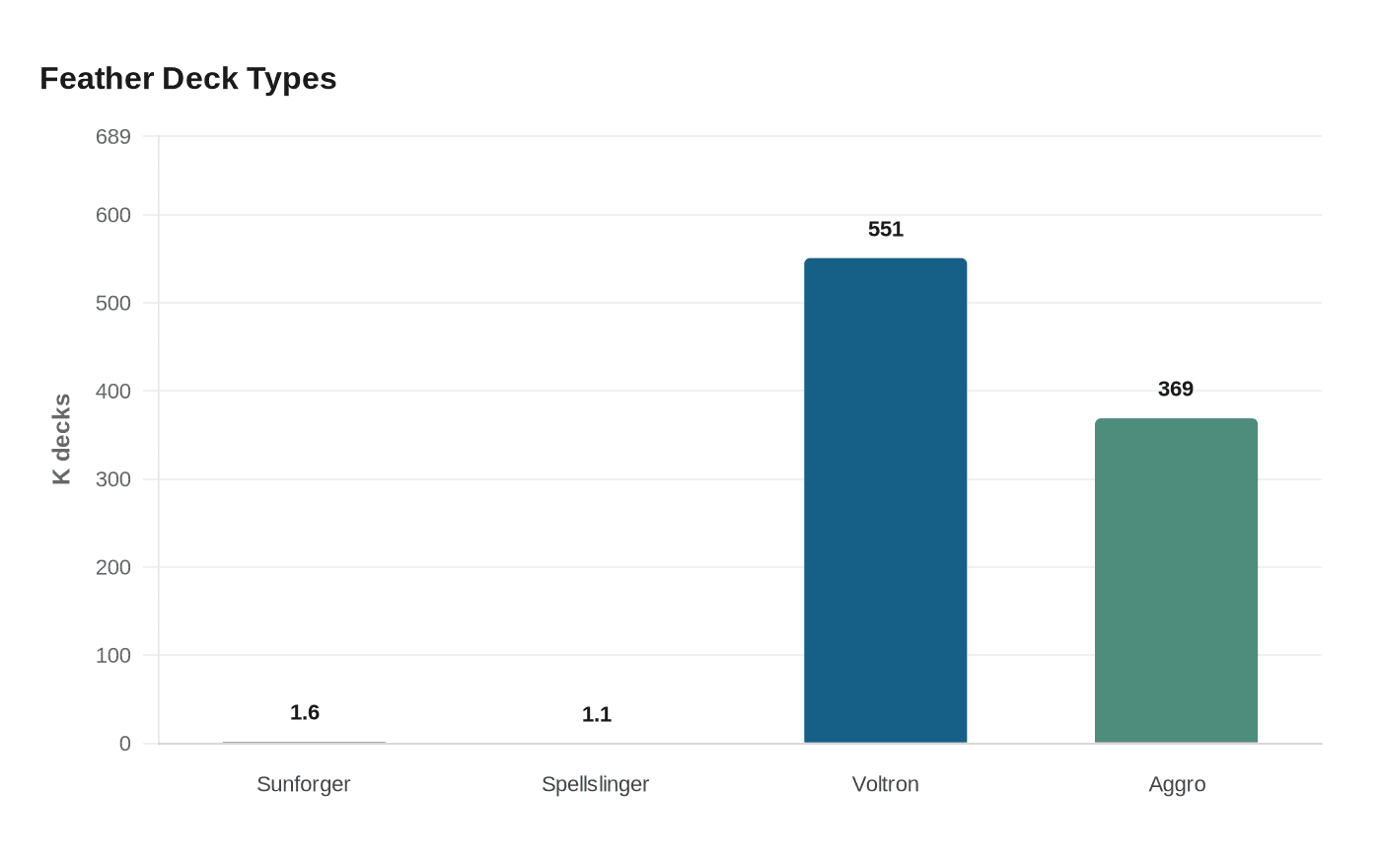
Feather’s appeal has always been broader than a single lane, and EDHREC’s current breakdown makes that plain. The commander page sits at roughly 13,026 to 13,035 decks depending on the crawl snapshot, and the deck archetype pages show Feather spread across Sunforger, Spellslinger, Voltron, and Aggro. The biggest lanes are Sunforger at around 1.6K decks and Spellslinger at about 1.1K, with Voltron still a meaningful third pillar at 551 and Aggro at 369.
That spread is the reason a new mechanic can matter so much here. Feather is not a linear combo commander that only wants one narrow package, and it is not a pure Voltron threat that folds when it runs out of combat tricks. It lives in the overlap: reusable protection, cheap card draw, targeted pump, and the kind of Sunforger-fueled toolbox play that lets Boros look clever instead of just loud.
What repartee actually changes in play
The useful part of repartee is not that it gives Feather a brand-new identity. It is that it reinforces the exact patterns Feather already wants, especially the ones built around targeting your own creature and getting the spell back again. In practice, that means a repartee card can act like a protection spell, a value spell, and a trigger all at once, which is a lot better than spending a slot on a one-time trick that barely justifies itself.
That pushes Feather toward cleaner turns and better sequencing. Instead of casting a protection spell once and moving on, you get to keep reusing the same effect while building board presence, drawing cards, or forcing awkward combat math. In Boros, where every card has to work for its mana, that kind of repeatability is the difference between a deck that merely functions and one that feels polished.
The older inclusions repartee is likely to outclass
Repartee does not erase Feather’s old staples, but it does threaten the clunkier cards that only looked good because Feather needed enough targets. The first cards to feel the squeeze are the one-shot combat tricks that protect a creature once and then leave you down a card if Feather is removed or the board stalls. The same goes for mediocre pump spells that do not draw, do not replace themselves, and do not meaningfully change the battlefield beyond a single swing.
The old slots most at risk are the ones that only did one of these jobs:
- cheap protection spells that saved Feather once but did not improve card flow
- narrow cantrips that were playable only because they targeted your own creature
- combat tricks that advanced Voltron but did little for the spell-recursion plan
- filler interaction that was fine in Boros, but not special enough to keep recasting
That does not mean every old inclusion gets cut. Sunforger remains a real pillar, and the best Feather shells still want a mix of instant-speed tricks and protection. But repartee raises the bar. If a card cannot be replayed, cannot protect, and cannot pull double duty, it starts looking much weaker next to a new option that does all three.
The new lines repartee opens up
This is where Feather starts feeling refreshed instead of merely nostalgic. With repartee-style spells in the mix, Feather can lean harder into a turn structure where the same spell keeps coming back while the board state keeps changing. That turns protection into pressure and pressure into selection, because every targeted spell becomes part of a loop instead of a one-and-done effect.
The strongest new patterns are the ones that let you keep Feather on the table without slowing down your own development. A spell that targets Feather or another creature you control can now serve as protection against removal, a trigger for value, and a way to keep your hand stocked for the next turn cycle. In Sunforger builds, that becomes especially attractive because the deck already wants to play at instant speed and chain together the right answer at the right time.
Feather also benefits from the fact that the commander is already built for this kind of incremental tuning. You do not need to rebuild the whole shell to make the upgrade matter. A few better-targeted spells can improve protection density, keep the recursion engine online longer, and make combat steps less fragile.
Why this release cycle matters for Commander
The timing is part of the story too. Wizards published the Secrets of Strixhaven mechanics article in April 2026 and followed with an update bulletin on April 15, 2026, so Feather’s May 18, 2026 coverage lands squarely in the set-launch reaction cycle. That is exactly when Commander players should pay attention to older all-stars, because fresh mechanics can quietly strengthen commanders that already have the right shell waiting for them.
Feather is a perfect example of that long-tail effect. It is not a forgotten legend needing a rescue package. It is a Commander staple with enough history, enough support, and enough deck identity to absorb new printings without losing what makes it good. The fact that the card is Pierakor az Vinrenn D'rav, the Boros Firemane angel tied to Agrus Kos and the League of Wojek, only adds texture for players who know the lore as well as the list.
Repartee does not turn Feather into something else, and that is why it works. It sharpens the same game plan that has kept Feather near the top of Boros Commander for years, then hands it better tools to do the job. That is the kind of upgrade that makes an old favorite feel newly worth sleeving up again.
This article was produced by Prism’s automated news system from verified source data, official records, and press releases, then run through automated quality and moderation checks before publishing. The system is built and supervised by the people who set the standards it runs under. Read our full AI policy.
Did this article answer your question?