Wiccan Commander deck balances blink value with wizardly theme
Wiccan looks like a lore pick, but his best Commander shell is a blink-heavy machine that keeps your own mana rocks and cheap spells cycling for value.
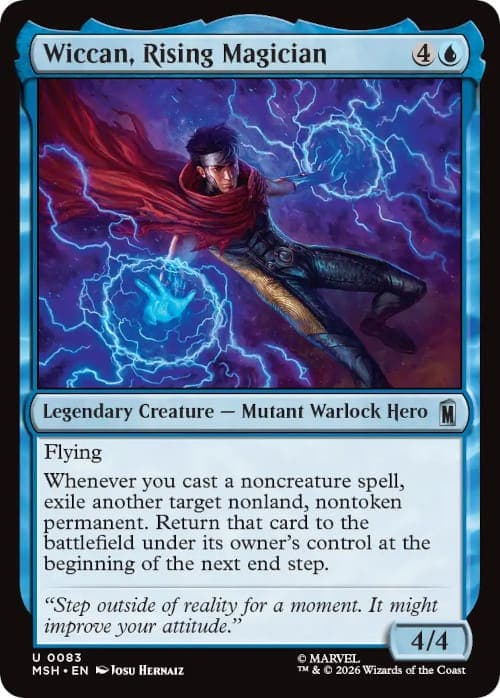
Wiccan — Billy Kaplan-Altman to Marvel readers — is a four-mana flying Mutant Warlock Hero whose trigger exiles another nonland permanent whenever you cast a noncreature spell, then returns it at the beginning of the next end step. That text pushes hard toward blink value, not the clean wizard fantasy you may have in your head. That gap between character fit and mechanical fit is where the real deckbuilding work starts.
What Wiccan actually does
That trigger is the engine you build around. It is an immediate invitation to treat him like a repeatable flicker or blink piece, except the timing matters. You are not permanently removing resources, you are temporarily resetting them, which opens up a very specific style of Commander play built around reuse, untapping, and sequencing.
The cleanest way to think about him is as a commander who turns every cheap spell into a little resource rewrite. Cast a noncreature spell, exile a permanent, get it back later, and line up the next turn with something fresh.
Why blink language matters here
His ability reads like flicker or blink depending on context, and that distinction tells you how to build. Traditional blink decks are often about protecting creatures or resetting enters-the-battlefield triggers, but Wiccan is broader than that because he hits any nonland permanent. That means your best targets are not automatically creatures, and that widens the shell in a way Commander brewers should not ignore.
Johnson is more interested in using the trigger on his own permanents than simply disrupting opponents. That is the difference between a card that plays like a trick and a card that plays like a value engine. If you are trying to win games efficiently, the self-targeting route is the one that turns Wiccan from a nuisance into a plan.
Tapped mana rocks are the sweet spot
The most practical target type is also the most obvious one: tapped mana rocks. Exile a tapped rock, let it come back on the next end step, and you effectively reset it for future turns. That means the permanent comes back ready to produce mana again, which is exactly the kind of small, repeatable advantage that snowballs in Commander.
Arcane Signet shows why one-mana instants are so attractive here. A cheap instant plus a mana rock can create repeated value because you are spending very little mana to reconfigure a permanent that will be useful again almost immediately. That is the kind of line that rewards tight sequencing, especially when you are trying to hold up interaction and still make progress on your own board.
Wiccan does not just ask for any artifacts. He asks for artifacts that are good when they come back untapped or reset, which is why artifact-heavy shells rise to the top so quickly.
Where the card and the fantasy pull apart
This is where the tension gets interesting. An artifact-centric build is probably the most natural way to extract maximum power from Wiccan, but it does not perfectly match the image of a magician or warlock. If you are building him for character fit, the obvious artifact pile can feel a little cold, a little too efficient, and maybe not magical enough for the vibe you wanted in the first place.
If you lean too far into theme, you risk leaving power on the table. If you lean too far into artifacts, you may end up with a deck that performs well but does not feel like the wizard-hero fantasy you signed up for.
What kind of player he rewards
Wiccan is not asking for brute-force aggression. He is asking for patience, sequencing, and a willingness to get paid off for doing small things well. Players who enjoy value engines, flicker loops, and carefully timed turns are going to get the most out of him, because his trigger rewards the kind of play that looks modest in the moment and oppressive over a full table cycle.
That also means the deck naturally leans into lots of noncreature spells. Every one of those spells is a chance to trigger Wiccan, and every trigger can become another temporary reset on a permanent you want to reuse. In a multiplayer game, that turns a normal turn cycle into a repeated stream of resource manipulation.
The honest read on Wiccan
The trigger is straightforward: exile, return, reuse, repeat. If you want the most efficient build, artifacts and cheap instants are the obvious path; if you want the most satisfying one, you have to decide how much mechanical power you are willing to trade to keep the wizardly theme intact.
This article was produced by Prism’s automated news system from verified source data, official records, and press releases, then run through automated quality and moderation checks before publishing. The system is built and supervised by the people who set the standards it runs under. Read our full AI policy.
Did this article answer your question?