Corsair MAKR PRO 75 Delivers Premium Gaming Performance but Skips True DIY
Corsair's MAKR PRO 75 ships pre-built despite the "DIY" label, delivering elite Hall Effect performance at $249.99 — but true kit builders should look elsewhere.

Corsair put the word "DIY" right on the box. It's printed on the packaging, embedded in the product name, and echoed across every marketing touchpoint for the MAKR PRO 75. The only problem: this keyboard ships as a prebuilt. Every time. No barebones option, no kit path. That gap between label and reality is the central tension of an otherwise technically impressive board, and it's the first thing any enthusiast considering a $249.99 purchase needs to understand.
What "DIY" Actually Means Here
The honest answer is: not much, at least by community standards. The MAKR PRO 75's predecessor, the MAKR 75, launched at Computex 2025 as a genuine barebones kit starting at $140, scaling to $250-$300 fully loaded without magnetic switches. That was a real kit. You chose your switches, you built it up, you owned the process.
The MAKR PRO 75 abandons that entirely. It arrives fully assembled, and the only hands-on flexibility you get from the box is a hot-swappable PCB, meaning you can pull and replace switches without soldering. That's a meaningful feature, but it's standard on dozens of boards at half the price. Tom's Hardware summed it up in their review title with characteristic bluntness: "Not DIY-priced (or DIY)." Carlos Ribeiro at KitGuru, reviewing it on February 10, 2026, gave it an 8.0/10 while calling it "a keyboard with a split personality." The branding promises a builder's experience; the product delivers a premium prebuilt.
To be fair, Corsair does allow some post-purchase customization through MAKR 75 ecosystem modules: a wireless add-on delivering up to 50 hours of battery life over 2.4GHz, an optional LCD display module for system stats and custom images, and an FR4 switch plate upgrade. That's a real ecosystem with real options. But the core keyboard itself? It comes pre-decided.
The Hall Effect Hardware, Explained
Strip away the branding debate and what remains is a genuinely capable piece of gaming hardware. The MAKR PRO 75 is built around Corsair's proprietary MGX Hyperdrive switches, a Hall Effect design that uses magnetic fields rather than physical contact points to register keystrokes. The practical upshot: actuation is infinitely adjustable from 0.1mm to 4.0mm in 0.1mm increments, with a 30-55 gram actuation force range. The switches are pre-lubed from the factory and rated for up to 150 million keystrokes.
What this enables at the software level is where the competitive gaming story gets interesting. The board runs at 8,000Hz wired polling rate, paired with Rapid Trigger, a feature that resets the actuation point dynamically as you lift off the key rather than waiting for a fixed reset position. Wooting pioneered Rapid Trigger and still holds the mindshare crown here; PC Gamer currently names the Wooting 80HE as its top Hall Effect recommendation, making the MAKR PRO 75 a direct challenger. Corsair also includes FlashTap SOCD (Simultaneous Opposing Cardinal Directions) handling, a feature the company first brought to the K70 PRO TKL, designed to help competitive FPS players execute instant counter-strafes and movement resets. Dual actuation and 100% N-key rollover round out the input fidelity package.
Build Quality: Where the Price Starts to Make Sense
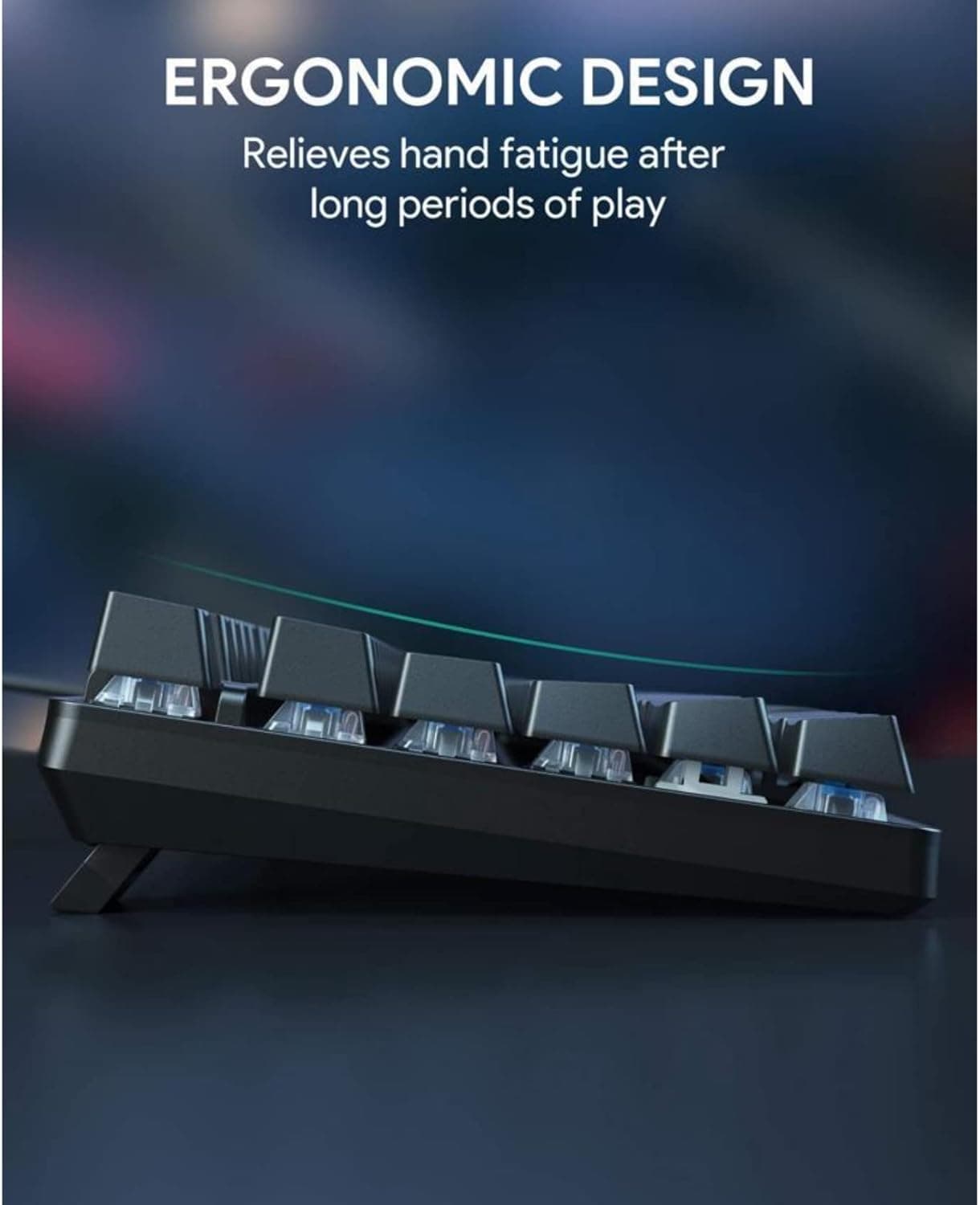
The chassis is full CNC-machined aluminum in a 75% layout, and it shows in hand. The gasket mounting system, FR4 switch plate, and multi-layer sound dampening work together to produce what Eddie Chim at FunkyKit describes as a "sublime keypress feel" with notably reduced vibration and resonance. Two removable magnetic feet handle typing angle adjustment, an approach Tom's Hardware specifically flagged as unusually well-executed: aluminum keyboards with plastic flip-up feet tend to flex or break under pressure, so Corsair's magnetic solution sidesteps a persistent category annoyance.
Keycaps are double-shot PBT, available in white, black, and yellow colorways. PBT at this price is expected, and Corsair delivers on texture and durability. The acoustic profile is decent if unspectacular; as KitGuru noted, the typing experience lands at "OK" rather than exceptional, and Basic-Tutorials.com found "almost no points of criticism" overall but acknowledged the keystroke sound won't appeal to everyone. This is a gaming board optimized for feel under rapid key input, not a typist's endgame.
Software: Two Paths, One Set of Growing Pains
Configuration runs through two options: Corsair's browser-based Web Hub, which requires no installation and covers core switch tuning, and the full iCUE desktop suite for deeper RGB and macro control. The no-install Web Hub approach is genuinely useful for LAN environments or shared machines, but KitGuru's Carlos Ribeiro flagged software bugs as a meaningful weakness, noting the board requires manual calibration before Rapid Trigger performs reliably. The ghost key presses he documented pre-calibration are the kind of issue that shouldn't exist at $249.99, even if they resolve with setup.
How It Stacks Up at $249.99
Pricing is where the debate sharpens. The MAKR PRO 75 sits at $249.99 in the US, £219.99 in the UK, and AED 961 in the UAE. Corsair's own K70 MAX is available at $229, undercutting it by $20 with a comparable feature set. Budget-conscious HE buyers can look at the Gamakay X NaughShark NS68 for significantly less. And if the true-kit DIY experience is what you're after, the original MAKR 75 barebones path (while lacking Hall Effect switches) remains a more honest entry point into customization.
The market context matters here: the Asia Pacific Hall Effect gaming keyboard segment was valued at approximately $420 million in 2024, with North America at $340 million, and both are projected to grow at a 21.3% CAGR through 2033. Corsair, Razer, and SteelSeries all moved into this space by 2024, which means the MAKR PRO 75 isn't competing in a niche; it's fighting for shelf space in an increasingly crowded premium tier. Corsair's original MAKR 75 scored only 70% from PC Gamer reviewer Phil Iwaniuk, which puts real pressure on the Pro model to justify both the upgrade and the price.
The Verdict on "DIY"
If you come to the MAKR PRO 75 expecting a kit-building experience, you'll be frustrated within the first five minutes. The "DIY" label is marketing shorthand for "hot-swappable and ecosystem-expandable," which is a legitimate but far narrower definition than what the mechanical keyboard community means by the term. A genuine 75% kit build, whether through the MAKR 75 barebones route, Glorious, or another enthusiast path, will give you more agency over every layer of the board, often at lower cost.
But if you come to it as a prebuilt Hall Effect gaming keyboard with serious competitive credentials, the picture improves considerably. The MGX Hyperdrive switches, 8,000Hz polling, FlashTap SOCD, and premium aluminum construction deliver a package that genuinely performs. The honest frame for this board: it is an excellent gaming peripheral with an identity crisis, and knowing that going in makes the $249.99 decision much cleaner.
This article was produced by Prism’s automated news system from verified source data, official records, and press releases, then run through automated quality and moderation checks before publishing. The system is built and supervised by the people who set the standards it runs under. Read our full AI policy.
Did this article answer your question?