Meshtastic powers smart-campus sensing network at Universidad Militar Nueva Granada
Meshtastic’s campus use case just got practical: a solar sensor node, mobile trackers, and a Docker dashboard turn a mesh into live telemetry.
A mesh that actually does work
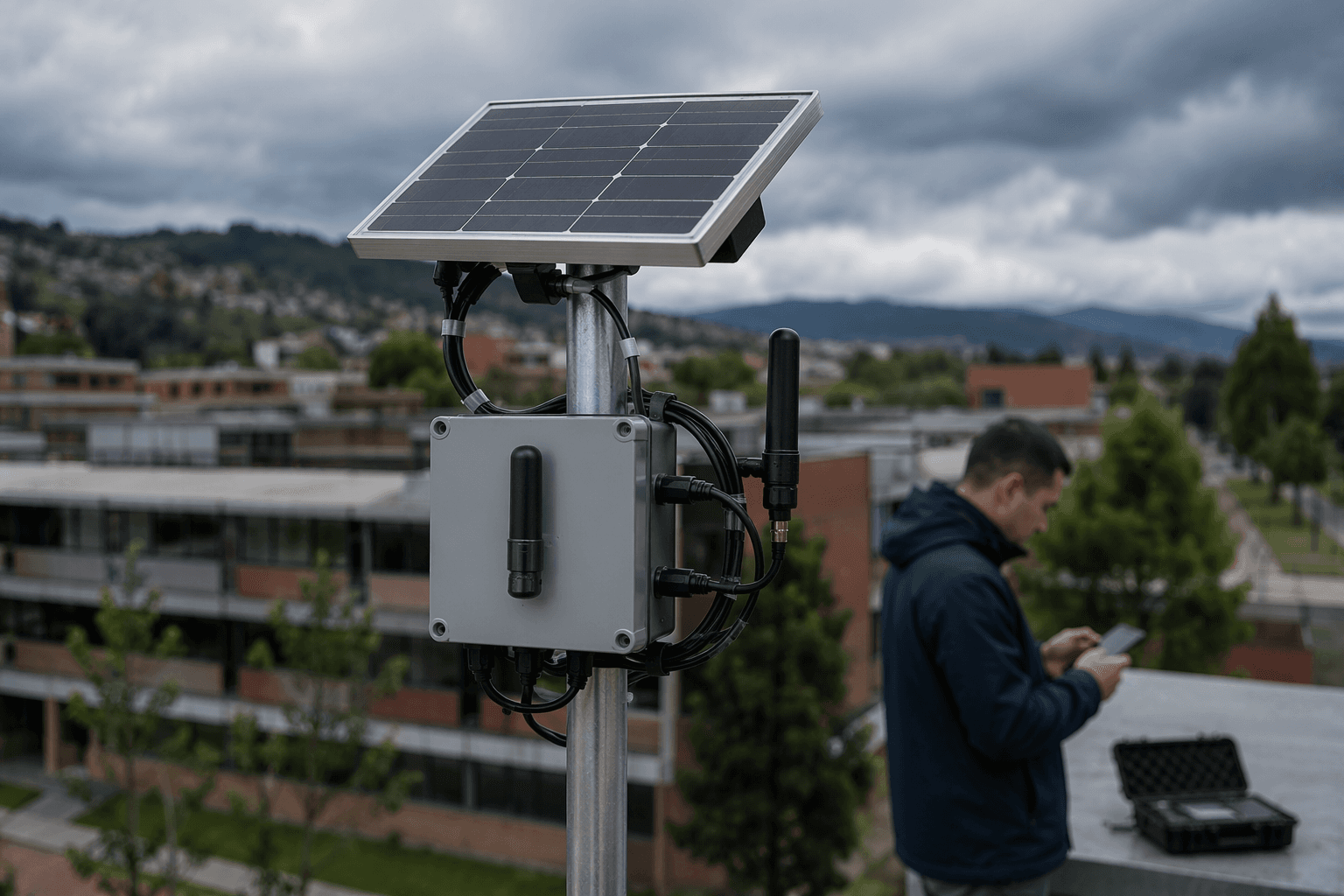
Meshtastic stops looking like a chat toy the moment you see it running a smart-campus sensing stack. The new UMNG build turns the mesh into a real telemetry path, with a solar-powered ecological node, mobile trackers, a Raspberry Pi 4 edge gateway, and a live dashboard chain built for persistence instead of novelty. That is the useful takeaway here: this is what Meshtastic looks like when the goal is not just moving packets, but making those packets become operational data you can watch, store, and act on.
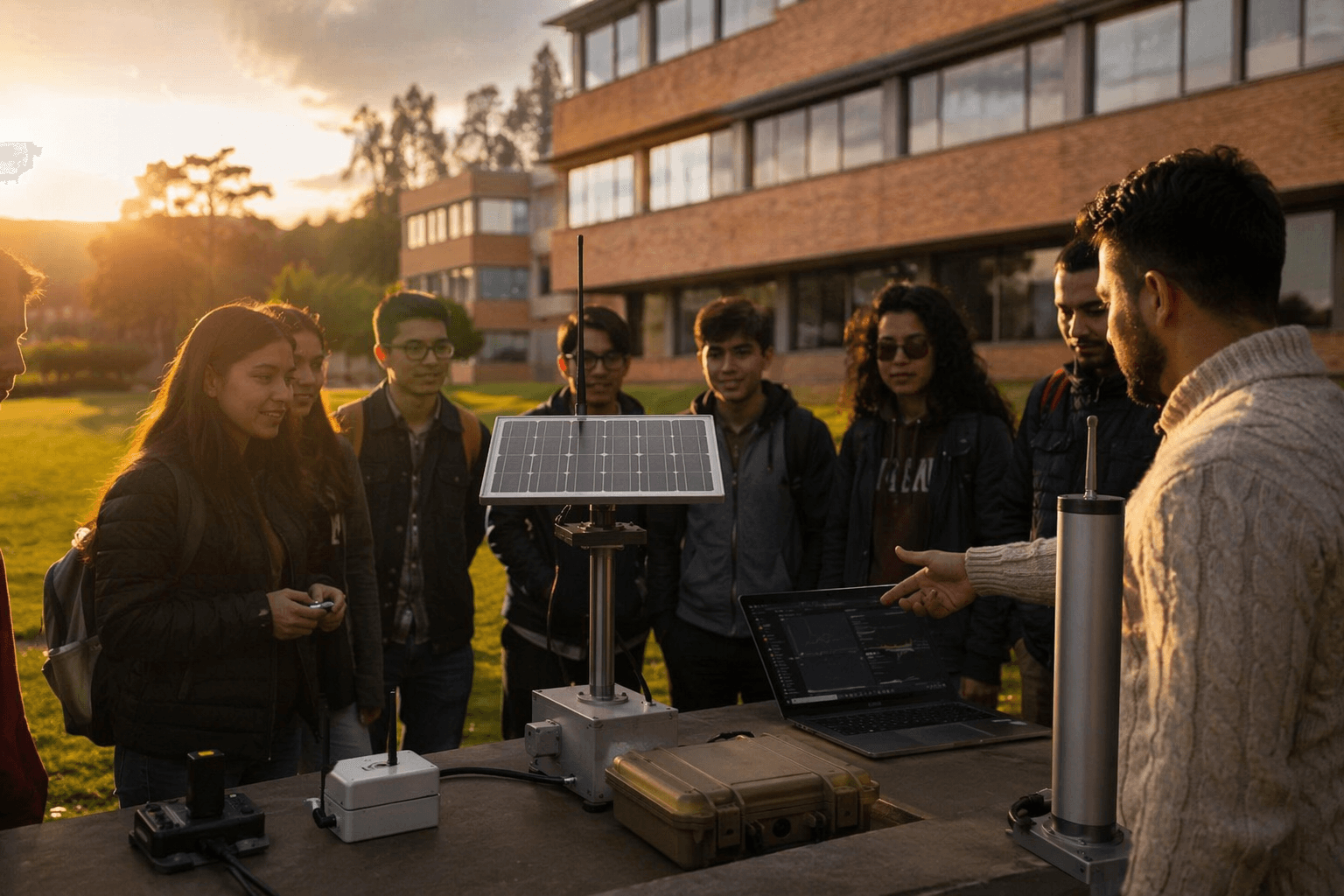
The paper, titled *A Meshtastic-based LoRa Mesh System for Smart Campus Applications: From Solar-Powered Sensing to Containerized Data Management*, was submitted on May 19, 2026. It was developed for Universidad Militar Nueva Granada, or UMNG, in Cajicá, Colombia, and it fits neatly into the university’s longer smart-campus arc. UMNG already published a 2021 tree-monitoring paper built around a GIS base map and web applications for the Nueva Granada campus in Cajicá, so this Meshtastic system reads less like a one-off demo and more like the next layer of an existing campus digitization effort.
The stack is the point
The part worth copying is not just the radio choice. It is the full shape of the system. The UMNG build uses a solar-powered ecological sensing node built around a Raspberry Pi Pico and a Semtech SX1262 transceiver. That gives the node the kind of low-power profile Meshtastic is good at, while still leaving room for actual environmental sensing instead of simple messaging.
On the mobile side, the system uses Seeed SenseCAP T1000-E trackers. Those units are a strong fit for this kind of deployment because Meshtastic’s own documentation describes them as compact, high-performance trackers built around Semtech’s LR1110, Nordic Semiconductor’s nRF52840, and MediaTek’s AG3335 GPS module. In practice, that means you get a purpose-built moving endpoint that can feed location-aware data into the mesh without dragging a phone into the middle of every workflow.
The edge and backend are where the project gets especially relevant for anyone who wants to go beyond hobby messaging. The gateway runs on a Raspberry Pi 4, and the backend is containerized with Docker Compose. Inside that stack, Node-RED handles ingestion, InfluxDB stores the time-series data, and Grafana turns it into live visualization. If you have ever wished a mesh could behave more like a small observability system, this is the blueprint.
What makes it a real field build
This is the kind of Meshtastic deployment that teaches a useful lesson: once you add power management, local ingestion, and a dashboard, the mesh becomes infrastructure. The solar node matters because outdoor sensing projects fail fast when they depend on constant attention. Meshtastic describes its SenseCAP Solar Node as a long-term outdoor device with a 5W solar panel, slots for four 18650 batteries, and an internal Grove interface for sensor expansion. That combination is exactly why solar keeps showing up in practical off-grid builds. It buys you endurance, and it gives you room to attach real sensors instead of leaving the node as a glorified radio.
The mobile trackers matter for the same reason. A campus is not a static grid, and the moment people, carts, bikes, or assets move through it, your network needs to track motion as cleanly as it tracks fixed nodes. Meshtastic’s T1000-E positioning makes sense here because it is designed for low-power, high-precision tracking, not as an afterthought. The UMNG system is using Meshtastic the way it should be used in the field: as a communications layer that links fixed sensing, moving endpoints, and a local data pipeline.
What you can copy right now
The most practical part of this build is that none of its moving pieces are exotic.
- Use a solar-powered node when the sensor is outdoors and you want long uptime without constant battery swaps.
- Put the mesh gateway on a Raspberry Pi 4 if you want a small, familiar Linux box that can run container tooling.
- Use Docker Compose to keep Node-RED, InfluxDB, and Grafana together so the system is easier to rebuild and easier to explain.
- Use a tracker like the SenseCAP T1000-E when the use case includes movement, route traces, or asset visibility.
That last point is where a lot of people waste money. They buy mesh hardware for the idea of distributed sensing, then never build the ingestion path that makes the data visible. A live dashboard is not decoration. It is the difference between a packet hobby and an operational system.
Why this matters for the Meshtastic ecosystem
Meshtastic itself helps explain why this kind of paper lands well right now. The project describes itself as a community-driven, open-source off-grid mesh network built around affordable, low-power devices. It also has a large enough community to matter in practice, with its Discord server showing roughly 50,000 members. That scale matters because it means the software and hardware patterns around it are no longer niche experiments. They are being refined by a broad user base that already knows the tradeoffs of low-power, long-range networking.
The wider implication is bigger than UMNG. If you can combine Meshtastic with standard container tooling and a clean visualization layer, then schools, labs, and community groups do not need to invent a custom backend every time they want to monitor a garden, a building, a trail, or a campus zone. They can start with the same building blocks: a sensor node, a mobile tracker, a gateway, and a dashboard. That is the real value of this paper. It shows Meshtastic working as a communications substrate for distributed sensing and local telemetry management, not just as a social mesh.
The smart-campus lesson
UMNG’s earlier GIS tree-monitoring work already showed a campus willing to build digital layers around its physical environment. This new Meshtastic system extends that logic into low-power wireless sensing and off-grid data handling. The result is a setup that feels grounded, not speculative: solar for uptime, trackers for motion, containerized services for repeatability, and Grafana for immediate visibility.
That is the part worth remembering when the novelty of the mesh fades. The winning move is not buying more radios. It is building the pipeline that turns the mesh into data you can trust.
Know something we missed? Have a correction or additional information?
Submit a Tip