Meshtastic vs MeshCore, choosing the right network for the job
The better mesh is the one that matches your topology: Meshtastic thrives on motion and improvisation, while MeshCore shines when repeaters and paths are already mapped.

Choose the network shape before you choose the firmware
The cleanest way to think about Meshtastic versus MeshCore is not as a showdown, but as a routing problem. NodakMesh’s central argument lands hard because it is so practical: topology and mission should decide the stack. In the field, that means asking whether you are building something that has to bend around changing nodes and improvised coverage, or something that can lean on known relay sites and a more deliberate structure.
That is the key to the whole comparison. Both systems solve real off-grid communication problems, but they make different assumptions about how a mesh should behave once it is alive.
Meshtastic’s strength is its loose, forgiving shape
Meshtastic’s official routing model is managed flood routing. A packet is broadcast outward, nearby nodes rebroadcast it, and the message keeps moving until it reaches its destination or the hop limit runs out. If no confirmation comes back after a timeout, the device retransmits the message up to three times. That design is simple in the best possible way: it favors ease of joining, resilience, and networks where the set of nodes changes from hour to hour.
That is why Meshtastic feels so natural in hobby use. You can flash a board, step outside, and start talking without first drafting a relay plan. The protocol does not assume static nodes, which makes it especially comfortable in ad hoc situations, mobile setups, and mixed environments where people, vehicles, and handhelds all come and go.
Meshtastic’s channel configuration reinforces that model. Devices need matching channel names and compatible radio settings to communicate on the same mesh, and the project exposes several roles, including Client, Repeater, Router, and Client Mute. The current guidance leans toward keeping most devices in CLIENT, CLIENT_MUTE, or CLIENT_BASE roles, with CLIENT nodes able to receive, send, and intelligently repeat messages to help stabilize the mesh without turning every radio into a special-purpose infrastructure box.
MeshCore starts from a more structured assumption
MeshCore, as NodakMesh frames it, takes a different path. The first message floods to find a contact, but after that the network learns a route and sends later traffic through specific repeaters. That makes MeshCore feel more like a network with memory, one that expects some amount of planned infrastructure and known relay points.
That difference matters most when the network already has shape. If your repeaters are fixed, your coverage area is deliberate, and your goal is to carry traffic through defined paths rather than through a constantly shifting cloud of rebroadcasts, MeshCore’s model can be the better fit. It is not about elegance in the abstract; it is about matching routing behavior to the actual map on the ground.
This is where protocol tribalism misses the point. A mesh that will live on a tower beacon, a shop node, or a building install is solving a different problem from one that has to tolerate cars rolling through town, handhelds roaming, and nodes appearing wherever someone happens to be standing.
Topology changes everything
Once you start thinking in topology instead of brand names, the trade-offs get easier to read. Meshtastic’s flood-first model is friendly to movement, temporary nodes, and spontaneous use. MeshCore’s learned-path model is friendlier to known repeater placements and managed coverage. Neither is universally superior, because the mission is doing the deciding.
A few common scenarios make the split clearer:
- A weekend field group with handhelds and no fixed infrastructure usually benefits from Meshtastic’s low-friction join process.
- A shop network with a couple of permanent nodes, a car repeater, and a tower beacon may favor a more structured routing approach.
- A building install that depends on predictable relay points may reward the discipline of learned paths.
- A rolling, variable setup where devices move often, or where the network shape is still being discovered, fits Meshtastic’s assumptions better.
The hidden constraint in both cases is airtime. Meshes live and die by how much traffic they can carry before the channel gets crowded, and Meshtastic’s configuration tools make that visible by exposing region, modem preset, max hops, transmit power, and channel behavior. In constrained radio environments, every extra retransmission matters.
Why Meshtastic keeps growing beyond the hobby bench
Meshtastic has become more than a one-off radio experiment. The project describes itself as a community-driven, open-source off-grid mesh network built for affordable, low-power devices, and its ecosystem now spans firmware, Android, Apple, and documentation work across GitHub. Its community pages also list local groups actively organizing regional networks, which says a lot about how far it has moved from the “flash a board and see what happens” phase.
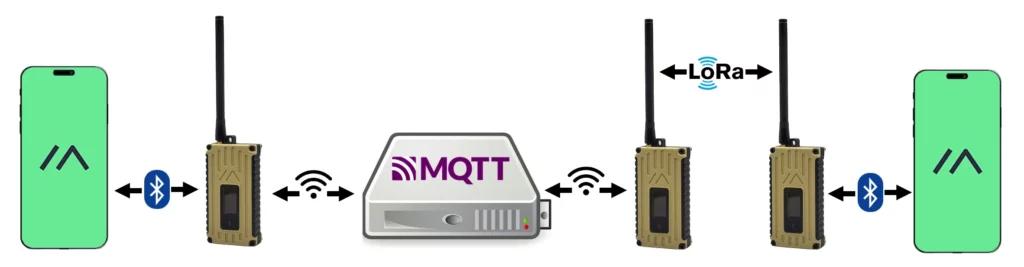
That broader footprint matters because Meshtastic now lives in more than just casual field use. The project says it is used in Search and Rescue, off-grid communication, disaster recovery, and grid-down scenarios. It also supports MQTT bridging when devices have Wi-Fi or Ethernet connectivity, which opens the door to hybrid setups that can move between pure off-grid messaging and more connected infrastructure.
The security story has matured too. Meshtastic introduced public key cryptography for direct messages in v2.5.0 after an earlier proposal in 2022 was revisited and reworked. That is the kind of change that signals a project moving from rough utility toward something operators can trust in more serious deployments.
The right choice depends on the job in front of you
If the network has to be easy to join, tolerant of movement, and useful before the topology is fully planned, Meshtastic is the obvious place to start. Its managed flood routing, channel rules, and device roles are built for real-world hobby use, where the mesh may be improvised, social, and constantly changing.
If the network already has known relay sites, deliberate coverage goals, and a structure that should be preserved after the first packet, MeshCore starts to look compelling. Its learned routing model makes sense when the network is meant to follow a shape rather than discover one on the fly.
NodakMesh gets to the heart of it with unusual clarity: the question is not which protocol is better in the abstract. The question is which one matches the network you are trying to build. That is where the real operator’s judgment lives, and it is why the right mesh often feels less like a victory and more like a good fit.
This article was produced by Prism’s automated news system from verified source data, official records, and press releases, then run through automated quality and moderation checks before publishing. The system is built and supervised by the people who set the standards it runs under. Read our full AI policy.
Know something we missed? Have a correction or additional information?
Submit a Tip