Meshtastic Powers Off-Grid Voter Outreach Amid Digital Divide
Off-grid voter outreach shows Meshtastic at its best: cheap radios, sparse-mesh delivery, and a practical bridge to the internet when infrastructure disappears.

Why this use case matters
When cell service drops and internet access is thin or missing, Meshtastic stops feeling like a hobby bench project and starts looking like field gear. That is the lesson tucked inside off-grid voter outreach: a cheap mesh node can become a real communications layer when the work has to happen in rural areas, tribal communities, or other places where ordinary networks are unreliable.
The bigger backdrop is the digital divide itself. Nearly 8 million households remain offline, and the gap is not just about convenience. It touches education, work, health care, and participation in government. U.S. Census Bureau materials describe that divide as a shortfall in broadband, devices, and digital skills, and the same reporting shows how heavily it lands on rural households and tribal communities.
What Meshtastic is doing here
Meshtastic earns its keep because it is simple in the right way: an open-source, off-grid, decentralized mesh network built around affordable, low-power devices. There are no cell towers in the loop, no satellites to pay for, and no internet connection required for the core network to function. The project is community driven, which matters when you want a platform that can be modified, extended, and understood by the people using it.
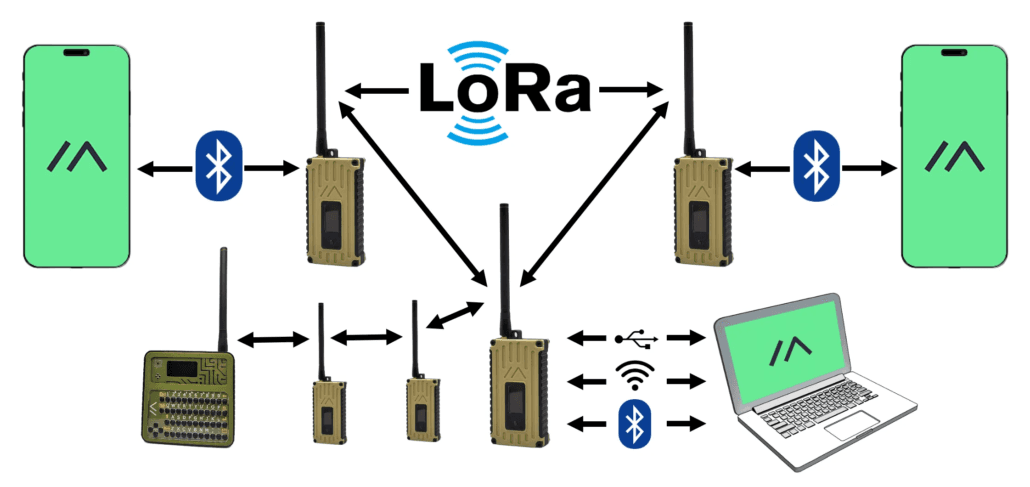
The field workflow is straightforward. You send a message from the companion app, and that app connects to a radio over Bluetooth, Wi-Fi, Ethernet, or serial. The radio then broadcasts the packet into the mesh, where intermediate devices can pick it up and relay it onward. Meshtastic also says a received packet can be retransmitted up to three times if another device does not confirm it, which is the kind of redundancy that matters when your network is sparse and every hop counts.
Why the hardware fits deployment work
This is where the crossover from hobby hardware to field operations gets interesting. Many Meshtastic nodes cost under $100, which makes it realistic to spread coverage across a town, a canvassing route, or a temporary command setup without burning through a budget. Battery-powered operation can last a long time, which is not a luxury when you are running long field deployments, canvassing shifts, or overnight monitoring.
That low-power profile changes how you think about deployment. Instead of assuming one central radio will solve everything, you start planning around where the nodes can actually hear one another and how messages will move through the chain. In practice, the mesh rewards careful placement, conservative expectations, and a willingness to build for coverage instead of hoping for it.
The bridge to people who are still online
Meshtastic becomes even more useful when you connect the mesh to the internet at the edge. FastAlert.now is described as that bridge, a two-way handoff between a Meshtastic mesh and the web. A message can originate in a rural area, move across the mesh, and then be forwarded to staffers, responders, or organizers who only have phones and laptops.
FastAlert.now is also presented as a private alert system, with a Democracy Labs-branded entry point, which makes the whole arrangement easier to understand operationally. It is not just about passing messages around a dead zone. It is about getting a field update out of the dead zone, documenting it, and pushing it where it can trigger action. For Meshtastic users, that is a meaningful shift: the mesh is no longer only the local network, it is the first mile of a broader comms stack.

What this teaches about coverage planning
The first lesson is that coverage planning beats optimism. A mesh only works as well as the nodes you can place, power, and maintain, so you have to think in terms of relay points, not just endpoint devices. If a message has to move from a phone in the field to someone back at a desk, every hop has to be treated as part of the deployment plan.
The second lesson is message discipline. Sparse meshes are not the place for chatty, low-value traffic. Keep messages short, specific, and operational. If a packet has to ride through multiple radios and may be retransmitted, the cleanest message wins every time.
The third lesson is battery management. Long runtime is a strength, but only if you treat it like a resource. A node that looks fine on a bench can become a problem in the field if you ignore charging cycles, spare batteries, or how long a unit needs to stay alive before the next handoff. The whole appeal of Meshtastic in this scenario is that it can keep moving when the grid and the carrier network cannot, so power planning has to be part of the job from the start.
Trust, security, and the right boundary
There is also a bigger trust question here. The Electronic Frontier Foundation has been clear about elections: keep paper records for every vote, use automatic risk-limiting audits, and do not move voting online. That stance matters because it draws a clean line between communications and election administration.
Meshtastic fits on the communications side of that line. It helps people coordinate, alert, and document without depending on commercial infrastructure. FastAlert.now adds a controlled bridge to the internet when a message needs to leave the mesh, but the voting process itself remains outside the system. That distinction is the operational sweet spot: resilient communications for outreach and security work, without confusing the mesh with the machinery of voting.
The real takeaway for Meshtastic users
The best part of this story is not the politics. It is the proof that the platform can move out of the maker lane and into real-world field operations. A low-cost radio mesh, a phone app over Bluetooth, a few well-placed nodes, and a disciplined alert path to the internet can cover a lot of ground when normal infrastructure fails.
That is the kind of deployment that rewards Meshtastic’s core strengths: low power, low cost, decentralized routing, and enough flexibility to fit a serious job. In a place where broadband is missing and the digital divide is still shaping who gets reached, Meshtastic is not just surviving off-grid. It is doing the kind of work that makes off-grid communication matter.
This article was produced by Prism’s automated news system from verified source data, official records, and press releases, then run through automated quality and moderation checks before publishing. The system is built and supervised by the people who set the standards it runs under. Read our full AI policy.
Did this article answer your question?