California State Bar Launches Free Spring Mindfulness Series for Legal Professionals
California's State Bar just institutionalized mindfulness for attorneys with a free four-part Zoom series; three sessions remain, running April 8 through April 29.
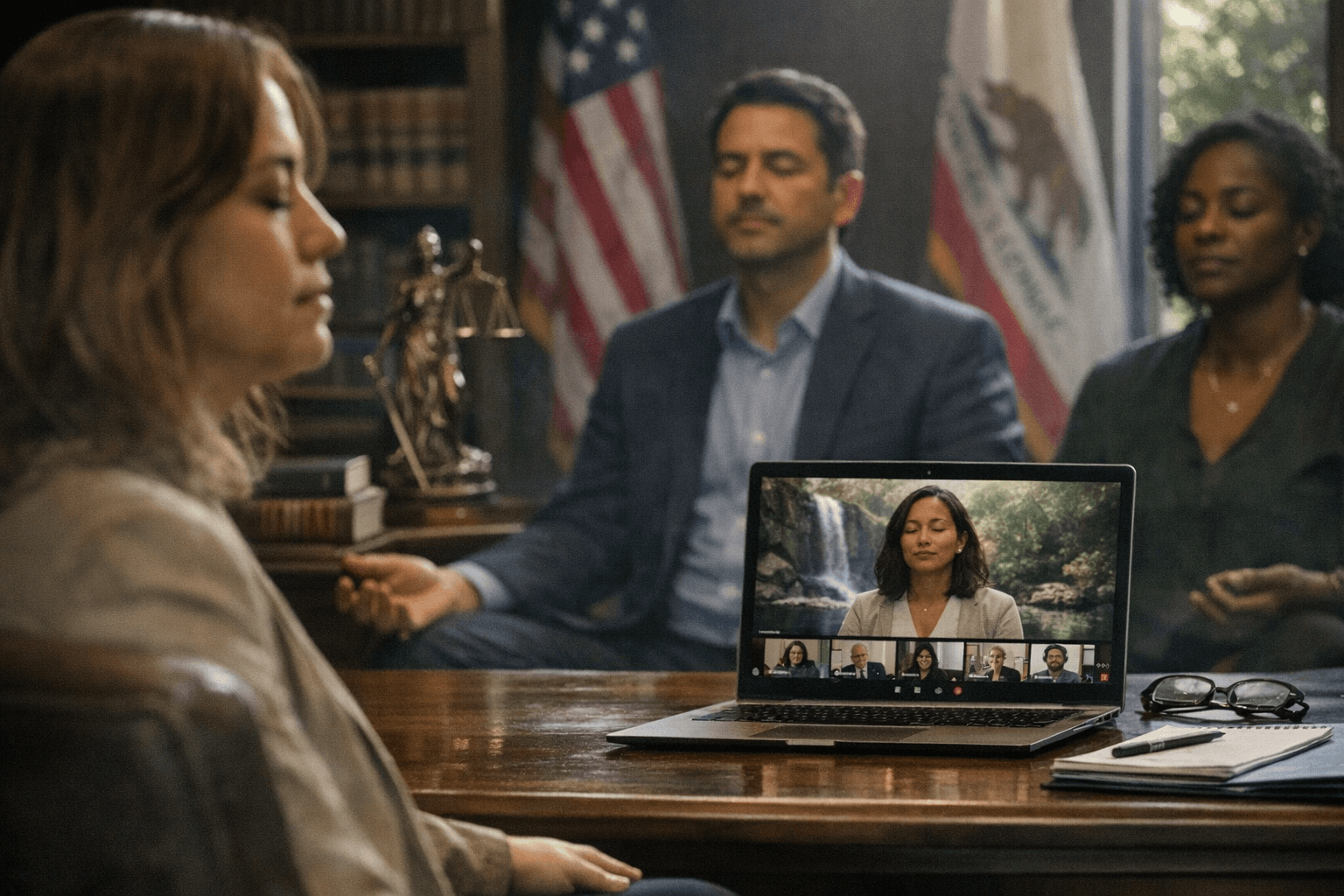
The statistic that stops most lawyers cold: more than 45% of attorneys report experiencing depression at some point during their career. Burnout, according to a Bloomberg survey of nearly 1,400 legal professionals, now runs at levels where the youngest attorneys report feeling it roughly 58% of the time. Stress in law is not an edge-case problem. It is the professional baseline. Against that backdrop, the State Bar of California's Lawyer Assistance Program has done something structurally unusual: it built a mindfulness curriculum designed specifically for that environment, embedded it inside the institution responsible for attorney welfare, and made it free.
The Lawyer Assistance Program, known as LAP, launched its Spring Mindfulness Series on April 2 in collaboration with the Mindfulness in Law Society, a national organization whose work in contemplative legal education has drawn endorsements from the American Bar Association, the Conference of Chief Justices, and the National Task Force on Lawyer Well-Being. The Mindfulness in Law Society's mission is to enhance well-being in the legal profession by educating it about the benefits of mindfulness meditation, yoga, and other contemplative practices. The four-part series runs via Zoom and is open at no cost to attorneys, bar applicants, law students, and others working within the legal profession.
The opening session, Introduction to Mindfulness, has already taken place. Three remain on the calendar. April 8 covers Mindfulness, Civility and Dharma, a session connecting attention practice to the relational demands embedded in legal culture. April 14 is dedicated to Moving into Stillness, which introduces movement-based techniques into the broader framework. The series closes on April 29 with Mindfulness and Related Techniques for Attorney Resilience, an applied module targeting the specific stressors legal professionals navigate through a working day: compressed timelines, courtroom pressure, and the accumulated cognitive cost of back-to-back client interactions.
None of the four sessions carries MCLE credit, and that framing is itself deliberate. Organizers positioned the offering as practical skill-building rather than continuing education compliance, situating contemplative practice as a performance and resilience tool rather than a wellness supplement tacked onto professional development. The LAP has increasingly embedded mindfulness at the center of its core programming; its existing Refocus program treats mindfulness as both a wellness tool and a professional skill that enhances mental health, sharpens cognitive performance, and supports competent, ethical lawyering. The Spring Series extends that framework through a structured, collaborative format, with the Mindfulness in Law Society contributing pedagogical depth built from years of teaching contemplative practice specifically within legal professional settings.
That partnership carries institutional weight. The Mindfulness in Law Society has spent more than a decade advocating for contemplative practice as a professional skill rather than a personal spiritual pursuit. National organizations have aligned behind that framing, but adoption at the state bar level, a body with direct regulatory and wellness responsibility for its licensees, represents a different order of legitimacy. It moves mindfulness from optional enrichment into the formal architecture of professional support, which is where the meaningful culture shift in any licensed profession tends to begin.
What the Spring Series offers, at its most portable level, is a set of techniques scaled to fit the actual rhythm of a legal workday and specifically the transition points between high-stakes engagements. These are not retreat-style practices requiring an hour on a cushion. Three micro-practices, drawn directly from the session curriculum, can be completed in two to five minutes and require no equipment, no dedicated space, and no prior experience with meditation. Each is designed for deployment between hearings, not around them.
The first is anchored breath awareness. In the two minutes before a difficult proceeding, a deposition, a tense client call, or a contentious hearing, directing complete attention to the physical sensations of breathing, the rise of the chest, the pause at the top of an inhale, the slow controlled release, activates the parasympathetic nervous system without requiring any change of setting. The LAP's materials describe mindfulness as helping calm the nervous system, lowering stress levels common in high-pressure legal environments. Two focused minutes, applied consistently before the highest-stakes moments rather than reserved for a quiet weekend morning, compounds in effect over time.
The second technique is a body-grounded stillness check, the practice at the heart of the April 14 session. Movement-based work can discharge accumulated physical tension before settling into focused attention, which is one reason why sitting still in a courtroom for three hours tends to produce diminishing cognitive returns in the afternoon. A three-to-five minute sequence of slow, deliberate movement with full attention on physical sensation, whether rolling tension out of the neck and shoulders or standing and consciously shifting weight from foot to foot, recalibrates the nervous system without requiring a yoga mat. The insight behind Moving into Stillness is that settled focus is often more accessible after movement than before it.
The third is a single-focus attention drop: deliberately narrowing awareness to one sensory anchor for 60 to 90 seconds before a cognitively demanding task. A sound in the room, the texture of a legal pad under a palm, the specific weight of sitting in a chair. The technique, addressed in the April 29 resilience session, interrupts the rumination carryover that builds when a lawyer moves from one engagement to the next without any reset interval. For a litigator transitioning from a motion hearing into a settlement negotiation, this micro-practice reduces context-bleed without requiring a closed door or a formal sitting practice.
Accessibility is built into the series structure. The Zoom delivery eliminates geographic and scheduling barriers that have historically kept legal professionals out of in-person wellness programming, and participants requiring accommodations are invited to contact the LAP directly to request modifications. The curriculum is designed as an entry point, not an advanced practice, consistent with the LAP's approach of reducing threshold friction for a profession where seeking support has long carried professional stigma.
That stigma has measurable consequences. Research funded by the Hazelden Betty Ford Foundation and the American Bar Association Commission on Lawyer Assistance Programs found that 18% of attorneys qualify as having problematic alcohol use, significantly above general population norms, while 19% suffered from statistically elevated levels of depression. The LAP's mandate includes confidential support for attorneys navigating substance misuse, depression, and anxiety. Framing mindfulness as a performance tool rather than a signal of distress changes the engagement calculus entirely. A lawyer who would not identify as someone in need of wellness support might register without hesitation for a free professional resilience series.
The structural implication is worth noting. A four-session, profession-specific mindfulness curriculum delivered via Zoom at no cost is a replicable model. Other state bars, public defender offices, law school wellness programs, and large firm professional development teams face the same documented burden of occupational mental health strain. Tracking uptake and participant outcomes from the California series will offer useful data for any institution evaluating whether brief, targeted offerings can shift the professional baseline in measurable ways.
Registration for all three remaining sessions is open through the State Bar of California's Lawyer Assistance Program. April 8 is the next entry point, and no prior practice is required to participate. The series is less an introduction to meditation and more a recalibration of what professional competence can look like when attention itself becomes a trained skill.
This article was produced by Prism’s automated news system from verified source data, official records, and press releases, then run through automated quality and moderation checks before publishing. The system is built and supervised by the people who set the standards it runs under. Read our full AI policy.
Did this article answer your question?