South Korea Launches Month-Long Mindfulness Initiative with 108 Wellness Spots Nationwide
South Korea's Relax Week 2026 deploys exactly 108 wellness spots nationwide, a figure that echoes the 108 defilements at the core of Buddhist practice.

The number 108 does not appear in South Korea's new nationwide wellness initiative by accident. In Buddhist tradition, 108 is considered the standard and most sacred count, symbolizing the defilements, or kleshas, that block enlightenment. And practitioners who seek to release themselves from those defilements traditionally bow 108 times, each prostration aimed at one of the 108 sources of suffering. That ancient arithmetic sits at the organizing center of Relax Week 2026, a month-long public mindfulness campaign run by the Jogye Order of Korean Buddhism that unfolds across all of April around a curated network of 108 Relax Spots spread nationwide.
The Jogye Order partnered with Buddhist media outlet Bulgyosinmun to produce the initiative, which formally debuted at the Seoul International Buddhism Expo 2026 at COEX on April 2 through 5. The expo gave organizers a high-visibility launch point, positioning Relax Week not as a niche retreat but as a mainstream wellness offering carrying the institutional weight of Korea's largest Buddhist order. An organizing official described the intent plainly: "Relax Week is designed not just to provide information, but to create meaningful experiences where individuals can discover rest in their own way."
The 108 designated spots span six categories: meditation and yoga centers, counseling services, hanok and wellness accommodations, cafés and restaurants, cultural spaces, and nature-healing parks. A centralized digital platform with an interactive map and location-based services lets users identify nearby offerings and book experiences directly, while discounts, free passes, and promotional benefits reduce the financial barrier to entry.
What separates Relax Week from standard wellness tourism is its emotional navigation system. Rather than presenting a flat directory, the program organizes its offerings into 15 themed journeys called the Relax Course, each calibrated to a specific emotional state. Themes include "When You Feel the Urge to Get Away" and "When You Need Time Alone," framing the act of choosing a mindfulness experience the way a skilled teacher might: begin with where you actually are, not where you imagine you should be.
The context behind that mission matters. South Korea has confronted a structural burnout crisis, with government efforts to cap working hours at 52 per week aimed at addressing chronic overwork across Korean workplaces. Into that landscape, the Jogye Order is deploying what are, at their core, ancient contemplative practices repackaged through the language and infrastructure of wellness tourism.
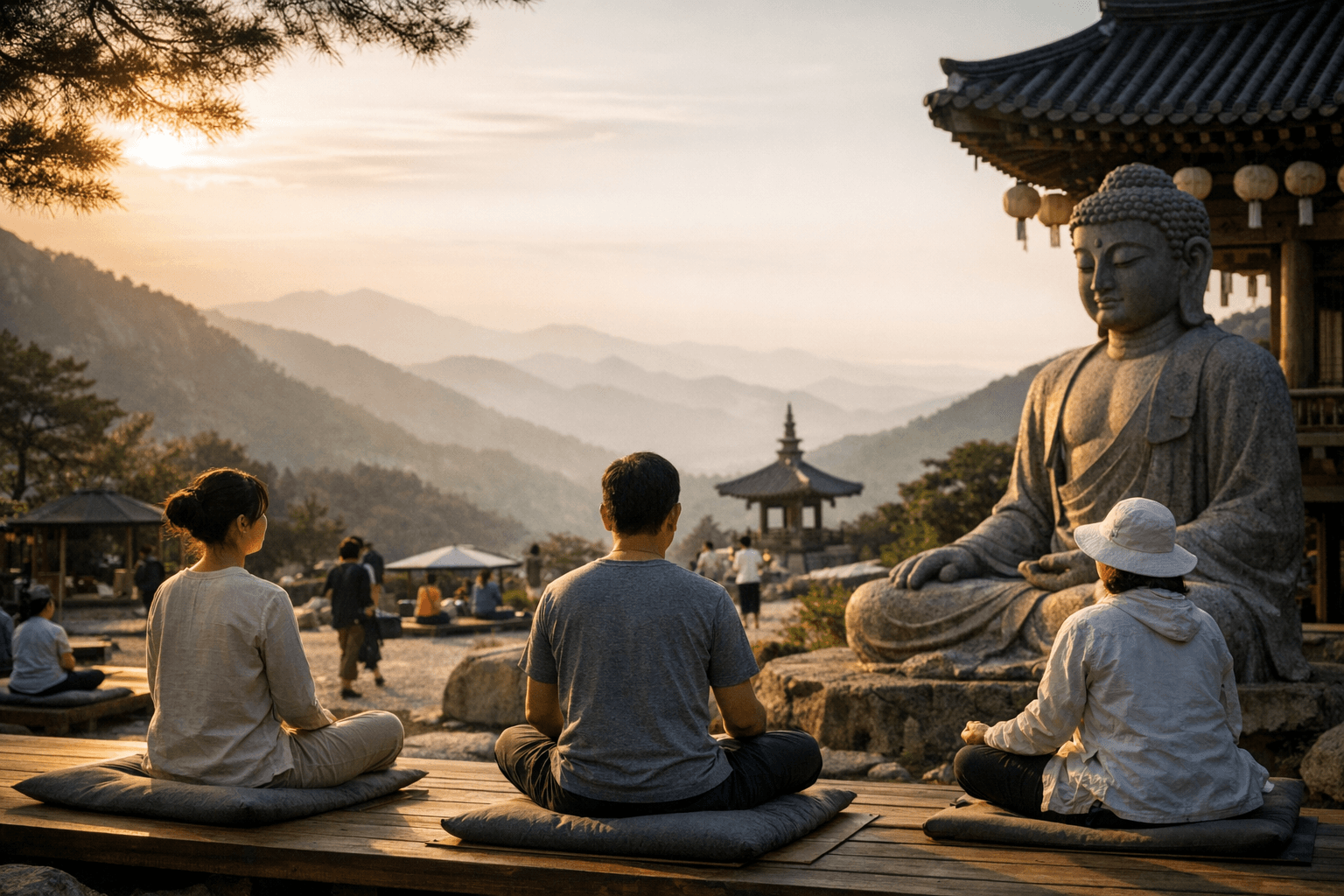
For practitioners outside Korea, the five core experiential elements embedded in the initiative translate directly to home use. The first is the nature sit: Relax Week's nature-healing park category centers on unstructured outdoor time, and 20 minutes seated outside with no goal beyond observation approximates its intent. The second is the tea ritual. Korean temple practice has long included darye, the monastic tea ceremony, among its core participatory elements, treating preparation and drinking as a complete meditative act. At home, this means boiling water deliberately, holding a cup with both hands, and drinking without a screen in view. The third is the silent walk. A chamseon session in Korean Buddhist temples typically consists of 50 minutes of Seon meditation followed by 10 minutes of slow walking called pohaeng or gyeonghaeng. That walking segment, attempted on a single city block without earbuds or a destination, requires no cushion and no timer. The fourth is the device-free hour, embedded in Relax Week's hanok accommodation model: one full hour with no phone, no screen, no partial compliance. The fifth is the basic seated breath practice of the Seon tradition, watching the breath rise and fall and counting each exhale from one to ten, beginning again whenever the mind wanders. Three uninterrupted minutes of this at the start of the day is not a shortcut; in the framework these 108 spots are built around, it is the actual practice.
The campaign's Relax Zoom-In digital video series profiles five selected spots in depth, extending the initiative's reach to anyone who cannot travel to Korea this April. For a global mindfulness audience, those videos offer a window into what a state-scale contemplative infrastructure looks like when a major religious body moves it out of the monastery and into public life.
Whether Relax Week generates sustained practice or primarily a spike of short-term wellbeing will depend on attendance data and post-program evaluations the Jogye Order has yet to release. What the initiative already demonstrates is that when institutional religion, media, and a national expo stage align around the same 108 spots, the cushion has a way of finding people who never went looking for it.
This article was produced by Prism’s automated news system from verified source data, official records, and press releases, then run through automated quality and moderation checks before publishing. The system is built and supervised by the people who set the standards it runs under. Read our full AI policy.
Did this article answer your question?