Cognitive Fusion Questionnaire Validated for Meditators and Schizophrenia Patients
A Charité Berlin team validated the 7-item Cognitive Fusion Questionnaire across 940 participants, finding α = 0.94 reliability and sensitivity to change after mindfulness group therapy.
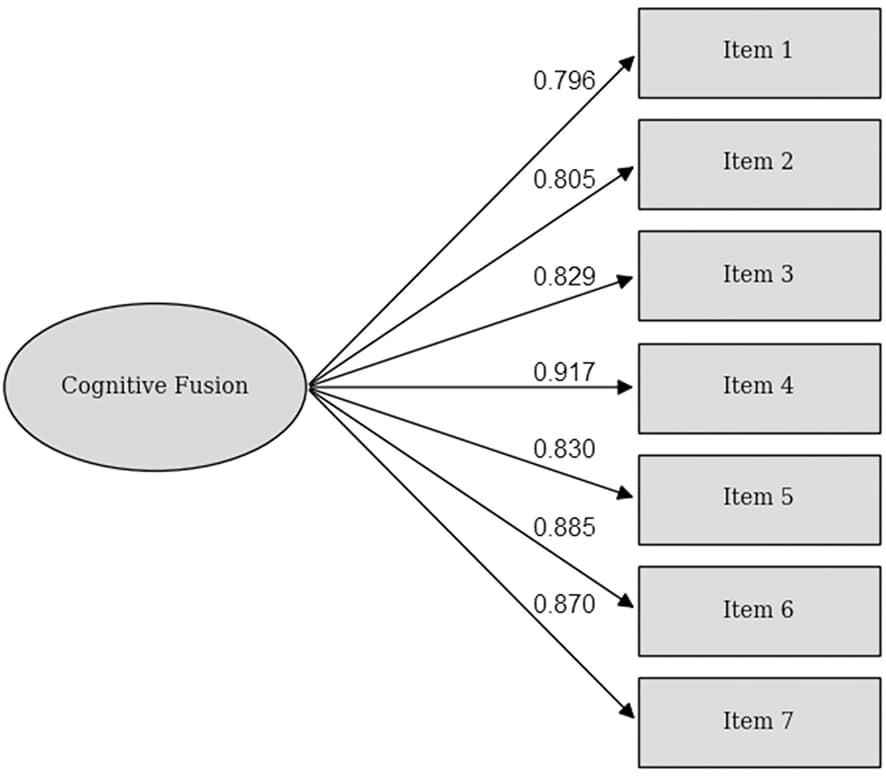
The same seven-item questionnaire that tracks whether a meditator is hooked by their own thoughts has now been validated across 940 participants spanning regular cushion-sitters and people living with schizophrenia-spectrum disorders, giving mindfulness researchers and ACT-informed clinicians a shared, cross-population measuring stick. Researchers from Charité – Universitätsmedizin Berlin published the findings on April 1, confirming the Cognitive Fusion Questionnaire's reliability, concurrent validity, and sensitivity to therapeutic change across three connected studies.
Cognitive fusion is the shorthand for getting stuck inside thoughts: a thought like "I can't handle this" doesn't arise and pass; it fuses with you, narrows your options, and drives your next twenty minutes. Defusion work, whether that's labeling thoughts, doing the leaves-on-a-stream visualization, or the ACT-standard "I notice I'm having the thought that..." reframe, targets this exact dynamic. Until now, the CFQ lacked cross-validated psychometric evidence confirming it could measure that dynamic reliably across non-clinical meditators and clinical populations alike.
Study 1 administered the original English CFQ to 779 regular meditators and found internal consistency at α = 0.94. The instrument also correlated negatively with the Southampton Mindfulness Questionnaire at r = −0.67, confirming that higher fusion scores track inversely with mindfulness capacity. Study 2 tested a German translation, the CFQ-D, in 123 patients with schizophrenia-spectrum disorders, yielding α = 0.92 and an SMQ correlation of r = −0.30. The gap between the two correlation magnitudes points to meaningful cross-cultural psychometric variation worth pursuing in future work.
Study 3 delivered the practically important result. A randomized controlled trial of 38 participants showed that people receiving mindfulness-based group therapy reduced their cognitive fusion scores over time. A tool that can't detect the change a therapist is working toward is clinically useless; this one does.

For anyone facilitating a weekly mindfulness group, that sensitivity-to-change finding has a straightforward application. Administer the CFQ at session one as a baseline, scored on its seven items across a one-to-seven scale, a task that takes under three minutes. Run it again at the four-week mark. A score that has not dropped meaningfully suggests the group needs more explicit defusion work: structured journaling prompts ("What is the thought right now? What does it want you to do next?"), dedicated leaves-on-a-stream or cognitive deliteralization exercises, or more guided inquiry during sits that surfaces unhooking moments in real time. A meaningful drop confirms the defusion container is working and can support a shift toward values clarification or committed action work within the same group arc.
The Berlin team was candid that 38 participants is a modest RCT base, and larger multi-site replication across diagnostic groups remains the obvious next step. But the core measurement infrastructure is now in place: a seven-item instrument with excellent reliability in two languages, strong concurrent validity with an established mindfulness scale, and demonstrated responsiveness to the kind of intervention that practitioners are already delivering every week. For trials seeking to test whether reductions in cognitive fusion actually mediate improvements in anxiety, psychosis-related distress, or everyday functioning, that combination of properties has been a persistent gap. It is not one anymore.
This article was produced by Prism’s automated news system from verified source data, official records, and press releases, then run through automated quality and moderation checks before publishing. The system is built and supervised by the people who set the standards it runs under. Read our full AI policy.
Did this article answer your question?