EEG study finds distinct brain signatures in Vipassana and Shoonya meditation
Vipassana and Shoonya did not leave the same alpha-band footprint. The clearest split was in signal stability and irregularity, not just average frequency.
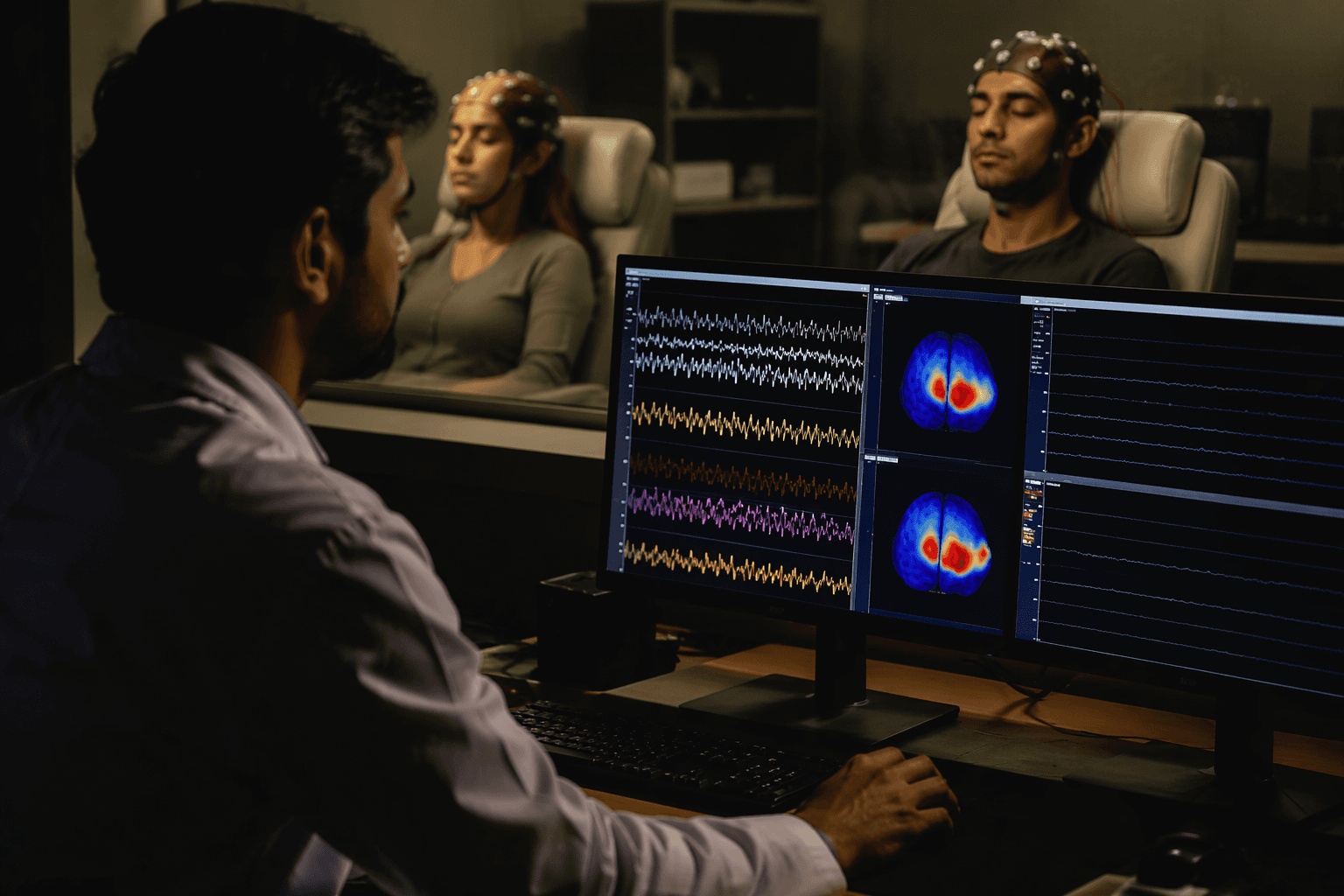
Vipassana and Shoonya may both look like stillness from the outside, but this EEG paper says the brain does not treat them as interchangeable. In alpha-band activity, Vipassana came through with steadier, less irregular dynamics than Shoonya, while the average peak frequency barely moved at all.
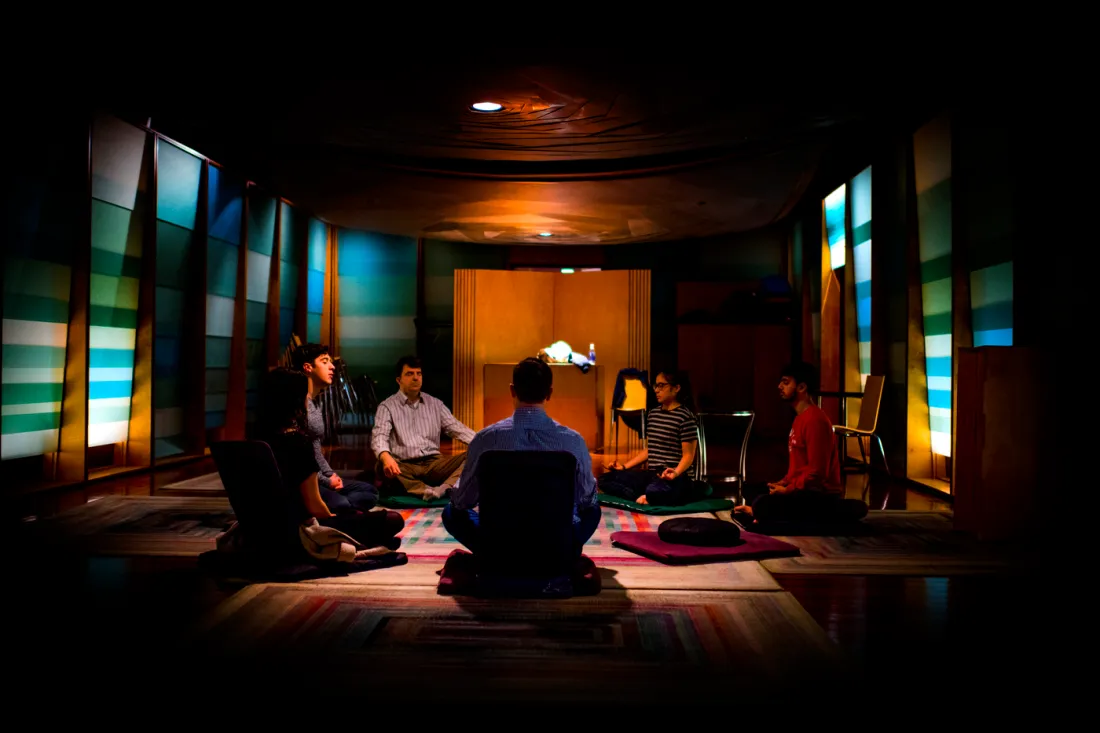
The paper, published July 7, 2026 in Neuroscience of Consciousness by Bianca Ventura, Andrea Buccellato, Saketh Malipeddi, Rahul Venugopal, Ravindra P. Nagendra, Bindu M. Kutty, and Georg Northoff, starts from a practical distinction that meditators already know well. Vipassana is framed in official materials as disciplined self-observation built around attention to physical sensations and the body-mind connection, and the study describes it as systematically scanning different body parts. Shoonya, by contrast, is presented as conscious non-doing, a non-directed style that asks for release rather than tracking.
What the study was actually measuring
The useful part of this paper is that it did not stop at average EEG power and call it a day. The authors looked at alpha-band dynamics over time, using Peak Frequency Sliding to follow millisecond-level shifts in the dominant alpha rhythm, and Power Sliding to track changes in oscillatory amplitude. They also used coefficient of variation and permutation entropy, two measures that capture how variable and how irregular the signal becomes across time.
That matters because contemplative practice is not just about how strong a signal looks in a snapshot. It is also about how the signal is organized from one moment to the next. If you compare a body-scanning practice with a non-directed one, the question is not only whether alpha gets larger or smaller, but whether it settles into a more ordered pattern or wanders around more unpredictably.
Where Vipassana and Shoonya separated
This is where the paper gets interesting. Mean alpha Peak Frequency Sliding did not differ significantly between the two practices. The table reported 9.44 Hz for Vipassana and 9.33 Hz for Shoonya, a difference too small to count as meaningful on its own.
Power told a different story. Mean alpha Power Sliding was 76.96 for Vipassana and 40.96 for Shoonya, so the two practices were not simply producing the same alpha profile with different labels. Even more telling, Vipassana showed lower coefficient of variation and lower permutation entropy than Shoonya for both phase and power dynamics, and both comparisons were significant at P < .001.
In plain language, Vipassana looked more temporally organized. Shoonya looked less constrained. That does not make one practice better, but it does suggest that the attentional job being asked of the practitioner changes the shape of alpha activity in ways a simple average can miss.
Why this is a better question than “does meditation change the brain?”
This study helps move the conversation away from broad claims and toward specific mechanics. A generic meditation label hides a lot of differences in instruction, effort, and attentional target. Vipassana asks for deliberate observation, often with the body as the anchor. Shoonya asks for conscious non-doing, which is a very different attentional demand even if both happen in silence.
That difference is exactly why the dynamic measures matter. The paper is not arguing that meditation universally boosts alpha or suppresses it. It is showing that how alpha unfolds over time may be more informative than whether the average number goes up or down. For anyone who practices regularly, that is a more useful frame: different methods may train different kinds of attention, and the EEG may be picking up the difference.
How this fits the broader EEG literature
This paper does not land in isolation. An earlier EEG study that compared Himalayan Yoga, Isha Shoonya, and Vipassana found that alpha-band graph measures could classify the traditions with as much as 90% maximum accuracy. That is a useful reminder that the brain does not flatten these lineages into one bucket just because they all get called meditation.
A 2024 EEG study of 34 expert Vipassana practitioners went further and showed that meditative depth could be decoded from EEG features and connectivity measures. Another 2024 paper found meditation-type-specific reductions in infra-slow EEG activity, with the effect especially pronounced in Vipassana. Put together, these studies point in the same direction: distinct contemplative styles can leave distinct signatures, and alpha is only part of the story.
How to use this as a practitioner
If you are choosing between styles, the cleanest takeaway is to match the method to the attentional goal. Vipassana fits when you want structured, sensation-by-sensation training and a disciplined body scan. Shoonya fits when you want a practice built around conscious non-doing and the absence of a target. The EEG result suggests those choices are not just philosophical, but measurable.
A practical way to read this before your next sit:
- Choose Vipassana when you want a clear sensory anchor and a method that keeps attention moving through bodily experience.
- Choose Shoonya when you want a less directed practice and are comfortable with attention settling without a specific object.
- Treat EEG claims as maps of attentional organization, not as scorecards for spiritual value.
The cleanest lesson here is the one the opening alpha numbers already hinted at: stillness is not one thing. If you want to know what kind of meditation you are doing, look at the instruction, not the label, and notice whether your attention is being trained to scan sensation or to release direction altogether.
This article was produced by Prism’s automated news system from verified source data, official records, and press releases, then run through automated quality and moderation checks before publishing. The system is built and supervised by the people who set the standards it runs under. Read our full AI policy.
Did this article answer your question?