Emotional Enmeshment Fuels Inferiority Through Self-Coldness, Study Finds
Inferiority in enmeshed families seems to travel through self-coldness, not a lack of self-compassion. In sits, the tell is the inner voice that grades, shames, and sharpens.
The real pressure point is not missing compassion. It is the habit of being cold to yourself.
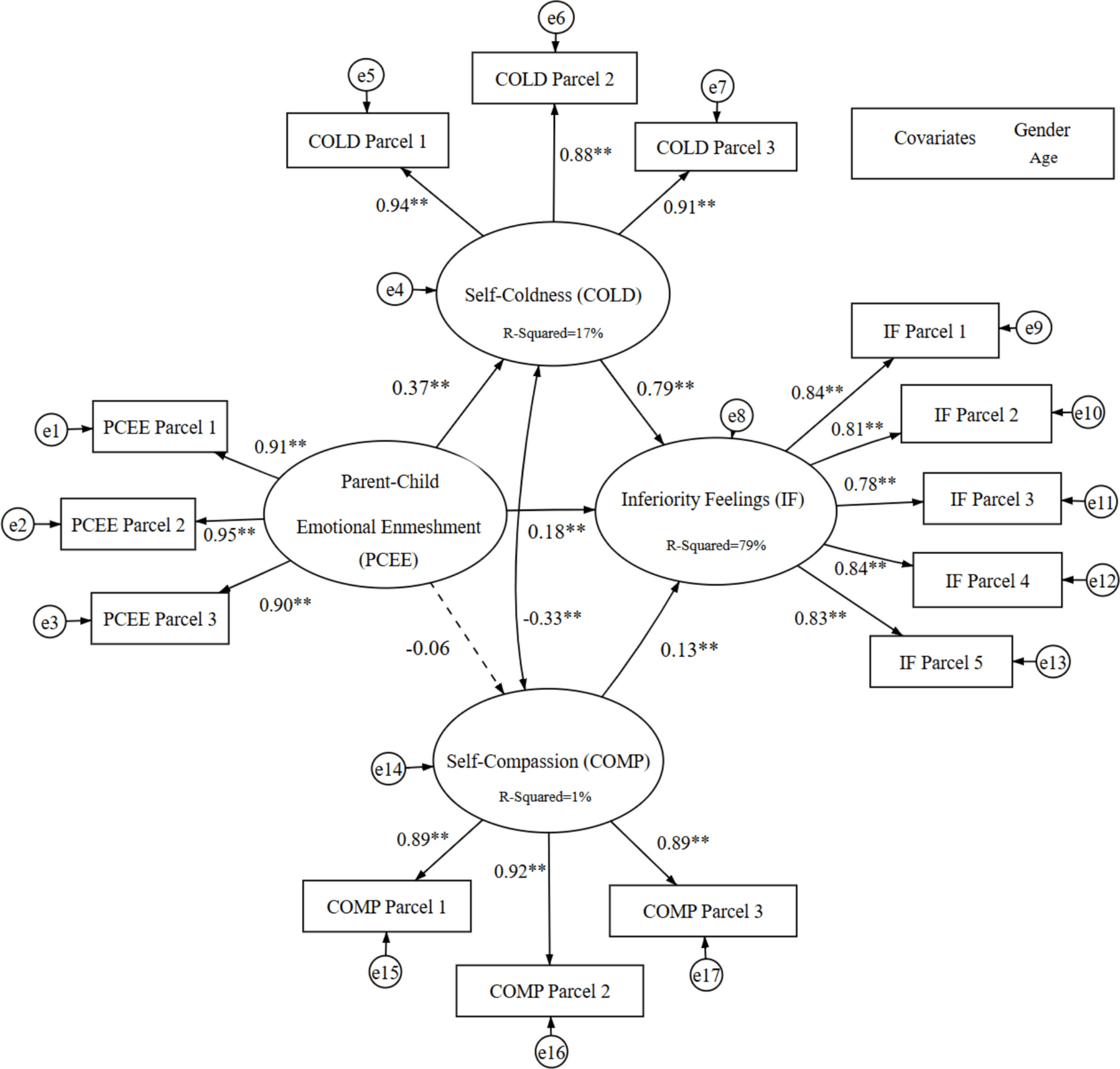
That is the cleanest takeaway from a new Mindfulness study of 381 adults in Turkey. The paper links emotionally enmeshed parent-child relationships to later feelings of inferiority, but the pathway runs through self-coldness, not through a simple lack of self-compassion. For anyone who practices mindfulness with an eye on inner dialogue, that distinction matters immediately: the problem may be less about failing to add warmth and more about learning how to stop the mind from turning on you.
What the study looked at
Büşra Nur Yüzer Kirik, Ramazan Akdoğan, and Elif Çimşir studied a convenience sample of 381 adults, 79.8% of them female, ranging in age from 18 to 75. Participants completed an online survey that included the Childhood Emotional Incest Scale, the Self-Compassion Scale, and the Inferiority Feelings Scale. The article was received on 23 March 2025, accepted on 30 April 2026, and published open access in Mindfulness on 5 May 2026.
The core result was straightforward. Parent-child emotional enmeshment significantly predicted inferiority feelings, and only self-coldness mediated that relationship. Self-compassion did not carry the same explanatory weight. The pattern held up in sensitivity analyses, including tests that excluded adults aged 60 and older, and in multi-group structural equation modeling across age bands, which strengthens confidence in the association even though the study was cross-sectional and not preregistered.
Why self-coldness is the more useful phrase
In meditation circles, self-compassion often gets treated like the all-purpose answer. This study suggests a sharper target: self-coldness, the internal stance that is hard, dismissive, and punitive toward the self. If inferiority is being fed by that stance, then simply telling yourself to be kinder may not reach the part of the mind doing the damage.
That is a practical distinction for anyone sitting with a lot of shame. The question is not, “Am I generating enough compassion?” The more revealing question is, “Where does the mind get icy, and what happens right after?” The answer may show up as a reflex to judge the sit, dismiss your own needs, or assume that any mistake proves something essential about your worth.
What to notice in a sit
The most useful meditation-language here is concrete. Self-coldness often shows up as a few repeatable patterns:
- The practice becomes a performance review: “This should be calmer by now.”
- Neutral sensations are interpreted as failure: “I am doing this wrong.”
- A passing emotion gets turned into identity: “If I feel needy, I am needy.”
- Comparison arrives dressed as insight: “Other people would handle this better.”
- Relief is discounted before it lands: “That doesn’t count, it was too small.”
These are not just annoying thoughts. In the logic of this study, they are the kind of inner weather that can keep inferiority feelings alive. If you recognize them, the first move is not necessarily to layer on a polished compassion phrase. It may be to notice the coldness itself, name it, and let that recognition interrupt the automatic spiral.
Why emotional enmeshment matters
The paper defines emotional enmeshment as a parent’s reliance on a child to meet unmet emotional and relational needs, and it frames that dynamic as a form of psychological maltreatment. That history can leave a very specific imprint: the child learns to scan outward for a parent’s needs while turning inward with very little tenderness of their own.
That is where the study speaks directly to mindfulness practice. A lot of practitioners are trying to unwind long habits of self-monitoring, people-pleasing, and quiet self-erasure. In that setting, the work is not abstract. It is about noticing the old reflex that says, “My job is to carry what other people feel, and my own experience comes second.”
Why the measurement matters
This study builds on a tool created in 2021 by Elif Çimşir and Ramazan Akdoğan: the Childhood Emotional Incest Scale, a 12-item, two-factor measure with the labels Surrogate Spouse and Unsatisfactory Childhood. That scale was validated in two samples, one of 319 participants and another of 415, and it was designed because emotional incest and covert incest had been undermeasured in empirical psychology.
That history helps explain why the new study is notable. It is not relying on a vague sense that “something unhealthy happened.” It is using a measure built to capture a particular relational pattern, one that the field has had to name carefully because the word incest usually makes people think only of overt sexual abuse. The scale gives researchers a way to study the emotional version of the dynamic with more precision.
The broader context is important too. A 2023 overview noted that the term covert incest was coined by Kenneth M. Adams in the 1980s. It also reported CEIS-related findings that were not trivial in a Turkish college-student sample, with 30% at moderate levels and 10% at severe levels. That kind of background helps place the 2026 paper in a longer effort to measure a difficult family pattern without flattening it.
How this fits other mindfulness research
The result does not stand alone. A 2023 Mindfulness study on gifted adolescents found that inferiority feelings were linked to anxiety and stress, with stronger indirect effects through self-coldness than through self-compassion. In that study, stress was linked only through self-coldness. The newer paper lands on the same basic insight: when inferiority deepens, the more toxic mechanism may be the harsh internal climate, not merely the absence of a loving one.
That is also consistent with broader self-compassion research. A Mindfulness review has tied self-compassion to secure attachment, healthier family functioning, and more constructive conflict repair, while intervention studies show mindfulness- and self-compassion-based approaches can reduce self-criticism and distress. The new paper does not argue against compassion practice. It sharpens the target by suggesting that reducing harsh self-talk may be the first, most practical lever.
What this means in daily life
For a meditator, the takeaway is not to chase a warmer feeling on command. It is to become alert to the little moments when the mind goes cold: the dismissive note in journaling, the disgust that follows a need, the internal sneer after a wandering sit, the sense that you must earn the right to rest. Those are the moments that may matter most.
The study’s authors are careful about limits. The design is cross-sectional, so it cannot prove causality, and the work was not preregistered. Even so, the pattern is strong enough to be useful: emotionally enmeshed care appears linked to adult inferiority through self-coldness, across age groups, in a sample of Turkish adults. For mindfulness practice, that makes the assignment clearer. Before trying to add more compassion, notice where the inner voice has gone frigid. That is often where the repair begins.
This article was produced by Prism’s automated news system from verified source data, official records, and press releases, then run through automated quality and moderation checks before publishing. The system is built and supervised by the people who set the standards it runs under. Read our full AI policy.
Did this article answer your question?