Heartfulness and bell meditation show distinct brain and heart patterns
After 21 days of 30-minute sessions, Heartfulness and bell meditation split into different brain and heart signals, with Heartfulness leaning more toward gamma and low-beta gains.
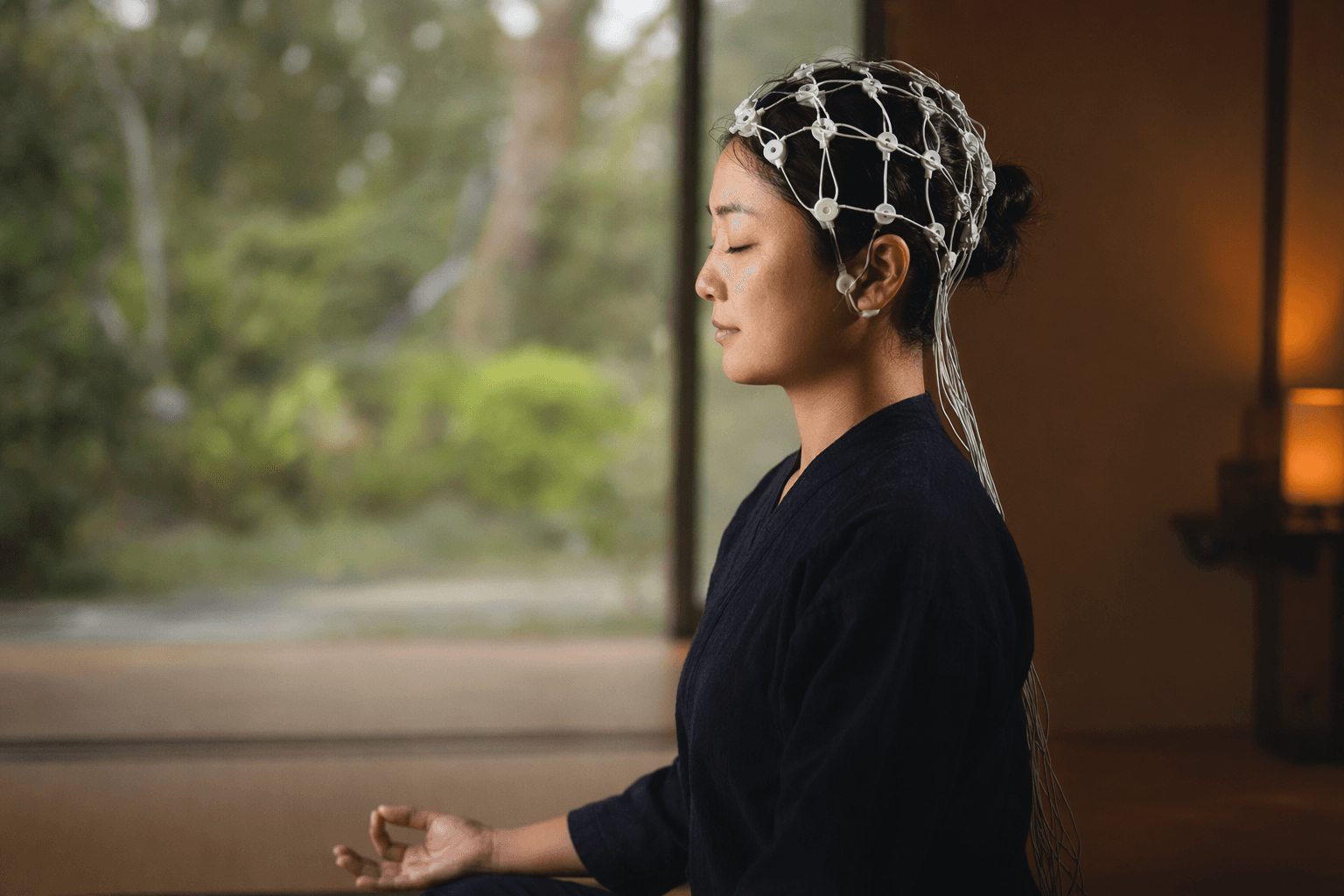
A tiny pilot in nine healthy male university students found that two meditation styles did not move the body the same way. After 21 days of 30-minute sessions, five days a week, Heartfulness and bell meditation each showed distinct patterns in resting EEG, heart rate, and heart-rate variability, hinting that the practice a person chooses may shape the experience in different ways.
The study, Neurophysiological and Autonomic Patterns Associated with Heartfulness and Bell Meditation: A Three-Arm Exploratory Approach, was published in Frontiers in Psychology on April 28, 2026. Sushil Prasad Mahato, M. Anjaladevi, Abinash Roy, Pailoor Subramanya, and Samiran Mondal led the work through the Central University of Kerala in Kasaragod and Visva-Bharati University in Santiniketan. The trial assigned three students to Heartfulness meditation, three to bell meditation, and three to a control group.
What stood out most was the split in brain activity. The Heartfulness group showed observed increases in gamma and low-beta activity, with Hedges’ g values around 1.0 to 2.3. The bell meditation group showed a small gamma change and a low-beta increase, while the control group showed minimal change in both measures. Across all three groups, heart rate fell, but low-frequency percentage dropped in the Heartfulness and bell groups and rose in the control group. Heart-rate variability amplitude decreased in every group.
That pattern fits a broader meditation literature that has long suggested different practices may not work through identical pathways. A 2015 review in Nature Reviews Neuroscience argued that mindfulness research needs randomized, actively controlled longitudinal studies with large samples, and earlier wearable-sensor work in Frontiers in Human Neuroscience found meditation could produce variable EEG changes along with a small 2 to 3 mmHg fall in mean arterial blood pressure. In other words, the field has never lacked hints. It has lacked direct comparisons like this one.

Heartfulness has its own distinctive framework. A 2022 Frontiers in Psychology overview described it as a contemplative system built around Meditation, Cleaning, and Prayer, with Pranahuti, or yogic transmission, as a defining feature. That same paper noted that scientific study of Heartfulness had only recently begun to examine its effects in humans, even as the tradition’s own research materials describe a wide program spanning sleep, anxiety, telomere length, mindfulness, and brain activity.
The new findings are still preliminary, and the authors say so by design. The sample was very small, all male, and limited to university students, and the measurements relied on BVP-derived heart-rate variability rather than a broader physiological battery. Still, the study offers a useful comparison for meditators who already feel that one sit leaves them quietly settled while another sharpens attention. In this early snapshot, Heartfulness looked more attention-linked, while bell meditation looked more relaxation-linked, a distinction worth testing in larger trials.
This article was produced by Prism’s automated news system from verified source data, official records, and press releases, then run through automated quality and moderation checks before publishing. The system is built and supervised by the people who set the standards it runs under. Read our full AI policy.
Did this article answer your question?