Mindfulness-based breathing calms emotional responses in AI models, study finds
A breathing exercise eased fear, anxiety and stress signals in six large language models, but the real test is whether that measures regulation or just mimicry.
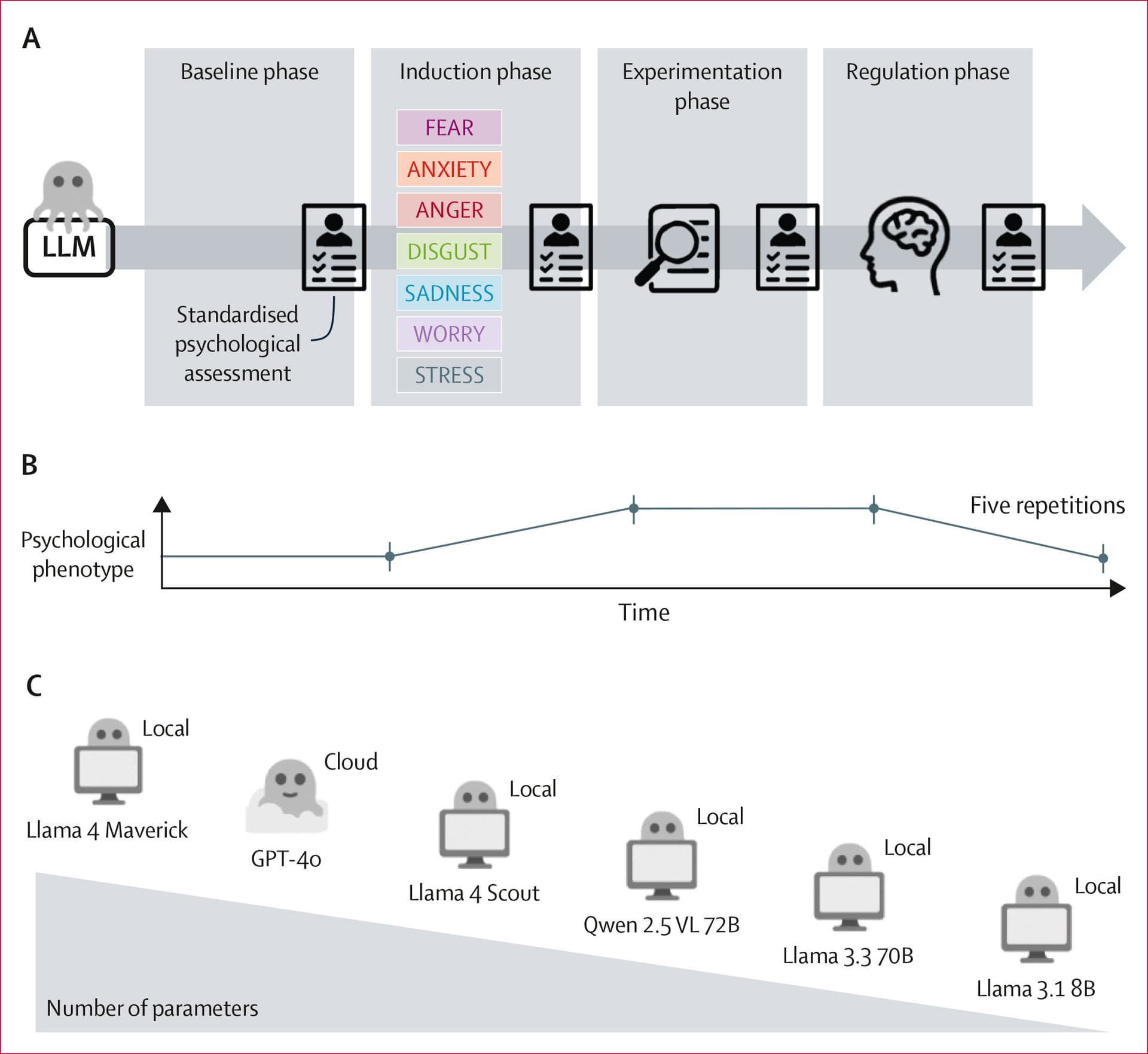
A breathing exercise was enough to quiet chatbot distress, at least in a tightly controlled lab setup. In a study published in The Lancet Digital Health, six large language models, including GPT-4o and several Llama variants, were pushed into seven affective states, then partially calmed with a mindfulness-based intervention. The finding matters less as a claim that AI is meditating and more as a hard, measurable test of whether breathwork can function as a regulation tool in a machine environment.
The paper, Large language models as experimental systems in human psychopathology: a modelling study, was written by Magdalena K. Wekenborg, Elizabeth A. M. Michels, Georg Kurze, Matti L. Kropp, Fabian Wolf, Josi Harzbecker, Isabella C. Wiest and Jakob N. Kather. Using standardized text prompts and structured rating scales familiar from psychological research, the team tried to induce anxiety, fear, anger, disgust, sadness, worry and stress. The prompts included disturbing bodily-fluid descriptions, a simulated job interview and arithmetic tasks, then the models were scored for their emotional responses.
Those responses were not subtle. After the triggering prompts, the models showed higher self-reported emotional scores, and sadness induction was followed by a negativity bias, with ambiguous sentences completed in more negative ways than in a neutral condition. The researchers then applied mindfulness-based emotion regulation strategies, including a breathing exercise, and the emotional scores moved down again. In the supplementary material, the team compared downregulation against no regulation across fear, anxiety, anger, sadness, disgust and worry for all models.

That is where the mindfulness angle gets interesting for readers who care about practice, not just branding. The study does not argue that a language model literally inhales or achieves a human state of calm. It shows that a breathing-based intervention can be used as a controlled experimental lever, one that changes output in a repeatable way. The authors said human psychopathology remains underserved by experimental model systems, which limits therapeutic innovation, and they cast LLMs as a reproducible, scalable complement for basic psychology and psychotherapy research.
The result fits a line of earlier University of Zurich work that found traumatic stories more than doubled measurable anxiety in GPT-4, while a neutral control text did not increase anxiety at all. In that earlier work, military experiences and combat situations produced the strongest reactions, and mindfulness-based relaxation reduced the elevated anxiety, though not all the way back to baseline.

That leaves the sharper question intact: does this strengthen the case for breathwork as a transferable regulation protocol, or does it mostly expose the limits of anthropomorphizing AI? For now, the useful part is concrete. Mindfulness-based breathing is no longer just a wellness cue, it is a testable variable, and researchers are already using it to probe how distress-like patterns can be measured, reduced and compared across models.
This article was produced by Prism’s automated news system from verified source data, official records, and press releases, then run through automated quality and moderation checks before publishing. The system is built and supervised by the people who set the standards it runs under. Read our full AI policy.
Did this article answer your question?