Mindfulness helps musicians silence monkey mind and ease stage anxiety
Stage panic is often an attention problem, not a talent problem; mindfulness helps performers stay with the music instead of the worry.

Musicians know the feeling: the piece is technically there, the hands are ready, but the mind starts freelancing. Matthew T. Giobbi’s June 9, 2026 essay cuts straight to that friction point, arguing that stage trouble often comes from monkey mind, not from a lack of skill. His core claim is simple and useful: if you want calmer, cleaner performances, you have to practice performing, not just practicing.
When rehearsal mode becomes stage panic
Giobbi’s point lands because it describes a trap almost every serious performer has hit. In rehearsal, monitoring every detail helps you learn the notes, polish phrasing, and catch mistakes before they harden into habit. Onstage, that same self-monitoring can turn into a running commentary about what might go wrong, and that internal chatter steals attention from timing, commitment, and expression.
He frames that shift as more than nerves. The restless mind is threat-seeking by nature, and anxiety grows when a performer tries to control the future instead of meeting the present task. That is why the same player who sounds composed in the practice room can suddenly feel mentally crowded under lights, with attention split between the score, the body, and a stream of critical thoughts.
What the research says about music performance anxiety
Giobbi’s argument sits on a research base that has been building for decades. A 2003 study of 19 students from the Manhattan School of Music, Mannes College of Music, Yale University School of Music, and the State University of New York at Purchase found that an eight-week meditation course reduced music performance anxiety compared with a no-meditation control group. That same line of research also cited a survey in which 66% of musicians and college music students reported performance anxiety.
The newer evidence pushes in the same direction. A 2022 preliminary investigation in *Revue musicale OICRM* found that a two-week mindfulness intervention significantly improved state anxiety in young adult musicians. A 2025 *Frontiers* study on music students and professional musicians reported that a brief mindfulness course could enhance wellbeing, boost emotional balance, and reduce music performance anxiety.
The strongest support yet came in a June 11, 2026 *Frontiers* meta-analysis that pulled together 32 independent studies with 1,983 participants, including 26 studies in the quantitative analysis. It found a moderate-to-large reduction in music-performance-related anxiety outcomes, with Hedges’ g at 0.732, and a small-to-moderate improvement in positive psychological functioning, with g at 0.350. The same analysis described the mechanism in familiar mindfulness terms: decentering and attentional reallocation.
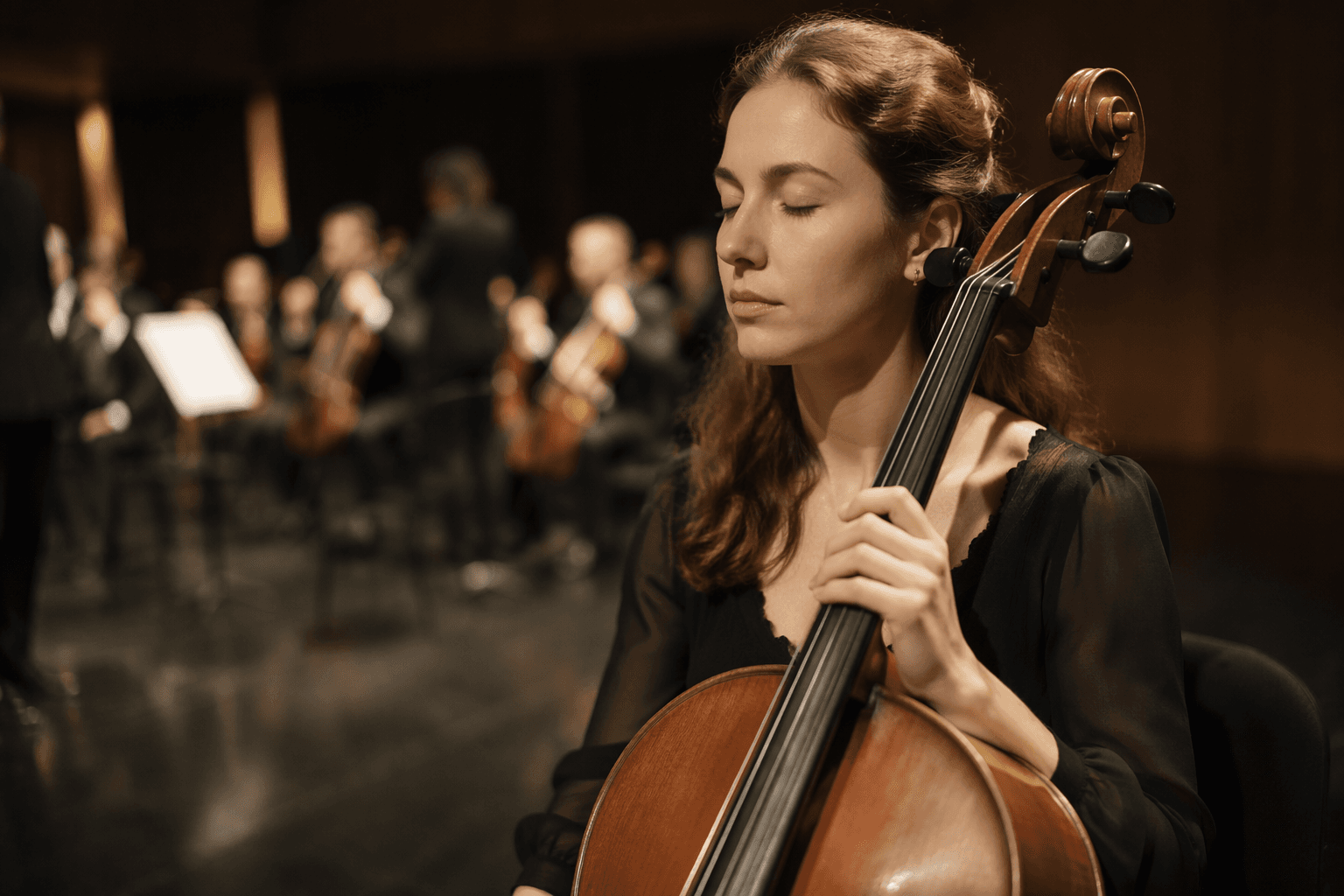
The practical move: train for the performance, not just the practice room
That mechanism matters because it matches what Giobbi is actually recommending. Mindfulness, in this setting, is not about floating above the work or emptying the mind. It is about staying with the task in front of you and noticing when attention has drifted into self-critique, future-tripping, or audience fear.
For musicians, that means rehearsing the mental conditions of performance, not only the notes. Play the piece all the way through with full attention on the music in the present moment, and resist the habit of stopping every time the inner critic starts making noise. The point is not to ignore technique, but to keep technique from swallowing the whole performance.
- Rehearsal mode asks, “What needs fixing?”
- Performance mode asks, “What is the music asking right now?”
- Mindfulness trains the switch between the two instead of letting them blur together.
A useful way to think about it:
That distinction is where a lot of anxious performers get stuck. They bring the laboratory into the concert hall, then wonder why the stage feels hostile. Giobbi’s answer is that the stage asks for commitment, not endless inspection.
Why audience fear and self-judgment feed the loop
One reason this works so well as a mindfulness problem is that audience evaluation sits at the center of performance anxiety. The earlier research cited in the 2003 study identified fear of audience evaluation as an important part of musical performance anxiety, and that tracks with what many players experience when the room goes quiet. The mind does not just worry about a wrong note; it imagines what that wrong note will mean.

Mindfulness interrupts that spiral by creating distance between the thought and the reaction. Instead of treating every spike of fear as a signal to tighten up, the performer notices the thought, lets it pass, and returns to the score, the breath, the gesture, or the phrase. That is the shift from reaction to volition Giobbi is getting at.
Why Giobbi’s voice carries weight here
Giobbi is not writing from the sidelines. He has taught at Rutgers University in Newark since 2004, with a focus on performance anxiety, and he contributes to Psychology Today through his Mindfulness & Music blog. That background matters because his case is built from both the musician’s bench and the psychologist’s lens.
He also helps pull mindfulness out of the wellness aisle and back into training culture. In his framing, this is not a soft add-on for people who are already struggling. It is a performance skill, one that can be trained alongside articulation, memory, ensemble awareness, and stagecraft.
The takeaway for performers under pressure
If you sing, play, speak, compete, or work in any high-stakes setting, the lesson is the same: your bottleneck may not be technical ability. It may be the restless mind that keeps yanking attention away from the task and toward the imagined disaster ahead. Mindfulness does its best work there, where automatic panic starts to take over and deliberate action still has a chance to step in.
The cleanest test is also the simplest one. The next time you run your piece, your talk, or your set, do it all the way through without negotiating with the inner critic on every bar or sentence. That single shift, from monitoring yourself to staying with the work, is where monkey mind starts to lose its grip.
This article was produced by Prism’s automated news system from verified source data, official records, and press releases, then run through automated quality and moderation checks before publishing. The system is built and supervised by the people who set the standards it runs under. Read our full AI policy.
Did this article answer your question?


