Mindfulness helps students manage anxiety, focus, and academic stress
Mindfulness works best for students when it is short, specific, and tied to exams, focus breaks, and burnout recovery. The payoff is real, but it is a support tool, not a cure-all.
Why student mindfulness keeps getting reshaped
Mindfulness gets a better reception on campus when it stops pretending students have spare time. The practices that travel well in student life are the ones that fit between classes, before an exam, or after a rough night, when attention is fried and stress is already leaking into grades. That matters because the fall 2024 National College Health Assessment found 30% of students said anxiety negatively affected their academics, and more than 75% reported getting less than 8 hours of sleep on weeknights over the prior two weeks.
That is the pressure point student mindfulness has been built around. It is not sold as a magic reset button. It is a small intervention that helps students notice stress earlier, interrupt spiraling thoughts, and respond with a little more intention before the crash gets worse.
What works when the test is tomorrow
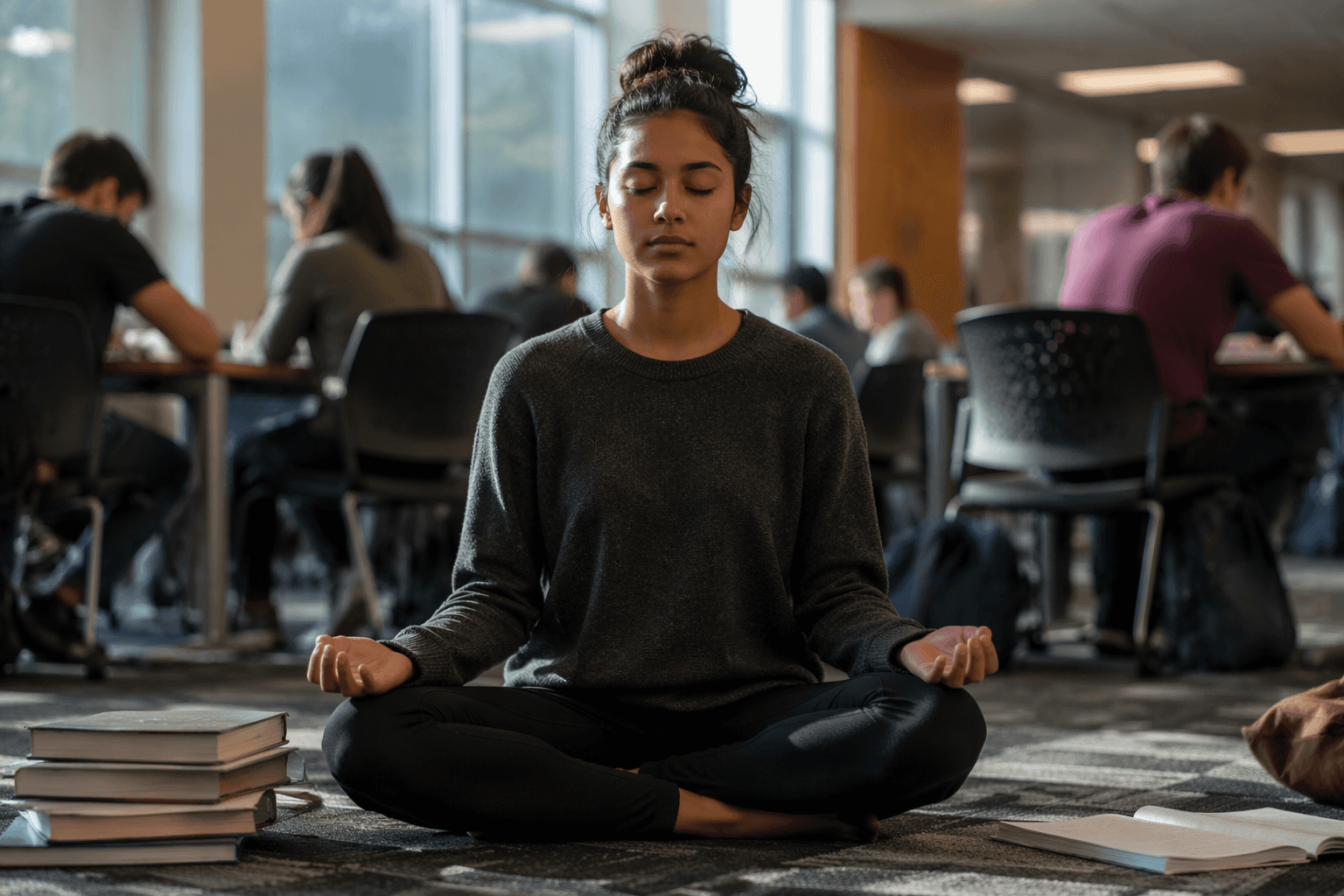
The most useful campus mindfulness tools are not long sits on a cushion. They are brief, low-friction exercises that can happen in the minutes before an exam, in the hallway outside a lecture hall, or while a student is staring at a blank study guide and feeling their pulse jump.
Northwestern University’s test-anxiety resource is a good example of how this has been adapted for real academic life. Its approach centers on brief mindfulness and writing exercises before exams, with the simple logic that getting worries onto paper can loosen their grip. Northwestern says the “write it out” practice has been shown to increase test performance by at least 5 points.
That kind of intervention works because it matches the moment. Students with exam anxiety usually do not need a grand philosophy of calm. They need something they can do in two to five minutes that interrupts the loop of catastrophic thinking long enough to read the question in front of them.
A practical pre-exam reset
The student-friendly version of mindfulness usually looks like this:
- slow, focused breathing for a minute or two
- noticing physical sensations, like tight shoulders or a clenched jaw
- a brief guided practice that anchors attention before the test starts
- writing down the worry instead of carrying it into the exam room
Those tools are portable, discreet, and repeatable. That is the whole point. A practice that requires a quiet hour and a perfect mood is not a student practice. A practice that can survive a crowded library and a bad sleep night is.
Attention fatigue is the hidden problem
A lot of student stress is not dramatic. It is cumulative. Classes, group projects, part-time work, doomscrolling, late-night studying, and constant context-switching leave attention fragmented long before finals arrive. That is where mindfulness can be useful even when a student does not feel especially “anxious” in the usual sense.
Short grounding exercises create a pause between stimulus and reaction. For students, that pause can be the difference between rereading the same paragraph five times and actually absorbing it. The stronger student-focused programs are built around that reality, treating mindfulness less like wellness branding and more like a way to train attention under load.
A 2023 systematic review found that mindfulness programs improve college students’ well-being, with the strongest evidence for reducing anxiety and depressive symptoms. A 2024 study went further, reporting that anxiety decreased significantly in both a mindfulness-exercise group and a mindfulness-specific group, and that the improvement held in the short term after the intervention ended. That is the kind of result campus programs keep chasing: not perfection, but a measurable drop in the mental static that makes school harder to do.
Burnout recovery needs something smaller than a full reset
Mindfulness is also showing up as a recovery tool, not just a performance aid. Students recovering from a brutal exam stretch, a housing mess, or the general grind of college life often do better with practices that acknowledge exhaustion instead of fighting it.
University of Rochester’s Mindful University Project makes that case plainly, describing mindfulness as a way to improve sleep quality, reduce emotional distress, and reduce burnout. That framing matters because burnout recovery is not the same as exam prep. One is about getting through a test. The other is about rebuilding enough mental room to function again the next day.
That is also why campus leaders keep reworking the format. A longer meditation session may be ideal in theory, but the student who has been awake until 2 a.m. is more likely to use a three-minute breathing reset than a 30-minute guided sit. The best student programming leans into that constraint instead of pretending it does not exist.
Why campuses are building mindfulness into support systems
Some of the most credible campus work treats mindfulness as one piece of a broader mental-health setup, not a standalone fix. University of Washington researchers have been explicit about that. Their campus mindfulness program, including work in dorms and groups, is not a substitute for mental health services. Its purpose is to reduce general distress and possibly prevent students from needing more intensive care later.
That distinction is important. If mindfulness is oversold, students tune it out fast, especially when their stress is rooted in sleep loss, academic pressure, or deeper mental-health needs. But when it is framed as a practical layer of support, it becomes easier to use and easier to trust.
Duke University shows how embedded this has become. Its Student Wellness Center has run Koru Mindfulness, a four-week program developed at Duke. That kind of offering signals something bigger than a passing trend: mindfulness has been folded into the campus support stack, alongside counseling referrals, wellness resources, and student-health programming.
The stakes explain the persistence
Mindfulness keeps getting adapted for students because the underlying problem is not going away. The Centers for Disease Control and Prevention says suicide is one of the leading causes of death in the United States, and the National Institute of Mental Health reports that the past-year prevalence of suicide attempt is highest among adults ages 18 to 25 at 2.0%. That does not make mindfulness an emergency intervention, and it should never be treated that way. It does explain why colleges keep looking for low-barrier supports that can reach students earlier, before pressure turns into a deeper crisis.
For that reason, the strongest student mindfulness programs are practical, modest, and specific. They do not promise to erase anxiety. They help students catch it sooner, steady attention for a few minutes, and recover faster after the day goes sideways.
That is the real value here: not a perfect state of calm, but a small, repeatable way to get through the exam block, the study marathon, or the post-burnout fog with a little more control than you had a minute before.
This article was produced by Prism’s automated news system from verified source data, official records, and press releases, then run through automated quality and moderation checks before publishing. The system is built and supervised by the people who set the standards it runs under. Read our full AI policy.
Know something we missed? Have a correction or additional information?
Submit a Tip