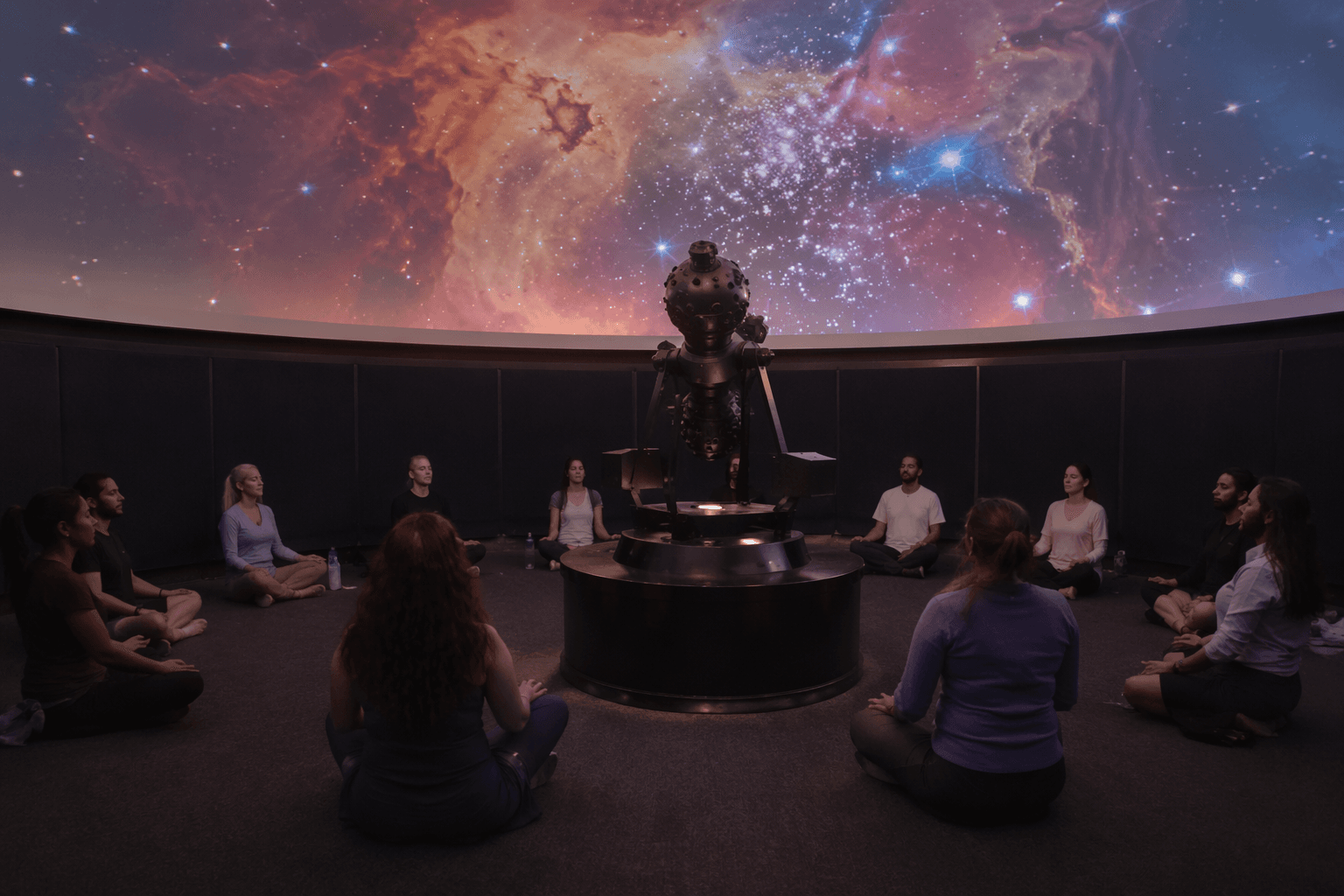
Mindfulness meditation may synchronize brain activity between practiced partners
Mindfulness may do more than steady one mind: in hyperscanning studies, practiced partners sometimes show measurable brain-to-brain synchrony, especially when breath and goals line up.
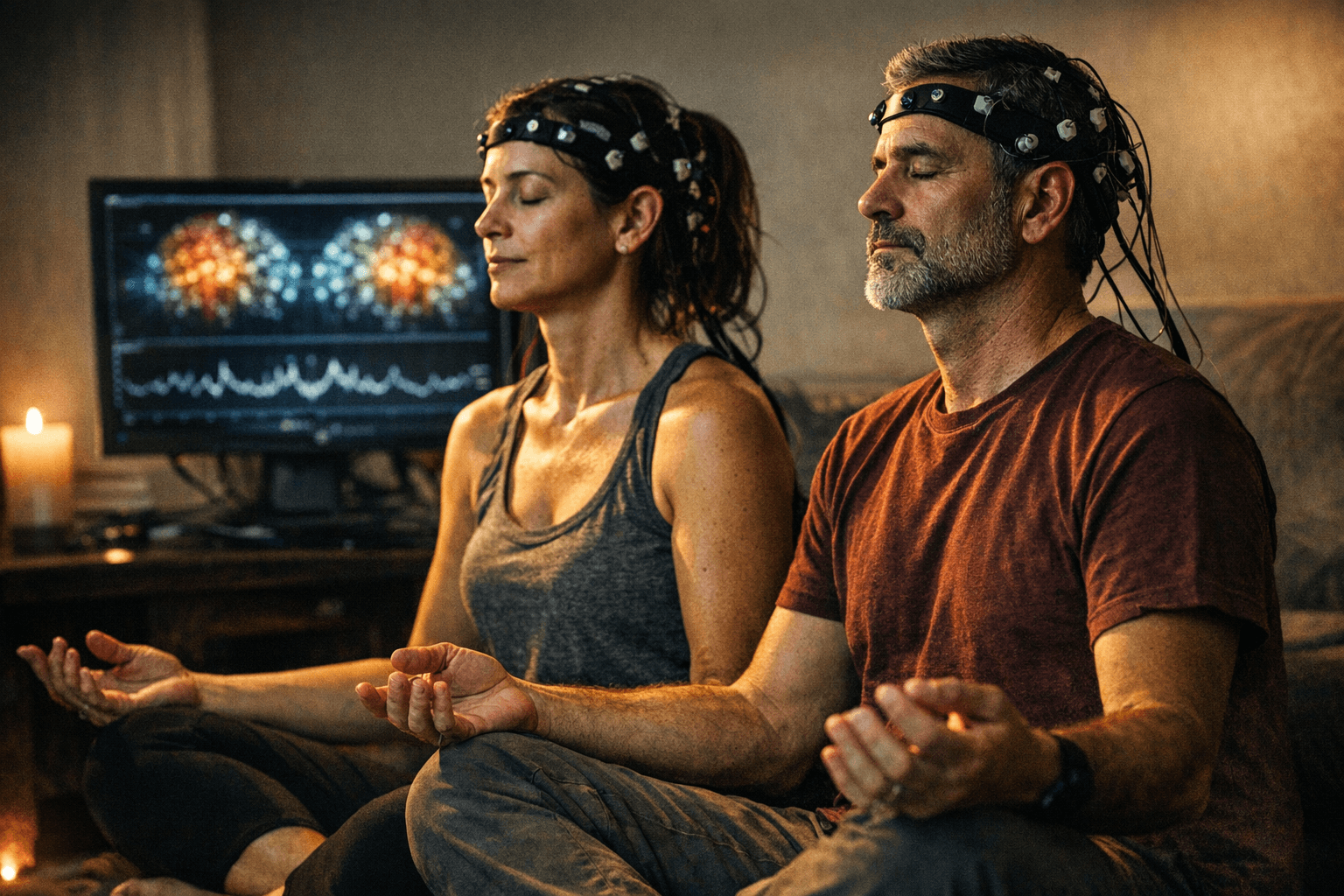
The new question in mindfulness science is not just what happens inside one brain, but between them. A mini-review in Frontiers in Cognition, by Lorne Schussel, Francesco Bubbico, Kazuyori Yagyu, Luisa Bernardinelli, Xinmei Deng, Mingping Lin, Xiaoling Li, and Yong Zhan, pulls mindfulness and meditation into the world of hyperscanning, the method that records neural activity from multiple people at once. Published on April 13, 2026, after being received on October 7, 2025, revised on March 10, 2026, and accepted on March 12, 2026, the paper treats social synchrony as a measurable part of contemplative practice, not just a poetic metaphor.
What hyperscanning is actually measuring Hyperscanning lets researchers watch two or more brains during the same task, so it can track whether activity lines up across people during cooperation, shared attention, or emotional exchange. That matters because traditional neuroimaging usually captures only one brain at a time, which makes it hard to study the back-and-forth of real interaction. A 2024 Frontiers review framed hyperscanning as a response to that limit, and this new mindfulness review uses the same logic: if meditation is sometimes practiced in pairs or groups, the social layer may be part of the signal.
The review itself is a narrative mini-review, but its study identification and screening were informed by PRISMA, the reporting standard better known from systematic reviews. Out of seven studies that met the authors’ criteria, five reported interbrain synchronization across meditation or mindfulness contexts. That is the central surprise here: the effect was not universal, but it was common enough across different protocols and frequency bands to suggest a real pattern.
Where the synchrony showed up The clearest theme was that mindfulness seemed to tune coordination most strongly when the task already required people to align with each other. In some studies, mindfulness induction was followed by anterior theta phase synchrony during cooperation tasks. In others, shared breathing and physical mirroring during motor coordination tasks produced alpha, theta, and delta coherence in frontal brain regions. Gamma synchrony also increased in socio-emotional paradigms and among expert meditators practicing together.
That mix of bands matters. Lower-frequency coupling appeared stronger when breath focus was paired with a shared goal, which hints that the most visible neural alignment may emerge when attention, respiration, and social intention are all pulling in the same direction. The paper does not flatten all of this into a single claim that “mindfulness makes people social.” Instead, it treats interbrain synchrony as something more specific, a relational process with measurable neural signatures.
Why some pairs sync and others do not One of the most useful parts of the review is its caution. Interbrain synchrony varied with expertise, task heterogeneity, and personality traits such as agreeableness, which means the effect is shaped by who is practicing, how long they have practiced, and what they are doing together. A seasoned meditator pair in a structured shared-attention exercise is not the same thing as two novices trying a guided session for the first time.
That nuance changes the way group meditation looks on the page and in the room. Teacher-led sessions may do more than deliver instructions one by one, because a shared rhythm of breath, attention, and timing could be part of what the brain is registering. The review does not say that every class should be redesigned around neural synchrony, but it does suggest that communal practice may be a distinct contemplative state, not just a collection of private experiences happening side by side.
The earlier studies that made this claim possible The mini-review builds on a small but pointed hyperscanning literature. In one EEG hyperscanning study of 41 dyads, mindfulness was associated with theta inter-brain synchrony during cooperative feedback processing. The authors reported that mindfulness appeared to improve empathy and understanding in relationships, qualities that are necessary for successful cooperation.
Another study, published in Cerebral Cortex, looked at 30 adolescent dyads randomly assigned to a mindfulness or non-mindfulness condition. After a 20-minute mindfulness exercise, the mindfulness group showed greater frontal interbrain synchrony in the gamma band when viewing different emotional stimuli together, while the control group did not. That makes the practice angle especially vivid: even a short session, when followed by a shared emotional task, can be linked to measurable coupling between partners.
The review also places these findings beside a landmark PNAS paper showing that long-term Buddhist practitioners could self-induce sustained high-amplitude gamma-band oscillations and phase synchrony during meditation. That earlier work never claimed social synchrony on its own, but it helped establish that highly trained meditators can generate unusually strong gamma activity. Seen together, the older meditation neuroscience and the newer hyperscanning work suggest that the brain’s capacity for rhythm during practice may extend outward when practice becomes shared.
What this means for the way mindfulness is practiced For practitioners, the most interesting takeaway is not that meditating with someone else magically makes the session better. It is that breath-based and shared-attention practices may have a relational dimension that can be studied, trained, and perhaps deepened. If the task involves cooperation, mirrored movement, or a common emotional frame, the brain signals may align more readily than they do in solitary practice.
For community leaders, retreat teachers, and dyads who already meditate together, the review offers a concrete reason to pay attention to structure. Shared breathing, synchronized timing, and a clear collective aim may matter more than many people assume. That is a useful shift in contemplative science: mindfulness begins to look less like a sealed inner practice and more like a coordinated human one.
The bigger story is still unfolding, but the direction is clear. The next frontier in mindfulness research may be less about whether meditation is calming and more about how practiced minds entrain one another, one breath, one task, and one shared moment at a time.
This article was produced by Prism’s automated news system from verified source data, official records, and press releases, then run through automated quality and moderation checks before publishing. The system is built and supervised by the people who set the standards it runs under. Read our full AI policy.
Did this article answer your question?