Mindfulness program lowers stress and anxiety in Indian college students
An eight-week MBSR course cut stress, depression, and anxiety in Indian college students, pointing campuses toward a repeatable exam-season support model.
A structured response to campus pressure
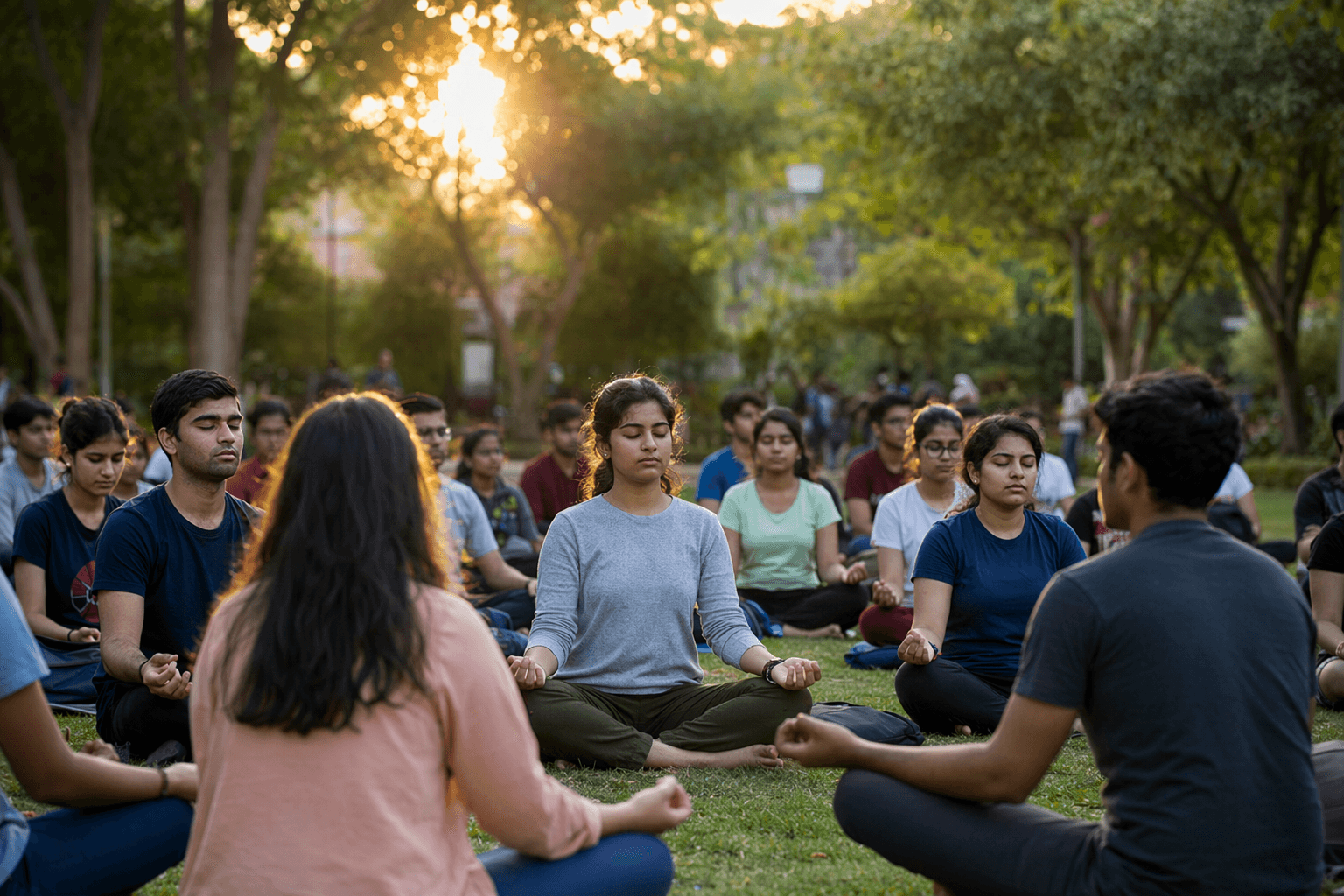
College stress is where this mindfulness story gets real. In an eight-week Mindfulness-Based Stress Reduction program, Indian students showed lower stress, depression, and anxiety, along with higher mindfulness and better mental well-being than controls, turning meditation from a loose wellness idea into a measurable campus tool.
That matters because the study was built for pressure, not calm. The researchers used a randomized controlled design and tested students before and after the intervention, looking at mindfulness, perceived stress, psychological distress, and overall well-being. The paper, a quantitative study by Vikas Kumar Sharma and Monika Abrol, was published in The International Journal of Indian Psychology, volume 14, issue 2, and spans pages 1053 to 1069.
What the eight-week program actually changed
The clearest signal in the findings is not abstract serenity, but academic functioning under strain. Students in the mindfulness arm reported less stress and fewer symptoms of depression and anxiety, while also scoring higher on mindfulness and mental well-being than the comparison group. In a setting shaped by deadlines, exams, and performance pressure, that is the kind of outcome campus leaders can actually work with.
The intervention itself was not improvised. Mindfulness-based stress reduction teaches mindful meditation and pairs it with discussion sessions and other strategies for applying the practice to stressful experiences, according to the National Center for Complementary and Integrative Health. That structure is part of why the study reads less like a wellness slogan and more like a repeatable support program.
Why the format matters, not just the idea
MBSR has a long institutional history, and that history is part of the point. UMass Memorial Health says the original eight-week program was created by Jon Kabat-Zinn in 1979 at UMass Memorial Medical Center. This Indian college study is not testing a new trend; it is extending an established curriculum into a campus setting where the pressure is immediate and visible.
That matters for student services because structured programs are easier to evaluate than loose advice. A campus can know who enrolled, how long the curriculum lasted, what was taught, and what changed afterward. That makes MBSR easier to scale than one-off mindfulness talks, and easier to build into a counseling center calendar, a wellness office plan, or a faculty-backed student support effort.
Who this seems most useful for
The study points most strongly to students who are carrying academic strain but may not walk into formal mental health care on their own. The notes frame the program as a low-cost, nonpharmacological option for students who still need help managing distress and staying functional during exams, deadlines, and other performance pressure.
That is a particularly important fit in India’s competitive higher-education environment, where the article explicitly places the intervention. The setting is not incidental. It is the point: a mindfulness curriculum only becomes persuasive when it is tested in the same pressure cooker where students actually live.
The evidence beyond one campus
The new study also lines up with a broader university-student evidence base. A 2024 systematic review and meta-analysis of 29 randomized controlled trials found that MBSR significantly reduced anxiety, depression, and perceived stress, while improving mindfulness and self-kindness in university students. That pattern supports the direction of the Indian findings and suggests the benefits are not isolated to one institution or one cohort.
At the same time, the safety picture stays honest. NCCIH says meditation and mindfulness practices are usually considered to have few risks, but negative experiences can happen, and more evidence is needed on safety. In its summary of a 2020 review, about 8% of meditation participants reported a negative effect, most commonly anxiety or depression. For campuses, that means mindfulness should be offered as a monitored, supportive option, not as a one-size-fits-all substitute for mental health care.
Why campuses are paying attention now
The study lands in a broader system that is already tracking student strain. The American College Health Association says the National College Health Assessment helps campuses monitor health and wellness issues that affect academic performance. In its fall 2024 reference group, 30% of students said anxiety negatively affected their academics, and more than 75% said they were getting less than eight hours of sleep on weeknights.
Healthy Minds Study data push in the same direction. The network says campuses use its findings to identify needs, benchmark against peers, evaluate programs and policies, plan services, and advocate for resources. In other words, administrators are already looking for interventions that can be measured, compared, and repeated, which makes an eight-week MBSR curriculum a natural fit.
The policy climate in India has moved too. On March 24, 2025, the Supreme Court of India emphasized the urgent need to address student mental health in higher education and constituted a National Task Force on Student Mental Health and Suicide Prevention in Higher Educational Institutions. That gives the campus-stress problem a sharper institutional edge and makes evidence-based support harder to ignore.
What a repeatable campus offer looks like
For colleges, the practical lesson is not simply to “offer mindfulness.” It is to offer it as a defined intervention with a start, an end, and outcomes that can be tracked. A campus wellness office could treat MBSR the way it treats any other student support pilot: recruit a cohort before exams, run the full eight-week sequence, and measure stress and well-being before and after.
- use the original eight-week MBSR structure
- offer it during known stress peaks, especially exam periods
- pair meditation practice with discussion and stress-application strategies
- track student outcomes the way campuses already track academic wellness indicators
- keep it accessible for students who need support but do not seek formal care
The strongest version of this model is simple and concrete:
That is the real value of this study. It shows mindfulness working not as a vague reset button, but as a campus response built for pressure, measured against pressure, and ready to be repeated when the semester gets hardest.
Know something we missed? Have a correction or additional information?
Submit a Tip