Mindfulness study maps workplace research trends, themes and influence
Mindfulness at work is far more talked about than studied. A new map shows the evidence clusters around company pilots, short programs and stress outcomes, not miracle claims.
What the workplace mindfulness map really shows
Mindfulness is everywhere in workplace wellness pitches, but the research base is narrower than the sales language. The clearest story in this new map is not that every office practice works the same way, but that the field has repeatedly circled a few familiar formats: company-based trainings, short programs, app-supported practice, manager-facing interventions, and outcome studies built around burnout and wellbeing.

That matters for anyone deciding whether a lunch-break session, a meditation app, or a full corporate program is actually worth the time. The evidence is not spread evenly across every possible version of workplace mindfulness. It is concentrated in settings where researchers can measure something concrete, compare groups, and see whether the practice changes stress, mood, or climate at work.
What the study mapped, and why that matters
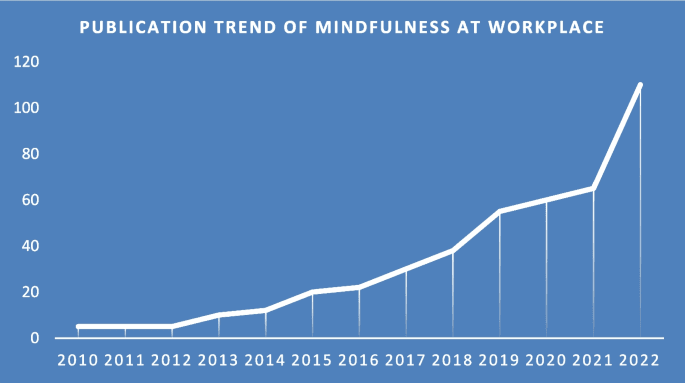
The article, published in the journal *Mindfulness*, examined 449 documents from 2010 to 2023 drawn from Scopus. Instead of testing a new program, the authors used bibliometric methods, including thematic clustering, performance analysis, keyword co-occurrence, co-citation analysis, and thematic mapping with VOSviewer, to trace how the workplace mindfulness field has developed over time.
That approach is useful because it shows the intellectual shape of the topic. It highlights which themes have been most durable, which authors and institutions have been most influential, and where the conversation has been most active. In plain terms, it tells you whether workplace mindfulness has grown into a broad evidence base or stayed concentrated around a few recurring concerns. The answer leans toward the latter: stress reduction, wellbeing, burnout, and performance continue to dominate the conversation.
The workplace formats researchers keep returning to
Short corporate courses and lunch-break sessions
One of the most common setups in workplace mindfulness research is the brief, company-based training. These are the programs most likely to resemble the kind of lunch-break session an employee can actually fit into a normal workday. They are appealing because they are low-friction, easy to pilot, and simple for employers to frame as a wellness benefit.
The catch is that short sessions are usually studied as part of a broader intervention package, not as a standalone miracle. The strongest evidence around workplace mindfulness has been tied to outcomes such as emotional exhaustion, stress, psychological distress, depression, anxiety, and occupational stress. That is a useful payoff if you are trying to get through a demanding quarter, but it is not the same as proving that a 30-minute class will transform an entire office culture.
App-based and hybrid programs
More recent workplace studies have also tested apps and hybrid formats, which makes sense in a world where many employees want practice they can repeat on their own schedule. These formats fit the everyday reality of modern work: fragmented calendars, remote or hybrid teams, and pressure to do more with less time.
For an ordinary employee, this is the most accessible entry point. An app can make mindfulness feel manageable, especially if you are trying it for the first time or want a way to practice between meetings. But the research conversation still tends to ask whether these tools reduce strain and improve wellbeing, not whether they can stand in for deeper organizational change. If the program is sold as a productivity engine, the evidence is less settled than the marketing.
Manager training and leadership rollouts
Another recurring workplace format is manager-focused training. That lines up with the broader mental-health-at-work push from the World Health Organization and the International Labour Organization, which called for concrete action in September 2022, including training managers to prevent stressful environments and respond to workers in distress.
This is one of the most practical places for mindfulness to land, because managers shape pace, expectations, and team climate. A workplace can offer meditation to every employee, but if the reporting lines are chaotic and the deadlines are brutal, the individual practice gets asked to do too much. The research map suggests that leadership-facing programs matter because they connect mindfulness to the conditions that either support or block healthier work.
Company field studies with measured outcomes
A good example of how the field has been built is a 2018 workplace mindfulness study in four companies. That intervention was examined through burnout, psychological well-being, organizational and team climate, and performance. Those are exactly the kinds of practical measures employers care about, and they show how the field has tried to keep one foot in real-world workplaces rather than in abstract wellness language.
This kind of study is also the closest thing to an ordinary employee reality check. If a workplace mindfulness program cannot say what it is trying to change, whether that is burnout, focus, team tension, or general distress, it is probably too vague. The best-studied workplace interventions are specific enough to name the outcome they are after.
Why the topic has moved from fringe to mainstream
The larger public-health context helps explain why workplace mindfulness has kept spreading. The World Health Organization says depression and anxiety cost about 12 billion workdays each year and roughly US$1 trillion in lost productivity. Its 2022 guidance estimates that 15% of working-age adults have a mental disorder at any point in time.
Mindfulness is not a cure for that scale of problem, but it is part of the response toolkit because employers are under pressure to do something concrete. In the United States, CDC researchers found that yoga participation rose from 6.0% in 2002 to 11.0% in 2012, while meditation rose from 8.0% in 2002 to 9.9% in 2007. That suggests these practices were already moving into the mainstream before workplace wellness teams began packaging them as a standard benefit.
What the evidence says about who may benefit most
A 2020 meta-analysis of workplace mindfulness-based programs pulled together 56 studies with 2,689 participants and 2,472 controls. That kind of synthesis matters because it shows the field has moved beyond isolated pilots toward a more testable evidence base. Still, the pattern is not equally strong across every outcome.
The clearest benefits continue to show up around emotional strain and wellbeing. Productivity is a more difficult claim, and the literature has been careful about that. A 2017 CDC study added another useful clue: worker groups with low rates of mindfulness practice could benefit most from workplace mindfulness interventions. That is a practical signal for employers, because it suggests the biggest gains may come from people who have the least exposure to these tools, not from treating every employee as if they need the same dose.
The bottom line for employees and employers
The real takeaway from this research map is simple: workplace mindfulness is best understood as a structured, repeatable tool for stress-related outcomes, not as a universal fix. If you are choosing between a lunch-break session, an app, or a company program, look for the one that is specific about what it is trying to change, how often it meets, and whether managers are part of the picture. That is where the evidence is thickest, and where the gap between promise and proof is narrowest.
This article was produced by Prism’s automated news system from verified source data, official records, and press releases, then run through automated quality and moderation checks before publishing. The system is built and supervised by the people who set the standards it runs under. Read our full AI policy.
Did this article answer your question?