One Week of Intensive Meditation Reshapes Brain Networks and Blood Biology
UC San Diego found 7 days of intensive meditation reshaped brain networks and caused post-retreat blood plasma to grow new neuron branches in a lab dish.
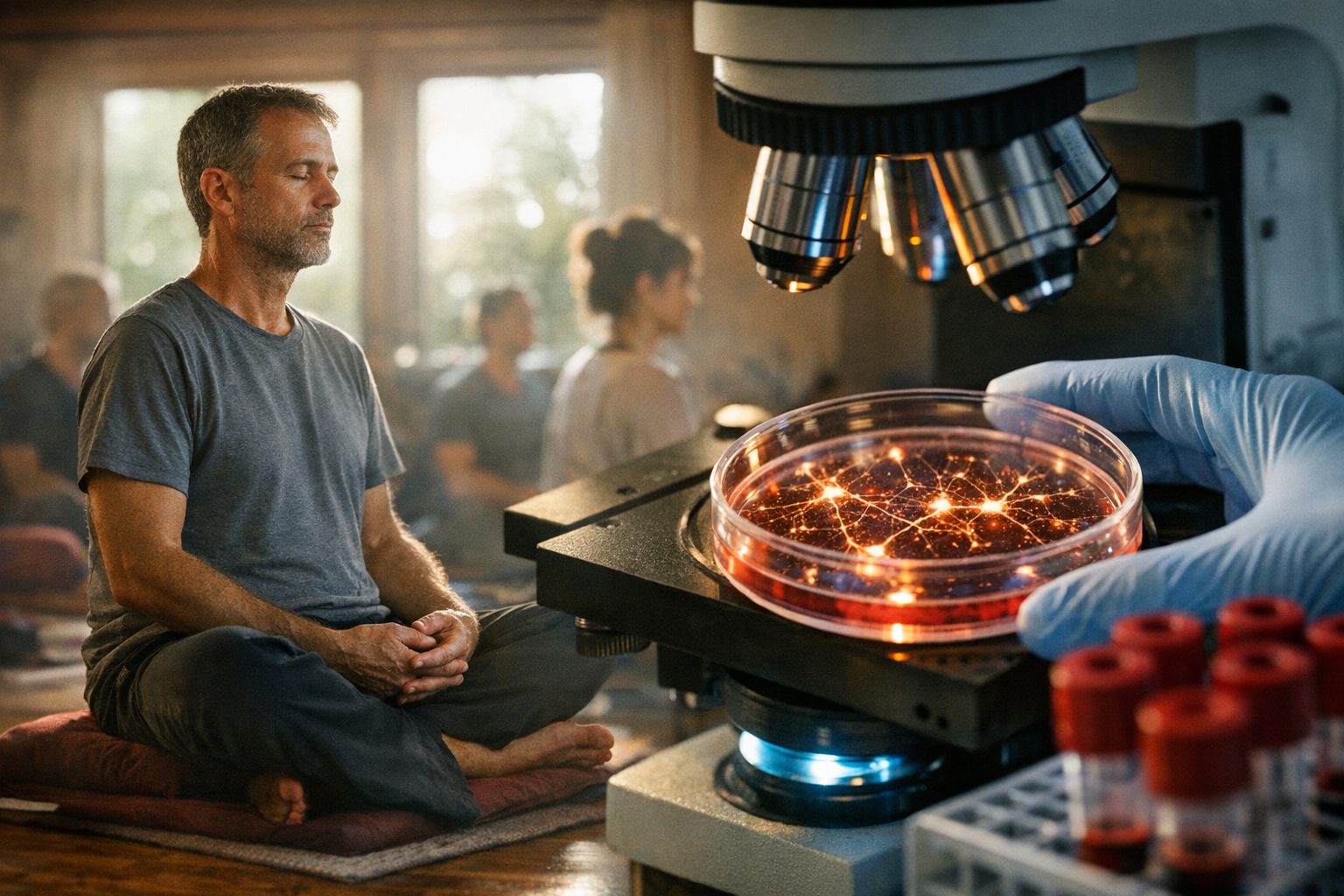
When University of California San Diego researchers drew blood from 20 healthy adults at the end of a seven-day meditation retreat and applied the plasma to neurons growing in a lab dish, the cells sprouted longer branches and formed new connections. That single downstream finding, published in Communications Biology, captures why this study is hard to set aside even amid legitimate caveats about its size.
The 20 participants attended a residential program led by neuroscience educator and author Joe Dispenza, D.C., logging approximately 33 hours of guided meditation over the seven days alongside daily lecture sessions and group healing practices. Before and after the retreat, each participant underwent functional MRI scans and blood draws designed to capture immune, metabolic, and molecular activity. The work was funded by the InnerScience Research Fund and a Veterans Administration Research Career Scientist Award.
The fMRI data showed the default mode network, the brain's self-referential mental chatter hub, quieted substantially during meditation, which researchers interpreted as increased neural efficiency. The blood results tracked changes across four interconnected systems: neuroplasticity signaling, metabolic regulation, immune function, and endogenous pain modulation. The UC San Diego team also noted that the post-retreat brain network patterns bore a structural resemblance to signatures documented in psychedelic research. The researchers were careful to frame this as mechanistically interesting rather than pharmacologically equivalent; the argument was that behavioral practice, at sufficient intensity and volume, may recruit some of the same neural pathways that compounds like psilocybin or ketamine engage through chemistry.
"We've known for years that practices like meditation can influence health, but what's striking is that combining multiple mind-body practices into a single retreat produced changes across so many biological systems that we could measure directly in the brain and blood," said senior study author Hemal H. Patel, Ph.D., professor of anesthesiology at UC San Diego School of Medicine and research career scientist at the Veterans Affairs San Diego Healthcare System. "This isn't about just stress relief or relaxation; this is about fundamentally changing how the brain engages with reality and quantifying these changes biologically."
The caveats are real. Twenty participants is a small pilot cohort, even accounting for the fact they were drawn from 561 volunteers, and the effect sizes and mechanisms need replication at scale. More pointedly, co-author Joe Dispenza is employed by Encephalon Inc., the company that offers the retreat program studied. The researchers disclosed this, and remaining authors declared no competing interests, but it is information that belongs in any honest read of the findings. A residential retreat also stacks multiple variables simultaneously: sleep consistency, reduced screen time, group social support, sustained silence between sessions, structured movement, and sheer meditation volume. The study cannot yet tell you which of those inputs is responsible for what.
That dosage question is the most actionable detail for anyone considering an at-home reset week. Thirty-three hours of meditation across seven days averages to roughly 4.5 to 5 hours of formal sitting daily, a volume categorically different from a standard 10- to 20-minute morning practice. The biological signals measured here were tied to immersive exposure, not maintenance doses. The elements most structurally accessible outside a residential program are the ones easiest to undervalue: sleep-protected extended sitting blocks, deliberate reduction of ambient digital input between sessions, and rigid daily scheduling rather than opportunistic practice. The group healing component is harder to replicate solo, but the silence and sleep architecture are not.
UC San Diego researchers called for larger controlled trials to determine whether effects replicate across diverse populations and whether specific retreat components can be isolated. The n=20 signal is worth tracking closely.
This article was produced by Prism’s automated news system from verified source data, official records, and press releases, then run through automated quality and moderation checks before publishing. The system is built and supervised by the people who set the standards it runs under. Read our full AI policy.
Did this article answer your question?