Tea becomes a mindfulness practice in China, Japan and India
Tea can be a real mindfulness tool, not a branding cliché, when you use its built-in slowness to train attention cup by cup.
Tea has a better claim on mindfulness than a lot of the language sold around mindfulness. In China, Japan and India, it has long sat at the intersection of contemplation, self-discipline and human communion, which is exactly why a daily cup can work as a usable meditation habit instead of a vague wellness gesture. The trick is to treat the ritual as attention training, not as a prettier label for drinking.
Tea as practice, not decoration
The strongest tea traditions do not ask you to escape ordinary life. They ask you to enter it more carefully. In Japanese chanoyu, the tea ceremony is rooted in Zen Buddhism and built around an established order for welcoming guests, with every gesture slowed down and made deliberate. Sen no Rikyū, who lived from 1522 to 1591, redefined the ritual and helped make wabi-cha, with its rustic simplicity, the standard in the Momoyama period.
That matters for mindfulness readers because it shows the logic of the practice. Tea is not only a beverage here. It is a repeated sequence of posture, pacing, touch and attention, the kind of structure that can hold a wandering mind without forcing it into a formal seated cushion session.
Why tea can calm the nervous system without turning into a ritual costume
The article’s practical value is that it does not mystify tea. It treats tea as an experiential practice in which body, mind and social interaction overlap, and that is the right frame for anyone trying to build micro-mindfulness into a busy day. Slow, attentive actions are linked in modern psychology to lower stress and better concentration, which is also why the mindfulness-based stress reduction model developed by Jon Kabat-Zinn became such a durable bridge between contemplative practice and measurable mental well-being.
That bridge has real history behind it. Kabat-Zinn founded the original 8-week Mindfulness-Based Stress Reduction program in 1979 at the University of Massachusetts Medical School, and UMass says hundreds of thousands of people worldwide have completed it. The point is not that tea replaces MBSR, but that the same attention mechanics show up in both places: pause, notice, return.
There is also a biological angle, though it should not be oversold. Tea contains L-theanine, an amino acid that has been associated in PubMed-indexed systematic reviews with stress reduction, mood and cognition outcomes in human randomized trials. Other review literature has looked at tea constituents, including L-theanine and caffeine, across 11 randomized placebo-controlled human studies for cognition and mood, and a 2024 Nutrition Reviews paper examined randomized controlled trials of tea, theanine alone and theanine plus caffeine on cognition, mood and sleep.
The honest read is this: tea may support a calm-but-alert state, but it is not magic. The evidence for L-theanine is promising, and a 2025 clinical review called it encouraging without declaring it closed-case science. That uncertainty is useful, because mindfulness should be judged by what it does in practice, not by how attractively it is marketed.
How to turn one cup into a meditation habit
The simplest way to use tea as meditation is to make the cup itself the session. Start with one fixed cup a day, at the same hour if possible, and keep the ritual narrow enough that you can repeat it without thinking. The goal is not ceremony for its own sake. The goal is to create a predictable container where attention has something concrete to do.
A workable sequence looks like this:
1. Put the kettle on and do nothing else until the water is ready.
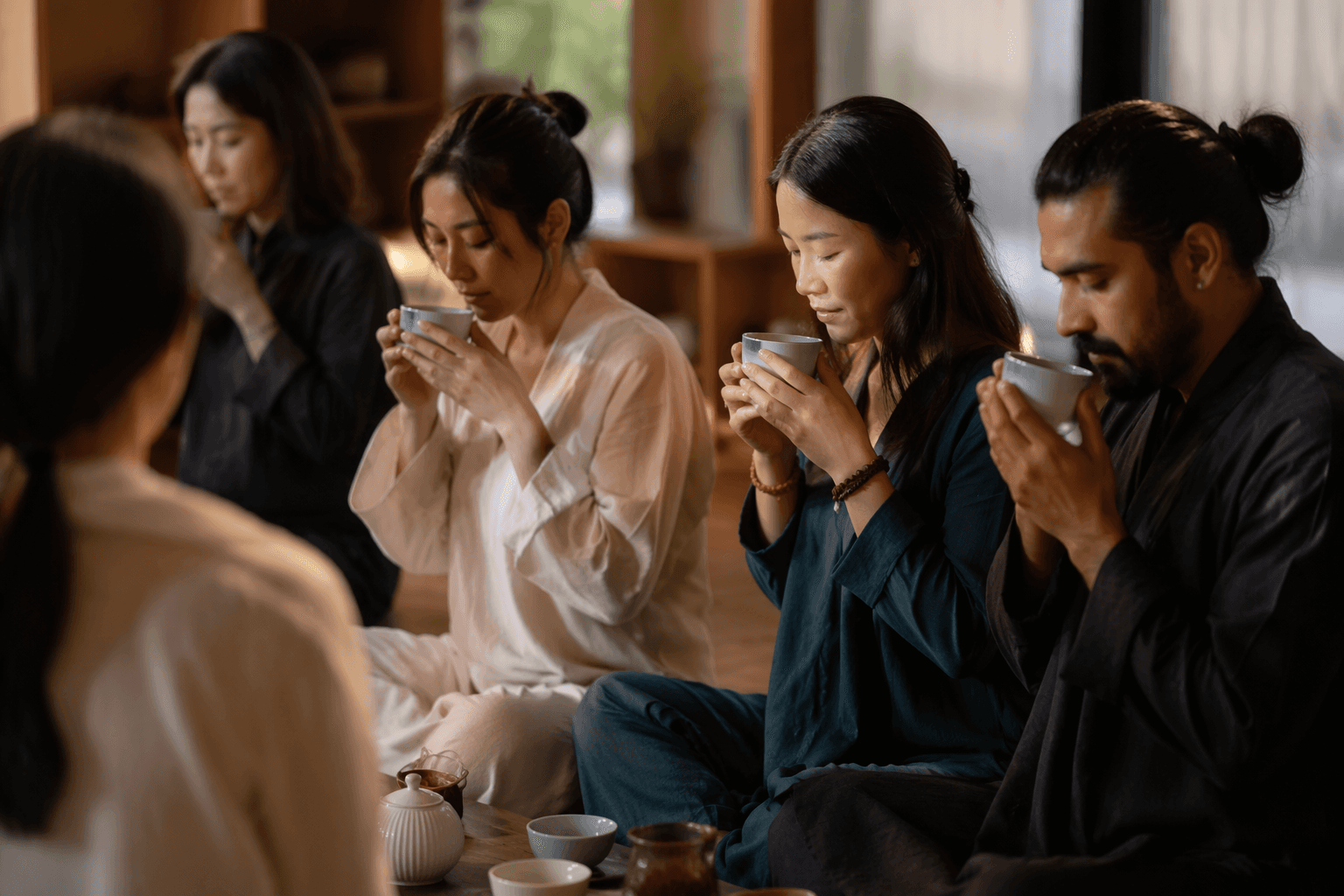
2. Hold the cup with both hands and notice the temperature before you drink.
3. Smell the tea once before the first sip.
4. Take the first sip slowly, then pause instead of immediately reaching for your phone or laptop.
5. Use the rest of the cup to notice flavor shifts, breath, and the urge to rush.
That is the point where tea becomes a practice rather than a prop. You are not trying to empty your mind. You are training it to stay with one ordinary object long enough to catch distraction in the act.
The Japanese tea ceremony makes that lesson visible because it is built from an established order. Sen no Rikyū’s influence was not just aesthetic, it was behavioral: the ritual turns ordinary hospitality into a discipline of exact movements, which is why the form still reads as a usable model for attention training. If you want a less formal version, senchado offers another example, a loose-leaf tea practice introduced into Japan in the latter half of the 17th century by the Chinese Zen master Yinyuan Longqi.
Where this helps, and where it starts to drift into wellness branding
Tea works best as mindfulness when it is specific, repeatable and a little inconvenient. It is useful if seated meditation feels too abstract, if your mornings are already structured around a hot drink, or if you need an attention cue that fits into a real calendar instead of a fantasy one. That makes it especially practical for people trying to build a habit from an existing routine rather than from scratch.
It starts to fail when the ritual becomes aesthetic cover for a distracted habit. If you are choosing a hand-thrown cup, a special blend and a calming playlist while still blasting through the drink on autopilot, you are decorating consumption, not training attention. The signal that it is working is simple: you are noticing the cup, the breath and the urge to leave the moment sooner than you would like.
The broader public-health backdrop helps explain why this small practice matters. The World Health Organization reported that 970 million people globally were living with a mental disorder in 2019, and the National Center for Complementary and Integrative Health says U.S. adult meditation participation rose from 7.5 percent in 2002 to 17.3 percent in 2022. In other words, more people are looking for low-friction ways to regulate stress, and tea is one of the few that can live inside an existing habit instead of demanding a new identity.
Tea becomes meaningful as mindfulness when it is treated with the same seriousness as any other attention practice: specific form, repeated often, watched honestly. The old traditions from China, Japan and India did not need the language of self-optimization to know what a cup could do. They knew that if you slow the hand, the mind sometimes follows.
This article was produced by Prism’s automated news system from verified source data, official records, and press releases, then run through automated quality and moderation checks before publishing. The system is built and supervised by the people who set the standards it runs under. Read our full AI policy.
Did this article answer your question?