Miniature painting guide breaks down paints by workflow stage
Stop buying random bottles: this guide maps paints to each stage, from primer to texture, so your next purchase solves one job instead of three.
Paint for the step you are on, not the bottle you just saw online
Miniature painting gets expensive fast when you treat every paint like a universal answer. The smarter move is to think in stages: bare plastic, basecoat, layer, metallic, shade, technical, and texture. That is the logic behind Wargamer’s guide, and it is the one that saves you from buying three versions of the same red while still not having a decent primer.
That approach also matches how the big brands actually sell the hobby now. Games Workshop calls Citadel Colour the “premier paint miniature range in the world,” The Army Painter pushes Speedpaint as a one-coat solution, and Scale75USA sells metallics as a separate system built for brush and airbrush use. This is not one clean ladder where every bottle does the same job. It is a set of workflow tools, and the right one depends on what you are trying to do next.
Start with the unpainted model: primer first, always
Primer is not glamourous, but it is the first decision that keeps the rest of the paint job from fighting you. Wargamer points beginners toward Vallejo surface primer, which makes sense because primer is the foundation layer, not the color choice you agonize over for twenty minutes. If the model is still bare plastic, resin, or metal, this is where you spend first.
Citadel spray cans remain a very common choice among Warhammer painters, which explains why so many tutorials start with a can in hand. Games Workshop’s 2022 update also added a new white spray undercoat intended for Contrast use, and that matters because undercoat color changes how the whole paint system behaves. In practice, the primer you choose affects coverage, brightness, and how hard you have to work later to recover lost detail.
Base paints do the heavy lifting
Once the model is primed, base paints are about clean, opaque color. Wargamer points to Citadel for base paints, and that recommendation fits the way Citadel has built its ecosystem around strong tabletop coverage and predictable results. If you want a red shoulder pad, a green cloak, or a bone armor plate that reads clearly at arm’s length, this is the stage where you want reliable opacity more than fancy effects.
This is also where people waste money by buying too many “special” colors before they own the basics. A sensible starter set uses base paints for the obvious armor, cloth, skin, and leather tones you will reach for every session. That keeps the collection focused and prevents duplicate bottles that solve the same problem in slightly different packaging.
Layer paints are where the finish starts to look intentional
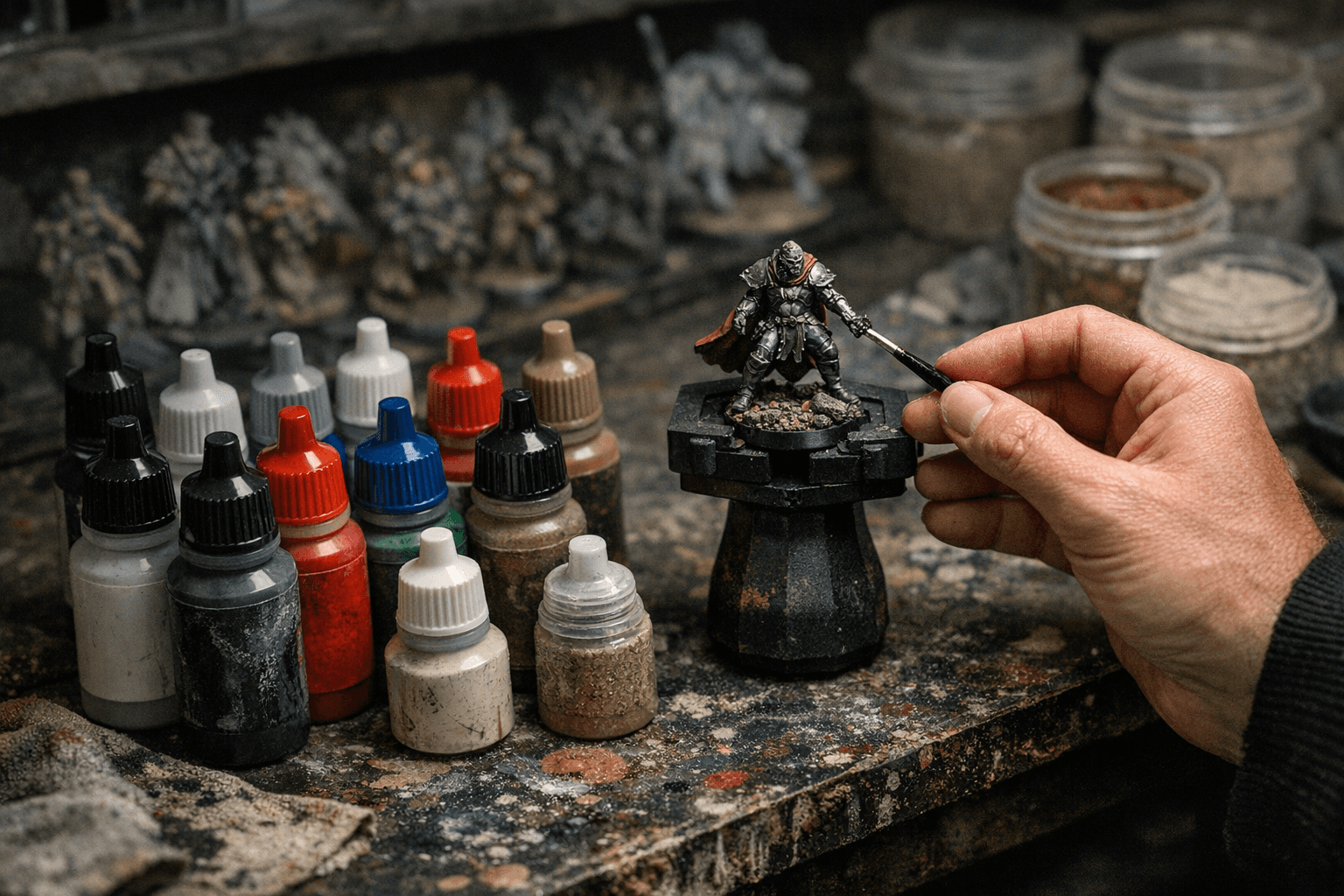
Layer paints are not the place to start if you are overwhelmed, but they are the place where a model stops looking flat. Wargamer again points to Citadel here, and that makes sense because layer paints are meant to build highlights and transitions on top of the basecoat rather than replace it. If your base paint does the coverage, your layer paint does the visual cleanup and brightness work.
This is where beginners often discover that one paint line cannot handle every job well. A layer color that looks great for raised edges may not cover as efficiently as a base paint, and that is normal. The point is to use the right formulation at the right stage, not to expect a single pot to behave like primer, basecoat, and highlight all at once.
Metallics deserve their own slot in the toolbox
Metallics are the clearest example of why workflow matters. Wargamer recommends Scale75 for metallic paints, and Scale75USA says its Metal 'n Alchemy range uses fine pigment, high covering power, and is designed for brush and airbrush use. That is a very different pitch from a generic silver or gold sitting in a starter box.
The current Metal 'n Alchemy line comes in 24 colors, which tells you Scale75USA is treating metallics as a full sub-category rather than a side note. If you paint armor, weapons, mech trim, or ornate details, a dedicated metallic range can save you from muddy finishes and weak coverage. It is one of the easiest places to see the difference between a paint that is merely metallic and a paint system built to be metallic from the ground up.
Shades, technical paints, and texture are not extras, they are workflow tools
Shades are how you create depth quickly, and Wargamer recommends Citadel shade paints for that job. Games Workshop’s 2022 update added a reformulated Shade range with 7 new colors, which reinforces just how central shading is to the modern Citadel ecosystem. If you want recesses to pop without painting every shadow by hand, shade paint is not optional, it is part of the process.

Technical paints and texture paints are the same story in different forms. Wargamer recommends Citadel for both, and that tracks with how these products solve specific finishing tasks rather than general color application. Technical paints help with effects, texture paints help with bases and surface variation, and both are the sort of purchases that make more sense once you know what kind of army or display scheme you keep repeating.
Speedpaint, Contrast, and the speed-paint lane
Not everyone wants the classic base, layer, shade route. Games Workshop’s Contrast line was launched in 2019 and became its all-time best-selling new paint type, so popular it sold out for months after launch. In 2022, Games Workshop expanded that system with 25 new Contrast paints, a reformulated Shade range with 7 new colors, and the white spray undercoat built for Contrast use.
The Army Painter made the same basic argument in a different ecosystem. Its Speedpaint line is marketed as a one-coat miniature-painting solution, and Speedpaint Mega Set 2.0 comes with 46 colors, 3 metallics, and 1 medium, for 50 bottles total. That is a very different buying decision from a traditional Citadel setup: instead of building a slow layering library, you are buying a system that prioritizes speed, shading, and quick tabletop results.
Buy first, expand later
The best part of this workflow approach is that it turns a giant paint wall into a sensible shopping order. Start with primer, then a handful of base colors for the army you actually paint, then one or two layer colors, one metallic range, one shade, and only after that think about technical and texture paints. That is how you avoid the classic hobby mistake of owning six specialty bottles and still not being able to finish a battleline unit cleanly.
- one primer, such as Vallejo surface primer
- a small set of Citadel base colors for your main army scheme
- a few Citadel layer paints for highlights
- one metallic option, especially if armor and weapons matter in your force
- a Citadel shade paint for recesses
- only then, technical and texture paints for finishing work
A practical starter set does not need to be huge, but it does need to be deliberate:
That is the real value of a guide like this. It does not pretend there is one best paint line for every miniature painter. It shows you how to buy with intent, match the bottle to the job, and build a collection that actually helps you paint more models instead of just collecting more unopened paint.
This article was produced by Prism’s automated news system from verified source data, official records, and press releases, then run through automated quality and moderation checks before publishing. The system is built and supervised by the people who set the standards it runs under. Read our full AI policy.
Did this article answer your question?