Ellen Allien's New Life turns grief into Berlin techno renewal
Ellen Allien’s New Life turns grief into a working blueprint for Berlin techno, where sharp edits, emotional depth, and BPitch’s scene logic still matter.
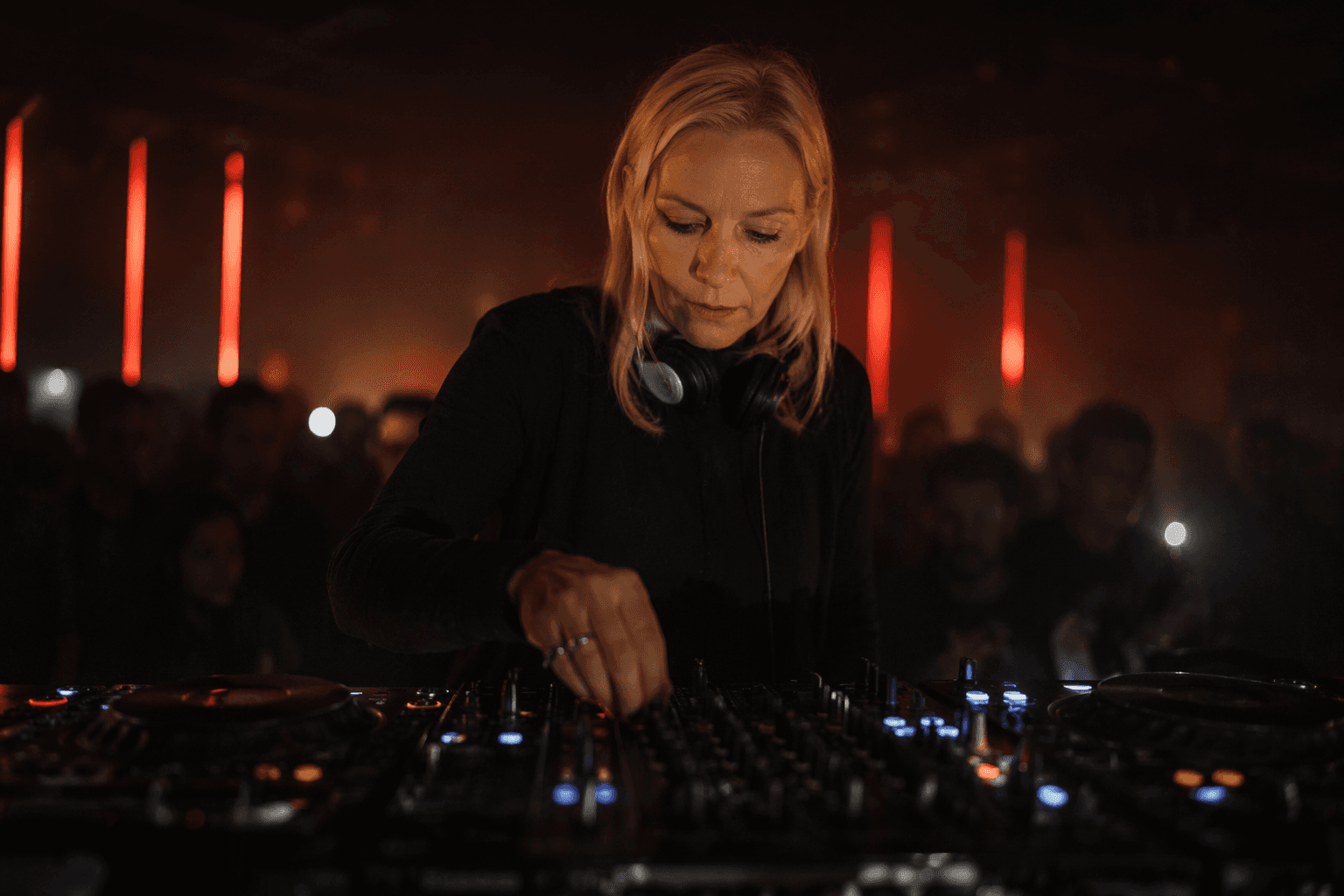
Ellen Allien has spent decades making Berlin techno feel alive, not preserved behind glass. With *New Life*, released on July 9, 2026 on BPitch Control, she turns grief and renewal into something club-ready, showing how a scene stays coherent when reduction, emotion, and purpose all pull in the same direction.
That balance is the real story here. Allien has always stood for techno that can hit hard and still carry memory, and this album extends that idea across a 10-track standard release, plus a radio edit of “Steh Auf,” without losing the tension that makes her work land on the floor.
Lesson 1: Cut for purpose, not clutter
Allien’s DJ identity has long made sense because it trusts restraint. The point is not to pile on elements until the room is full, but to pick records and moments that do one job clearly, whether that is opening space, tightening pressure, or releasing it. In the frame around *New Life*, the dance floor is not escape from feeling. It is where people start over.
That mindset is useful for anyone building sets in the minimal-adjacent lane. The strongest choices are usually the ones that keep the groove legible and the emotional signal clean. If a tune says “Cruising,” “Be Your Own Leader,” or “Riot,” the job is not to explain the title away, but to let the energy sit in the transition and do its work.
- Keep one clear rhythmic idea in focus.
- Use subtraction to create tension, not emptiness.
- Choose tracks that change the room without changing the story of the set.
That is why Allien reads as more than a veteran with a strong catalog. Beatport’s artist profile places her influence across music, art, design, and fashion, which fits an approach to DJing that treats taste as a discipline. The selector’s lesson is to build a spine first, then decorate it only when the set needs a turn.
Lesson 2: Let the concept travel, but keep the center fixed
*New Life* was recorded between Berlin, Miami, and Ibiza over the past winters, and that geography matters because it shows range without losing identity. The album does not sound like a postcard from three cities. It sounds like one artist testing how her language holds up in different climates, then bringing the result back to the Berlin axis that defines her.
BPitch’s language around the record is explicit: personal autonomy, community responsibility, empowerment, anarchy, collective action, regeneration, growth, and new hope. That might sound like broad manifesto material, but in techno it becomes practical very quickly. The idea is not to flatten emotion into slogan. It is to keep the set moving while still letting loss and resilience sit inside the kick drum.
The tracklist underlines that arc. “Lights Off,” “Wonderful Moment,” “Fantazy,” “Steh Auf,” “Move It,” “Mein Herz,” and “Bella” suggest a sequence that shifts from pressure to motion to recovery, and the presence of “Steh Auf (Radio Edit)” makes the message even clearer. This is club music built to survive translation, from big room to small system to home listening, without collapsing its core idea.
Lesson 3: Build a label that can hold a scene
BPitch Control is not just the backdrop to Allien’s career. It is the architecture that made her influence durable. She founded the label in Berlin in 1999, and BPitch’s own history describes it as an “island of creativity” in the city’s turbulent techno movement, created first to give space to fellow Berlin artists.
That origin story matters because it shows how a label becomes culture instead of inventory. Early BPitch names like Paul Kalkbrenner, TokTok, Sascha Funke, Modeselektor, and Allien herself gave the imprint a recognizable center of gravity, and that consistency is what makes the catalog feel like a scene with memory. For producers and selectors, the takeaway is blunt: if a label has no point of view, it becomes a storage unit.
The best scene labels do three things well:
- They filter hard enough that releases speak to one another.
- They give local artists a platform before the wider market notices them.
- They keep the city or community visible in the sound, not just in the branding.
BPitch still treats Berlin as a living reference point, not a logo. That is why Allien’s work continues to matter in 2026, with official pages showing her active in both music and touring. The label is still functioning as a mechanism for continuity, which is exactly what a healthy techno culture needs when styles cycle fast and attention fragments faster.
Berlin still hears itself in her records
The reason *New Life* lands is that it refuses the easy split between functional club tool and personal statement. Allien keeps those two ideas in the same frame, and that is what has made her such a durable figure in Berlin techno for decades. Her new album is not a detour from that history. It is the clearest version of it.
For minimal-adjacent techno, that is the model to study: cut with purpose, keep the concept mobile, and build institutions that can carry more than one release cycle. Allien’s work shows how grief can become motion without losing its weight, and how a dance floor can still feel like a place where a city remembers how to begin again.
This article was produced by Prism’s automated news system from verified source data, official records, and press releases, then run through automated quality and moderation checks before publishing. The system is built and supervised by the people who set the standards it runs under. Read our full AI policy.
Did this article answer your question?