Hornby T9 Greyhound OO gauge models arrive in SR green and BR black
Hornby’s T9 Greyhound returns in SR green and BR black, giving Southern and early BR layouts a 4-4-0 that fits two very different operating stories.

Hornby has put the T9 Greyhound back where Southern-region modellers can actually use it, with two new OO gauge editions now appearing in SR green and BR black. That livery choice is the whole story here: the same elegant 4-4-0 can sit naturally on an Era 3 Southern Railway layout or slide into an early British Railways scene without looking forced.
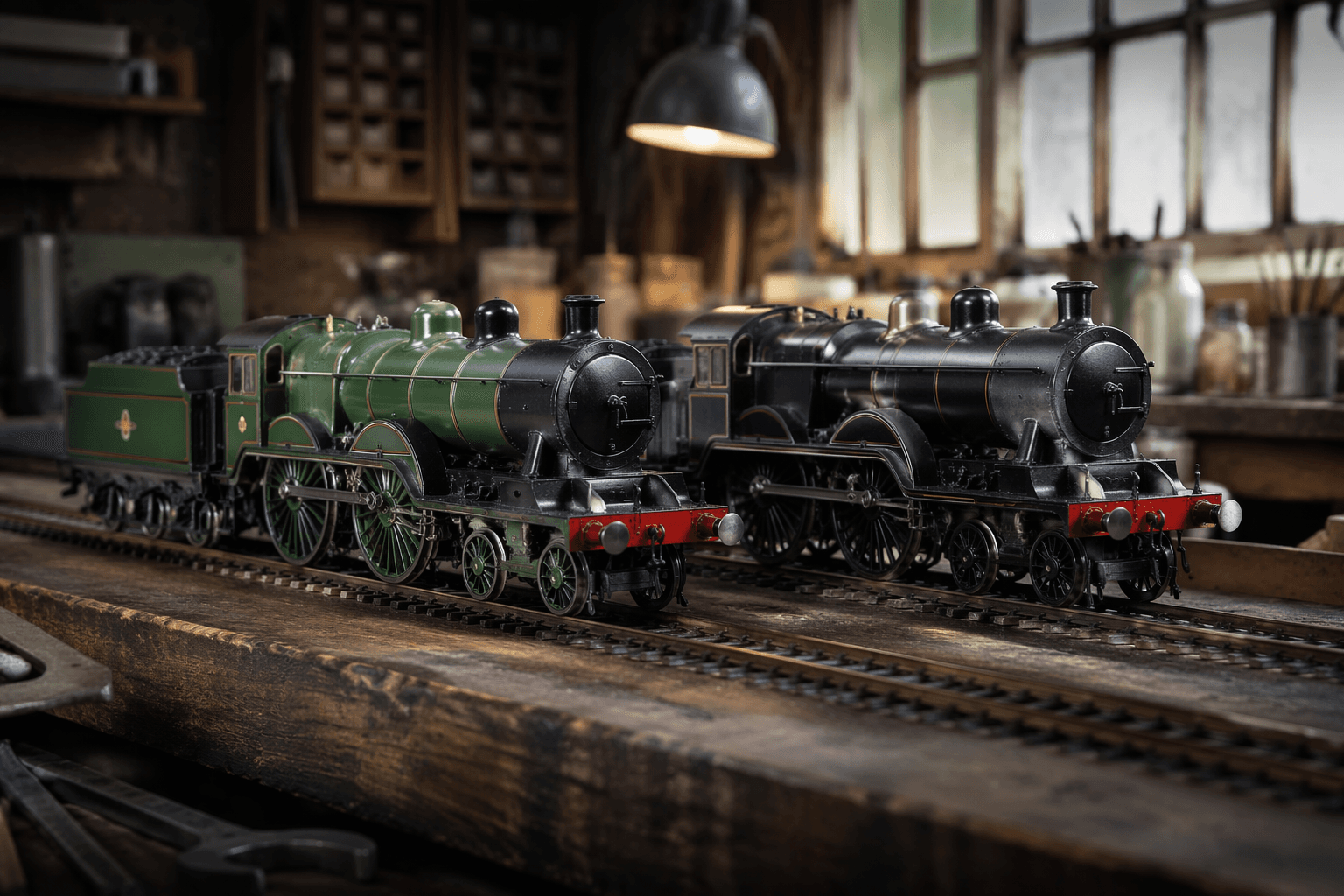
The SR green model, R30410, is the one with the hard facts attached. It is priced at £229.99, listed as OO gauge in 1:76 scale, and marked Era 3, Grouping, 1923 to 1947. Hornby has made it DCC-ready with a 21-pin socket, and the box includes an accessory pack with vacuum pipes, tank, brake rods and coupling assembly. NEM couplings are fitted too, so this is built for running rather than just display. If your layout leans toward Southern Railway passenger turns, branch-line workings or a tidy main-line secondary service, the green version is the cleaner roster fit.
The prototype earns that treatment. The T9 class totalled 66 locomotives, with 35 built at Nine Elms Works and 31 by Dübs & Co at Polmadie in Glasgow. Hornby says the class was completed at the London and South Western Railway’s Nine Elms Works in late December 1900, after the design had been introduced in 1899. The engine earned the nickname Greyhound because it could run at speeds of up to 85 mph, and the Southern Electric Railway Model Group has long described Dugald Drummond’s T9 as one of his most successful LSWR designs, praised for its free-running qualities and popularity with crews.
That long service life is exactly why the black version matters. The class mostly survived into British Railways ownership, and after nationalisation the locomotives initially wore plain black before later lined black in BR service. Four were loaned to the LMS for Somerset and Dorset duties during the Second World War, and 13 were converted to oil burners in 1947, which only broadens the number of roster stories the T9 can tell. For a layout set just after nationalisation, BR black is the better choice because it reads as a working survivor rather than a preserved showpiece.
The preserved example underlines the point. No. 30120 is the last surviving T9 and sits in the National Collection, with Hornby noting that it was built in August 1899, renumbered in June 1947, and returned to service in LSWR green in March 1962. That is the kind of career that makes the Greyhound unusually flexible in model form. Hornby has not just reissued a pretty express engine, it has given Southern-region modellers two usable answers to two different eras, and the livery you choose decides which side of the nationalisation divide your layout is really telling.
This article was produced by Prism’s automated news system from verified source data, official records, and press releases, then run through automated quality and moderation checks before publishing. The system is built and supervised by the people who set the standards it runs under. Read our full AI policy.
Did this article answer your question?