How DCC transformed model railroading with independent train control
DCC lets one layout run multiple trains independently on the same rails, but the real trade-off is decoder installs versus simpler wiring and more realism.
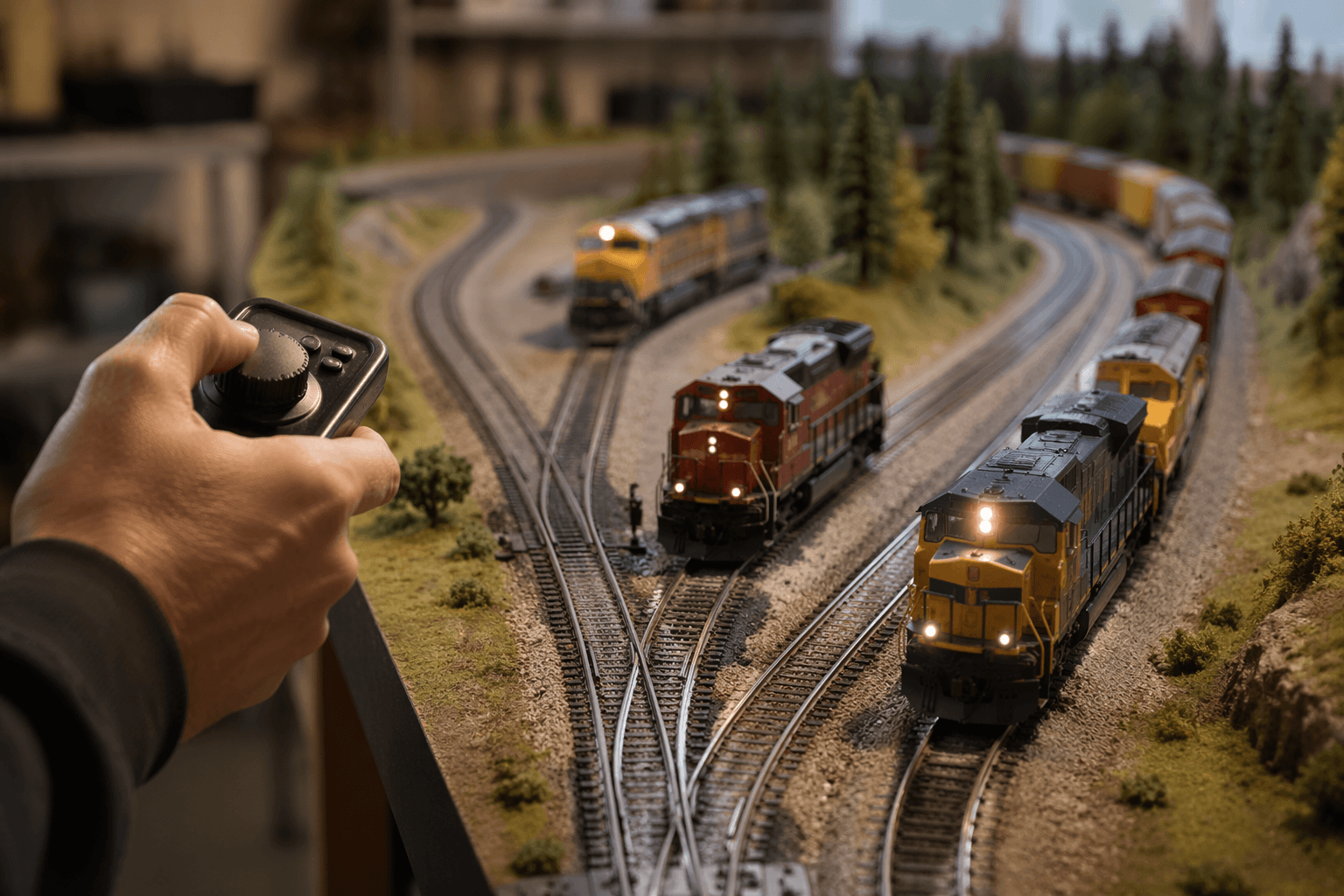
A switcher can work the yard while a road unit keeps moving on the main. On a small-to-mid-size layout, that is the difference between a railroad that needs constant cab swaps and one where two or three trains can move independently on the same rails. The catch is still the same one that stops a lot of conversions cold: every locomotive you want under digital control needs a decoder.
What DCC changes on the rails
Under DC, speed and direction come from changing voltage and polarity on the track. The old answer to multi-train operation is block control, where the railroad is split into electrical sections and selector switches assign a cab to each block; that works, but it gets tangled fast as the layout grows. DCC keeps a constant power level on the rails and sends digital commands that decoders in the locomotives interpret as speed and direction instructions.
With command control, simultaneous or sequential independent control of two mainline trains can be done with as little as a single-track main and sidings. You do not need to build the kind of block-by-block wiring that DC usually demands just to keep two trains from stepping on each other.
Why the NMRA standard matters when you buy gear
The big reason DCC became practical instead of merely clever is standardization. The NMRA started investigating command-control systems in the late 1980s, studied commercially available systems, and received proposals from Keller and Märklin before it launched a uniform standard effort in 1994. That standard gave manufacturers a common electrical and communications foundation, which is why affordable interoperable systems finally spread through the hobby instead of locking you into one brand’s island.
The NMRA DCC Working Group develops, revises, and extends the standards, tests equipment for compliance, and issues manufacturer IDs only after a decoder can demonstrate conformance. Those IDs are stored in CV8, while CV7 holds the decoder version, which is exactly the kind of detail that matters when you are trying to identify what is hiding in an older locomotive shell.
What came before, and why it mattered
DCC did not appear out of nowhere. GE’s Astrac showed up in 1964, and later systems like Onboard, Dynatrol, and the CTC-16 gave modelers a taste of command control before there was a shared standard. Model Railroader covered the CTC-16 in 1978, and that system could control up to 16 trains on the same track.
DC vs. DCC on a small-to-mid-size layout
If your railroad is a one-train layout and you are happy to run one locomotive at a time, DC still has the appeal of simplicity. Two wires to the track, a power pack, and you are moving. The minute you want one engine creeping in the yard while another circles the main, or you want to add more trackage without turning the underside of the benchwork into a switchboard, DCC starts paying for itself in operating freedom.
The honest trade-off is cost and conversion work. DCC usually requires decoders in motive power, and that is easy when a locomotive already has a socket or a factory-installed decoder, but more complicated and expensive when you have to retrofit a whole fleet. Digitrax put the sticker shock plainly when it first ran DCC: it knew it “couldn’t live without one” but “couldn’t afford it either.”
For a first system, the useful decision is not brand loyalty, it is headroom. An all-in-one command station, booster, and throttle can be the right move for a small layout if it is expandable, because that keeps the first buy from becoming dead money the moment you add a yard or a second operator. Digitrax’s Zephyr Express is one example of that kind of starter box; Digitrax markets it as fully expandable.
What DCC unlocks once you start operating
DCC can make locomotives behave more like real trains by enabling momentum, brake functions, and sound. Digitrax decoder documentation includes function outputs for lights, LEDs, smoke generators, and other onboard devices. The NMRA standard also defines consists as two or more decoders responding to the same commands.
This article was produced by Prism’s automated news system from verified source data, official records, and press releases, then run through automated quality and moderation checks before publishing. The system is built and supervised by the people who set the standards it runs under. Read our full AI policy.
Did this article answer your question?