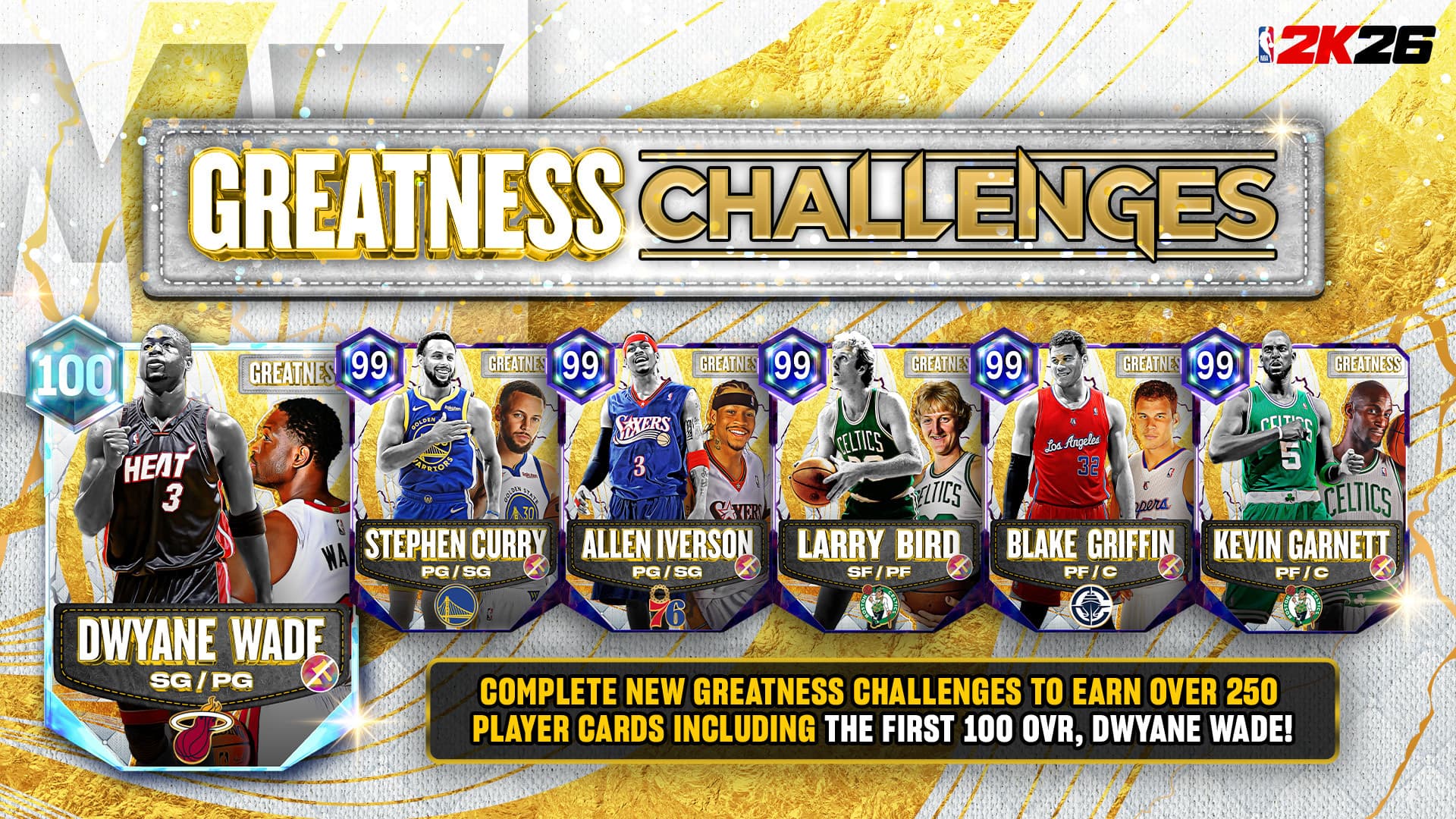
NBA 2K26 Greatness Challenges award 100 OVR Dwyane Wade and 250 cards
Wade is the prize, but the smart play is stacking Greatness Challenge branches and farming the stat lanes that match your lineup for the fastest 250-card climb.
The fastest path to 100 OVR Wade starts with one simple idea: don’t grind Greatness Challenges like a straight line. NBA 2K26 breaks the chase into five separate series, and that structure is the real edge. Instead of burning time on a single monolithic checklist, you can attack the branch that fits your roster, stack multiple objectives at once, and keep pulling rewards all the way to the first 100 OVR player in the game.
Greatness Challenges are built around a reward ladder that keeps paying out before the finish line. The mode awards more than 250 Player Cards overall, and every completed series gives you a 99 OVR Dark Matter player. That matters because the grind is not just about the final prize, it is about how quickly you turn the early cards into momentum for the next branch.

How the five series actually work
The challenge tree is split into Shooters, Heatwave Scorers, Playmakers, Slashers, and Defenders. Each lane is tied to a specific stat category, which makes the grind much cleaner than a generic win-count marathon. The official stat targets are straightforward:
- Shooters, built around 3-Point Shots
- Heatwave Scorers, built around Points
- Playmakers, built around Assists
- Slashers, built around Dunks
- Defenders, built around Defensive Plays, meaning blocks, steals, and rebounds
That design is what makes the mode efficient if you play it right. You are not just trying to win games, you are building stat stacks that move more than one ladder at a time. The guide also says you can work on multiple challenge paths at once, so the fastest route is usually the one that lets your lineup feed several objectives in the same run.
The best sequencing is the one that matches your roster, not the biggest reward name
If your team already runs through a primary creator, start with Playmakers or Heatwave Scorers. Those two paths are the easiest to overlap because a ball-dominant card can score and dish in the same possession, which means one game can move two challenge tracks instead of one. If you lean on spacing and a clean shooting release, Shooters becomes the cleanest lane because every made three pushes the counter without forcing you into a different style of offense.
Slashers usually comes easier if you have a rim-running build or a lineup that can get out in transition. Dunks are the kind of stat that can spike fast when the matchups are right, so this is a strong branch to fold into your regular offense instead of treating it like a separate chore. Defenders is the one I would watch most closely as a bottleneck, not because it is impossible, but because it asks for three different defensive stats, blocks, steals, and rebounds, inside one branch. That makes it the least tidy lane to farm, and the one most likely to slow down a clean completion route.
The practical move is to let your best natural stat-maker lead the grind. If you can pile up threes, points, and assists with the same card, do that first. If your roster is built around switchable wings and rim protection, you can chip away at Slashing and Defending together. The point is to keep the box score working for you on every possession, instead of chasing one challenge while ignoring the others.
The real prize ladder is loaded with name-brand rewards
Each completed series ends with a Dark Matter player that mirrors the style of the branch. Shoot your way to Stephen Curry, score through Heatwave Scorers for Allen Iverson, move the ball through Playmakers for Larry Bird, finish at the rim for Blake Griffin, and lock things down for Kevin Garnett. That lineup is not random. It tells you exactly how 2K wants this mode to feel, as a tribute to iconic playstyles rather than a generic card farm.
The final payoff is Dwyane Wade, and the official guide makes him the first 100 OVR player in NBA 2K26. That is why Greatness Challenges land differently from a normal promo ladder. Wade is not just another top-tier card sitting somewhere in the collection; he is the milestone at the end of a mode that asks you to master every major style of play. Once you understand that, the grind makes more sense. You are not racing to one isolated reward, you are proving you can clear the whole ladder.
MyTEAM’s new player pool makes the grind more flexible
Greatness Challenges also arrive in a MyTEAM that has changed in a major way. For the first time in franchise history, NBA and WNBA Player Cards are integrated in the same MyTEAM ecosystem, and attributes and badges function identically across both leagues. That is a bigger deal than it sounds like on paper. It widens the pool of cards you can build around, which matters a lot when you are trying to optimize stat objectives instead of just stack overall rating.
The broader MyTEAM feature set also includes a dedicated WNBA Domination tier, Game Changer Cards, All-Star Team-Up, and a new MyTEAM arena that features player accolades. That puts Greatness Challenges inside a mode that is clearly being pushed as a full-season playground, not a standalone side quest. For the Wade grind, that means you have more roster-building freedom and more places to keep your lineup active while you work through the branches.
Season timing matters if you want to stay ahead of the grind
Season 7 launched on May 15, 2026 at 8 AM PT, 11 AM ET, and 4 PM BST, so Greatness Challenges are part of the live seasonal rhythm of NBA 2K26 rather than a launch-window bonus. The roadmap also puts Early Access on August 29 and the global launch on September 5, which frames Greatness Challenges as a later MyTEAM content beat inside the game’s ongoing cycle.
That timing matters because it changes how you should approach the mode. This is not a one-night sprint. It is the kind of endgame content you chip at with a plan, using the right branch order, the right lineup structure, and the right stat priorities so you do not waste games on empty possessions.
If you want the shortest route to Wade, play the mode like a specialist
Greatness Challenges reward players who think in terms of overlap, not isolation. The five branches, the 40-plus Greatness Player Cards, the 99 OVR Dark Matter rewards, and the final 100 OVR Dwyane Wade all point to the same strategy: stay on the path that keeps multiple counters moving, and leave the awkward stuff to the lineup that can absorb it best. That is the cleanest way through the grind, and the reason Wade feels less like a random trophy and more like the payoff for mastering the whole MyTEAM ladder.
This article was produced by Prism’s automated news system from verified source data, official records, and press releases, then run through automated quality and moderation checks before publishing. The system is built and supervised by the people who set the standards it runs under. Read our full AI policy.
Did this article answer your question?