Build a Tabletop Cloud Chamber to Visualize Radiation Tracks Safely
For roughly $30 in materials, you can recreate the experiment that won Charles Thomson Rees Wilson the Nobel Prize and watch real radiation tracks appear at your own table.
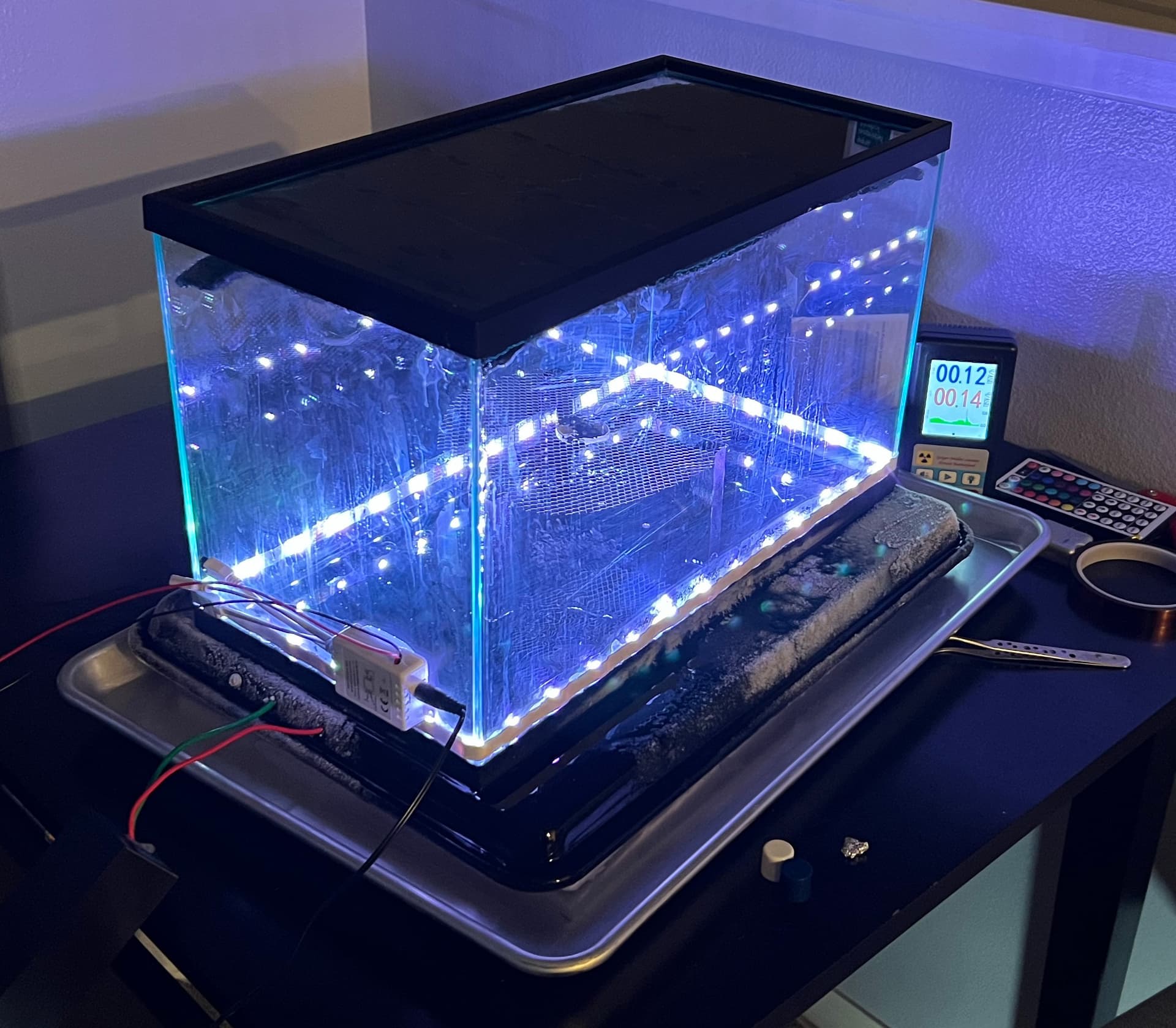
Somewhere above your head right now, a muon created by a cosmic ray colliding with the upper atmosphere is punching through the ceiling, through you, and into the floor at nearly the speed of light. You can't feel it. You can't see it. But with a clear acrylic container, some isopropyl alcohol, and a block of dry ice, you can watch it leave a track.
The diffusion cloud chamber, first developed by Scottish physicist Charles Thomson Rees Wilson in the early 1900s and honored with the 1927 Nobel Prize in Physics, remains one of the most viscerally compelling demonstrations in all of nuclear science. Background radiation, present in every room in the country, is enough to fill a properly built chamber with tracks within minutes. No exotic sources required.
What You're Actually Seeing
A diffusion cloud chamber works by maintaining a thin layer of supersaturated alcohol vapor just above a cold surface. When a charged particle, an alpha particle, a beta particle, or a cosmic-ray muon, passes through that vapor, it ionizes air molecules along its path. Those ionized molecules act as condensation nuclei, and tiny alcohol droplets form along the track, making the particle's path briefly but unmistakably visible.
Track shapes are diagnostic. Alpha tracks are short, thick, and sharply defined because alpha particles are massive and highly ionizing, losing energy quickly over a short path. Beta tracks are longer, thinner, and erratic, showing the deflections caused by their far lighter mass and multiple scattering collisions. Cosmic-ray muons, produced when high-energy cosmic radiation strikes molecules high in the atmosphere, appear as long, ruler-straight tracks crossing the entire chamber. Muons are so fast that relativistic time dilation allows them to survive the journey to Earth's surface despite their extremely short natural lifetime, which makes spotting one a genuinely remarkable physics event.
Materials and Sourcing: Safety First
The core build requires only a handful of components:
- A clear sealed vessel: acrylic or glass, with a flat, dark base for contrast
- Black felt or velvet lining for the interior walls and top surface
- High-purity isopropyl alcohol (90% or higher) or ethanol
- A cold sink: a block of dry ice packed in an insulated container under a flat metal base plate, or a commercially rated Peltier refrigeration plate for continuous operation
- A low-angle LED strip light to graze the vapor layer and reveal tracks
The bottom plate must reach below -26°C (-15°F) to establish the supersaturated layer. Dry ice, which sits around -78°C, exceeds this easily. Peltier-cooled builds offer a more permanent, turn-key setup that avoids the need to resupply cryogen but require attention to electrical safety and adequate heat-sinking on the warm side of the module.
Legal Compliance: Know Before You Build
This is where many hobbyist builds go wrong, not in physics but in paperwork. The good news: a cloud chamber running on background radiation alone requires no license, no permit, and no special authorization anywhere in the United States.
Problems arise when builders attempt to introduce a radioactive source to produce denser or more dramatic tracks. The U.S. Nuclear Regulatory Commission regulates radioactive materials under Title 10, Part 20 of the Code of Federal Regulations (10 CFR Part 20). Some consumer products containing radioactive material are classified as "exempt" and can be possessed without an NRC license; others fall under "general license" categories that require compliance with specific use conditions. Sealed sources with significant activity are specifically licensed materials that require formal authorization.
Old thorium-based gas lantern mantles occupy a legal gray zone. While trace thorium in consumer products has historically been treated as exempt, regulations vary by state, local ordinances differ, and possession intent matters. Before using any material beyond unmodified household items or background radiation, contact your institution's Radiation Safety Officer (RSO) or consult directly with your state radiation control program. When in doubt, background radiation alone produces excellent tracks and zero legal exposure.
Step-by-Step Build
1. Prep the chamber interior. Line the top interior surface with dark felt or velvet, securing it firmly.
The dark background maximizes track contrast against the bright condensation droplets.
2. Saturate the felt. Apply a measured amount of high-purity isopropyl alcohol to the felt, enough to saturate without pooling.
Excess alcohol drips onto the cold plate and interferes with the vapor gradient.
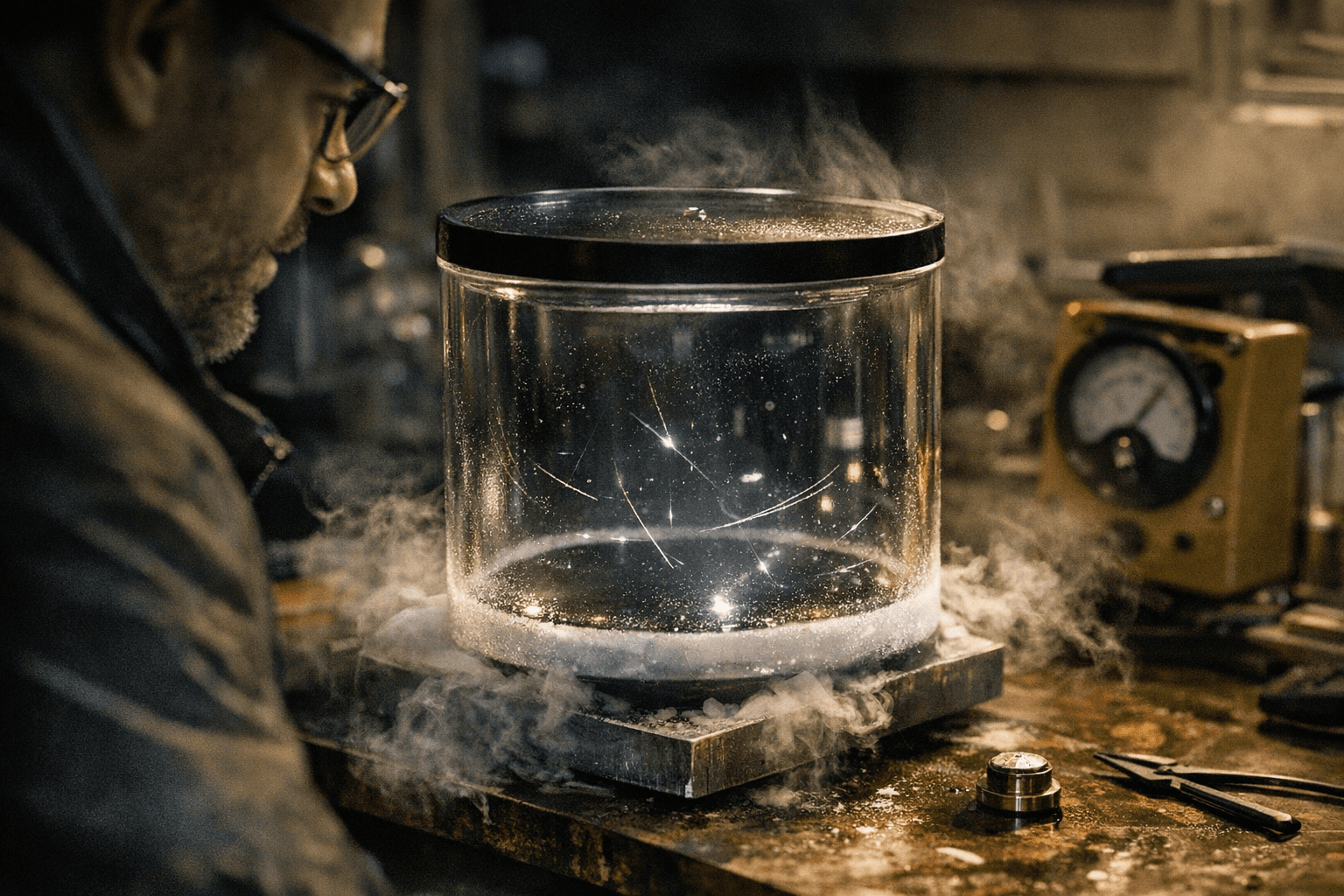
3. Establish the cold base. Pack dry ice into an insulated container and set a flat metal plate (aluminum works well for thermal conductivity) on top.
If using a Peltier cooler, ensure the heat sink and fan on the warm side are adequate before power-on, as overheating the module destroys it quickly.
4. Seal and equilibrate. Seal the chamber on the cold plate and wait 10 to 20 minutes.
This equilibration time is critical and frequently skipped by impatient builders, which is the single most common reason a first build produces no visible tracks.
5. Illuminate and observe. Dim all ambient lights to near-darkness.
Position your LED strip at a low grazing angle to the chamber floor, roughly parallel to the vapor layer. Tracks will appear as white streaks and blobs drifting slowly before dissipating.
Three Upgrades Under $20 That Double Track Visibility
If your initial build is producing faint or inconsistent tracks, these three low-cost modifications make a measurable difference:
- Aluminum HVAC tape on the base plate (~$6): Wrapping the cold plate with reflective aluminum tape improves both thermal contact and the reflection of your LED beam upward through the vapor layer, dramatically increasing contrast.
- A dedicated 5V LED strip with a warm-white color temperature (~$8): Cool-white LEDs scatter more in the vapor and wash out faint beta tracks. A warm-white strip at 2700K to 3000K produces the high-contrast, golden-toned illumination that makes thin beta tracks pop against the dark felt background.
- A sheet of black ABS or acrylic as an interior floor panel (~$5): Even when the vessel has a dark base, glare from condensation on the cold plate itself competes with track visibility. A thin black panel resting on the metal base eliminates this reflection and gives tracks a clean, dark canvas.
Common Failure Modes and Troubleshooting
| Symptom | Most Likely Cause | Fix |
|---|---|---|
| No tracks visible at all | Chamber not equilibrated | Wait the full 10-20 minutes; do not lift the lid |
| Fog fills entire chamber | Too much alcohol applied | Reduce alcohol, allow longer equilibration |
| Tracks appear then stop | Dry ice depleting, base warming | Refresh dry ice or check Peltier thermal management |
| Only fog, no discrete tracks | Ambient light too bright | Fully dim the room; reposition LED to true grazing angle |
| Faint tracks, hard to photograph | LED angle too steep | Lower the LED until it nearly skims the floor of the chamber |
Safety Compliance Checklist
Before every session, run through this checklist as standard operating procedure:
- Ventilation: operate only in a well-ventilated room. Isopropyl alcohol vapor is flammable and toxic to inhale in concentration; never run the chamber in an enclosed space.
- Cold-burn protection: handle dry ice exclusively with dry insulating gloves. Bare skin contact with dry ice causes burns within seconds.
- Electrical safety: if using a Peltier device, inspect wiring before each use and ensure no condensation is reaching electrical connections.
- Chamber stability: secure the vessel so it cannot tip. Spilled alcohol near electrical components is a fire hazard.
- Waste disposal: allow waste alcohol to evaporate in a ventilated area or dispose per your local regulations. Dispose of spent dry ice by allowing sublimation outdoors, never in a sealed container or confined space.
- Regulatory compliance: never transport or use specifically licensed radioactive material without documented authorization. Consult your RSO if any source material's regulatory status is unclear.
Educational Applications
Cloud chambers occupy a unique position in physics education because they require no inference. The particle is right there, visible, leaving a physical mark. For K-12 and undergraduate outreach, a well-lit chamber can anchor lessons on decay chains, particle mass-to-charge relationships, and measurement methodology, including track counting and track-length distributions as proxies for particle energy.
For more advanced coursework, pair cloud chamber observations with concurrent Geiger counter measurements or, under properly licensed conditions, scintillation detector or gamma spectroscopy data. The combination bridges qualitative visual understanding with quantitative detector output in a way no single instrument achieves alone. CERN's S'Cool LAB program has used this exact pairing to demonstrate nuclear physics to thousands of visiting students, using the chamber as the entry point for discussions that extend into relativistic muon lifetime calculations.
The invisible physics that filled Wilson's original chamber in the early 1900s is filling the air around you right now. The only thing standing between you and seeing it is a cold plate, some alcohol vapor, and twenty minutes of patience.
This article was produced by Prism’s automated news system from verified source data, official records, and press releases, then run through automated quality and moderation checks before publishing. The system is built and supervised by the people who set the standards it runs under. Read our full AI policy.
Did this article answer your question?