Scientists Synthesize Two New Heavy Nuclei, Expanding Periodic Table Boundaries
Chinese scientists caught just three alpha-decay chains to confirm Bk-235 and Am-231, two isotopes never before observed, using CAFE2's Ar-40 beam on a gold target.
Physicists at the Institute of Modern Physics (IMP) of the Chinese Academy of Sciences in Lanzhou synthesized two isotopes that had never existed in any laboratory: Berkelium-235 and its alpha-decay daughter Americium-231. Their findings, published in Physics Letters B by Wang and colleagues, deliver the first experimental anchor points for one of the most data-sparse corners of the neutron-deficient actinide chart.
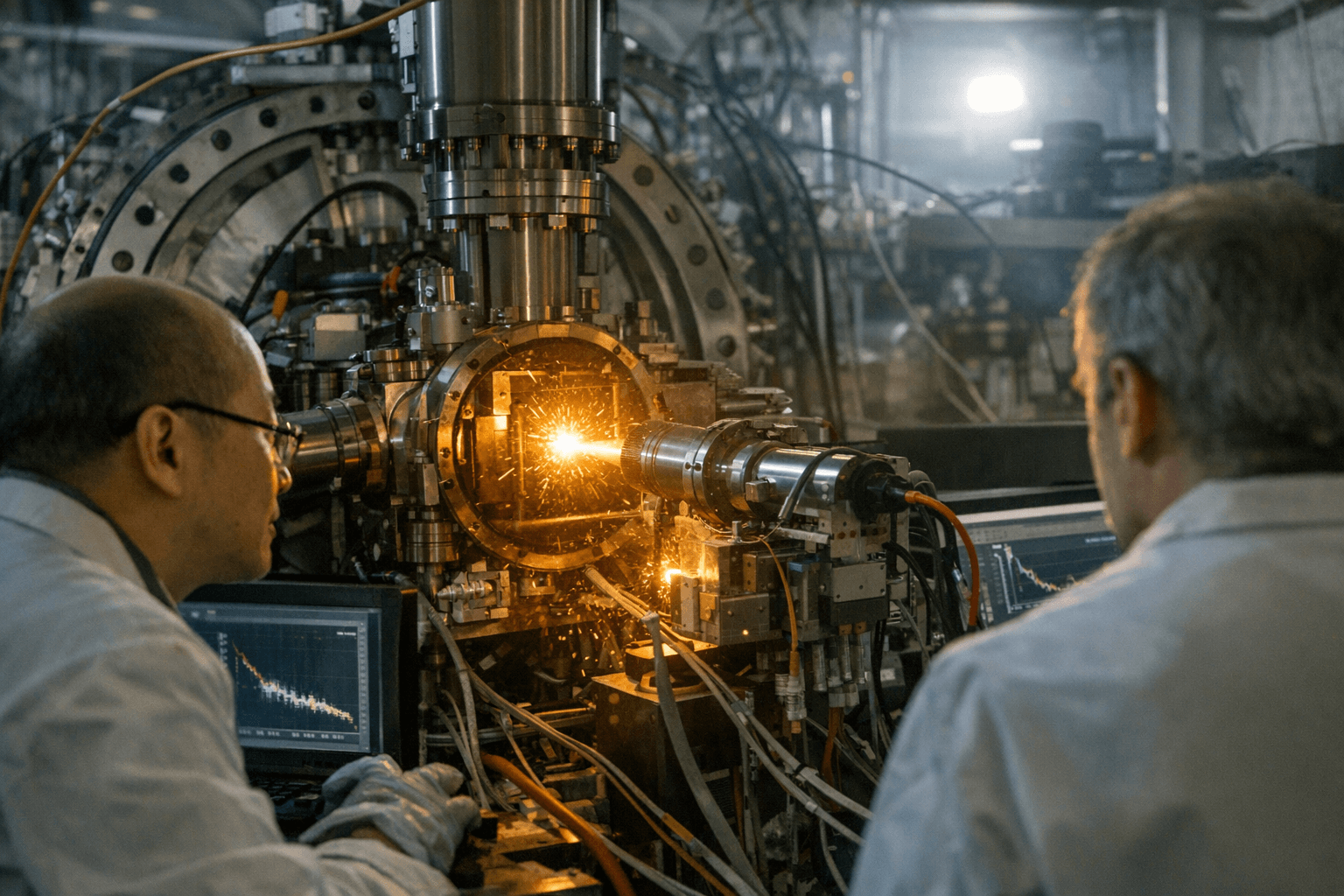
The reaction was written as ¹⁹⁷Au(⁴⁰Ar, 2n)²³⁵Bk: a high-intensity beam of Argon-40 ions from the China Accelerator Facility for Superheavy Elements (CAFE2) struck a Gold-197 target, the nuclei fused and shed two neutrons, and the residues recoiled into the SHANS2 gas-filled separator. SHANS2, short for Spectrometer for Heavy Atoms and Nuclear Structure-2, filtered beam-like background and steered genuine recoils onto a silicon detection stack where individual alpha events were recorded one atom at a time.
The entire dataset spans exactly three correlated alpha-decay chains. That sounds thin, but in this region of the chart it represents a genuine capability milestone. Low fission barriers eliminate many compound nuclei before they reach a detector, and production cross-sections are vanishingly small. That CAFE2's beam intensity was sufficient to coax out any chains at all says something concrete about what the Lanzhou facility can now reach. From those three chains, Wang et al. extracted an alpha-particle energy of 7,632 keV for Bk-235 and 7,109 keV with a 75-second half-life for Am-231.
Bk-235 carries 97 protons and 138 neutrons, placing it 12 neutrons above the N=126 closed shell. Am-231 sits at N=136. Both are deep in neutron-deficient territory, and Bk-235 previously appeared as a blank: known berkelium isotopes ran from 233 to 253 but skipped 235 entirely. The measured alpha energies now help benchmark nuclear mass models in a region where shell structure and deformation interact in ways that theory has struggled to predict without experimental input.
The decay chain itself steps diagonally down the nuclide chart. Bk-235 (Z=97, N=138) emits a 7,632-keV alpha to become Am-231 (Z=95, N=136), which releases its own 7,109-keV alpha over 75 seconds to yield Np-227 (Z=93, N=134), moving progressively toward the N=126 magic-number region. For anyone working with silicon or germanium detectors, the two clean alpha lines near 7.1 and 7.6 MeV are the spectroscopic fingerprints: separated by roughly 500 keV, they were distinct enough that even a three-chain dataset supported unambiguous identification.
On the question of applications, calibrate expectations carefully. Bk-235 and Am-231 are produced atom by atom, decay in seconds to minutes, and offer no credible path to medical, industrial, or reactor use. The real payoff is benchmark data for the nuclear mass models that feed astrophysics codes simulating r-process nucleosynthesis in neutron star mergers. Better experimental grounding in the neutron-deficient actinide region eventually produces more reliable predictions for how the universe forges its heaviest elements, even if that payoff arrives through years of downstream theoretical work rather than any near-term application.
Bk-237 remains absent from the known isotope list, and the neutron-deficient transactinide region is still largely unmapped. With CAFE2 and SHANS2 now proven capable of reaching previously unseen nuclei in some of the chart's most experimentally hostile territory, the Lanzhou program has positioned itself as one of the few accelerator complexes in the world with a realistic shot at filling those blanks.
This article was produced by Prism’s automated news system from verified source data, official records, and press releases, then run through automated quality and moderation checks before publishing. The system is built and supervised by the people who set the standards it runs under. Read our full AI policy.
Did this article answer your question?