University of Illinois Files NRC Permit to Build Campus Microreactor
NANO Nuclear and the University of Illinois filed a CPA with the NRC for a 15 MW KRONOS microreactor on the Urbana campus, kicking off a 12-month federal review.
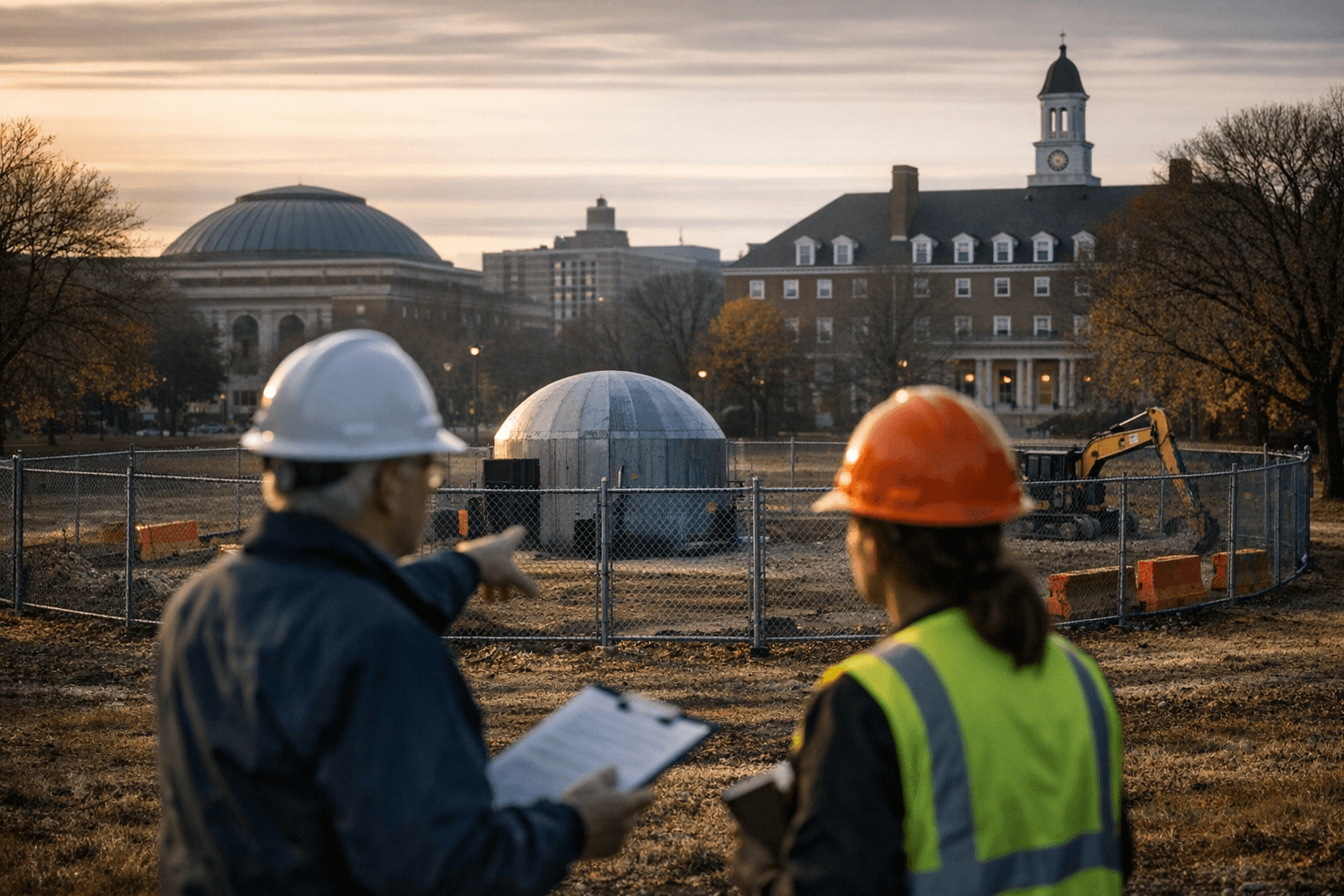
NANO Nuclear Energy (Nasdaq: NNE) and the Grainger College of Engineering at the University of Illinois Urbana-Champaign submitted a Construction Permit Application to the NRC on March 31 for the KRONOS micro-modular reactor, making NANO Nuclear the first commercially-ready microreactor developer to reach CPA stage in U.S. regulatory history. Only two other Generation IV advanced reactor developers have gotten this far.
The KRONOS is a high-temperature gas-cooled reactor designed to deliver 15 megawatts of carbon-free baseload power. It uses TRISO fuel particles embedded in a silicon carbide matrix, known as Fully Ceramic Microencapsulated fuel, with inert helium cooling that transfers heat to a molten salt loop capable of generating steam. On the Urbana campus, the system is also slated for at-scale demonstrations in hydrogen production, desalination, and microgrid distribution.
Submitting the CPA is not the finish line. The NRC first reviews the application package for completeness before accepting it for docketing. Once docketed, the agency begins a formal technical and environmental evaluation that NANO Nuclear estimates will take approximately 12 months. That review covers reactor design, safety analyses, site security, physical protection plans, and environmental impact, and the public will have formal opportunities to weigh in during the process. Critically, a Construction Permit only authorizes building the facility. Before any nuclear fuel can be loaded, the project must clear a second, separate Operating License review.
The pathway has already been long. Interest in microreactors at Illinois accelerated around 2019, and geotechnical site characterization work on the Urbana campus began in earnest in fall 2025. The CPA preparation required thousands of pages of technical documentation spanning reactor design, safety analysis, environmental review, regulatory compliance, and supply chain establishment. NANO Nuclear also completed a voluntary NRC readiness assessment before filing, a rigorous pre-application process designed to validate completeness.
Professor Caleb Brooks, the Donald Biggar Willett Faculty Scholar of Nuclear, Plasma and Radiological Engineering, put the milestone plainly: "By submitting the Construction Permit Application to the NRC, we are taking the next step in signifying that the work will be done correctly and precisely." Dean Rashid Bashir framed the larger ambition, saying the project will "play a major role in ushering in the next generation of advanced reactors" through both research and workforce development.
For NPRE students and researchers, approval would unlock direct access to an operational reactor environment and shorten the feedback loop between lab work and real-world application. The research agenda is deliberately practical: advanced instrumentation and controls, cybersecurity, physical security, modeling and simulation, and advanced materials. These are not academic exercises; they are the exact capability gaps the expanding U.S. commercial nuclear fleet needs filled.
For the broader advanced nuclear community, the Illinois filing functions as a live stress test of the NRC's campus-siting and microreactor licensing framework. How the agency handles docketing, what conditions it attaches, how community engagement plays out in a college-town setting, and whether an Operating License follows in any reasonable timeframe will collectively determine whether this becomes the blueprint that opens campus deployments at universities nationwide, or the cautionary tale that keeps them on the whiteboard.
This article was produced by Prism’s automated news system from verified source data, official records, and press releases, then run through automated quality and moderation checks before publishing. The system is built and supervised by the people who set the standards it runs under. Read our full AI policy.
Did this article answer your question?