CERN ends LHC collision era, prepares high-luminosity upgrade
The LHC’s last collisions of the current era flashed across CERN screens as the machine headed for a long shutdown and a High-Luminosity upgrade.
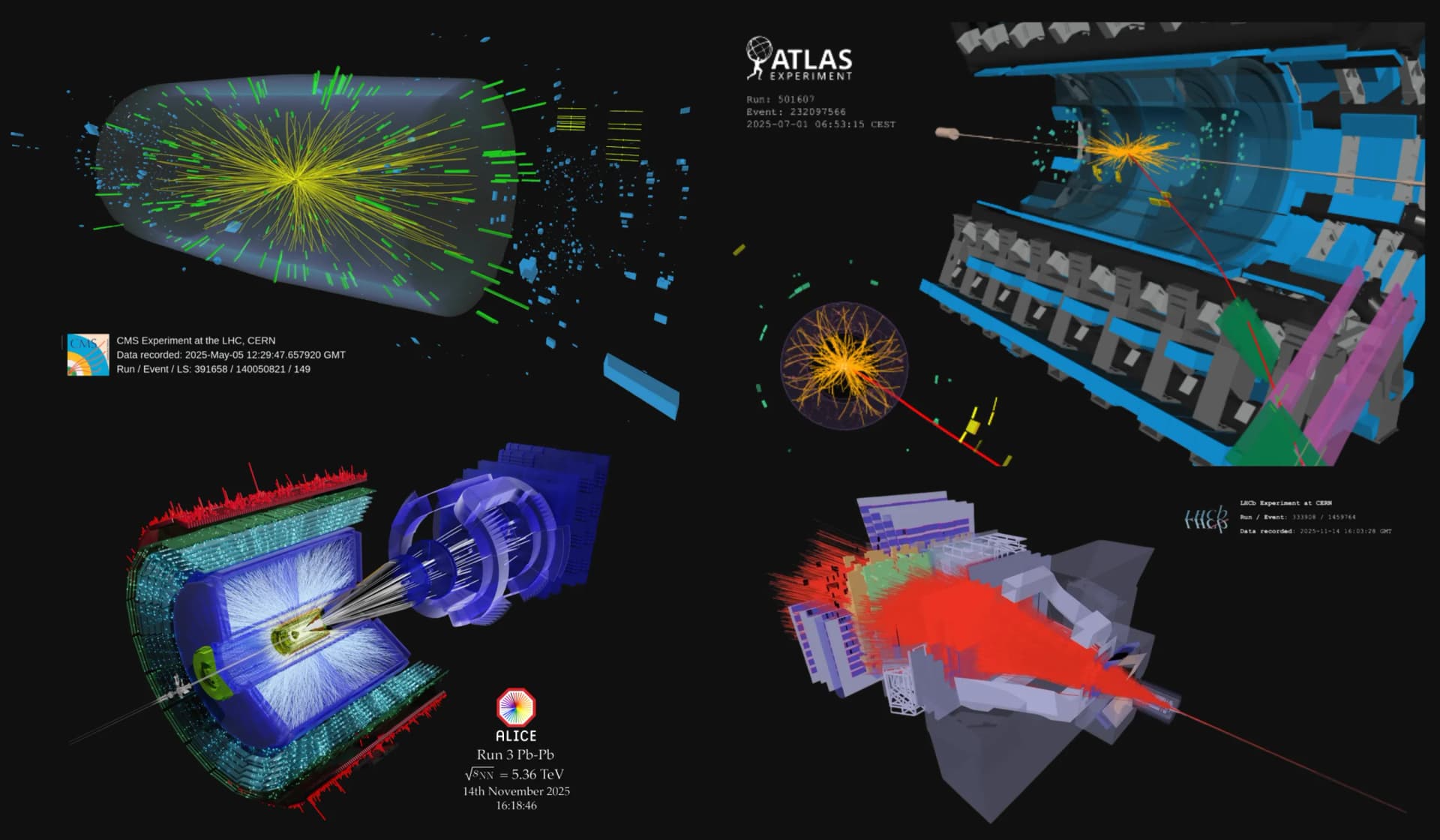
The last collisions of the current Large Hadron Collider run flickered onto the screens in ALICE, ATLAS, CMS and LHCb in the early hours of June 14, marking the end of one operating chapter and the start of the next. The machine is not going dark yet: beams will keep circulating for about two more weeks of high-intensity tests before the full shutdown begins.
After 12 years of operation, the collider has already delivered a staggering haul. ATLAS and CMS each recorded about 54 million billion proton collisions, while the heavy-ion program added roughly 300 billion collisions across the experiments, not counting special runs with oxygen, neon and other nuclei. Since 2010, the LHC has produced a record volume of data and thousands of scientific results, turning the current era into one of the most productive stretches in high-energy physics.

Those results reshaped the field in familiar and still consequential ways. They include the Higgs boson discovery, precision measurements of Higgs properties, studies of matter-antimatter imbalance, work on the quark-gluon plasma and the discovery of more than 85 hadrons. The archive is not a closed book, either. Collaborations will keep mining the stored collisions for years, which means the physics output from this run is still unfolding even as the hardware moves on.

The shutdown is a handoff to the High-Luminosity LHC, or HiLumi LHC, the upgrade designed to deliver much larger datasets and, with them, sharper measurements and a wider net for rare phenomena. For a community that follows every detector turn-on and every run plan, the key shift is clear: the limiting factor is no longer just how many collisions the machine can produce, but how much information the detectors can capture and the analyses can extract. The final collisions of this era were not an ending so much as a clean transition from discovery mode to the long work of building the next one.
This article was produced by Prism’s automated news system from verified source data, official records, and press releases, then run through automated quality and moderation checks before publishing. The system is built and supervised by the people who set the standards it runs under. Read our full AI policy.
Did this article answer your question?


