Cloud chambers reveal invisible radiation tracks in nuclear science
A cloud chamber turns invisible radiation into live tracks, making alpha, beta, and cosmic particles easy to spot on a tabletop.
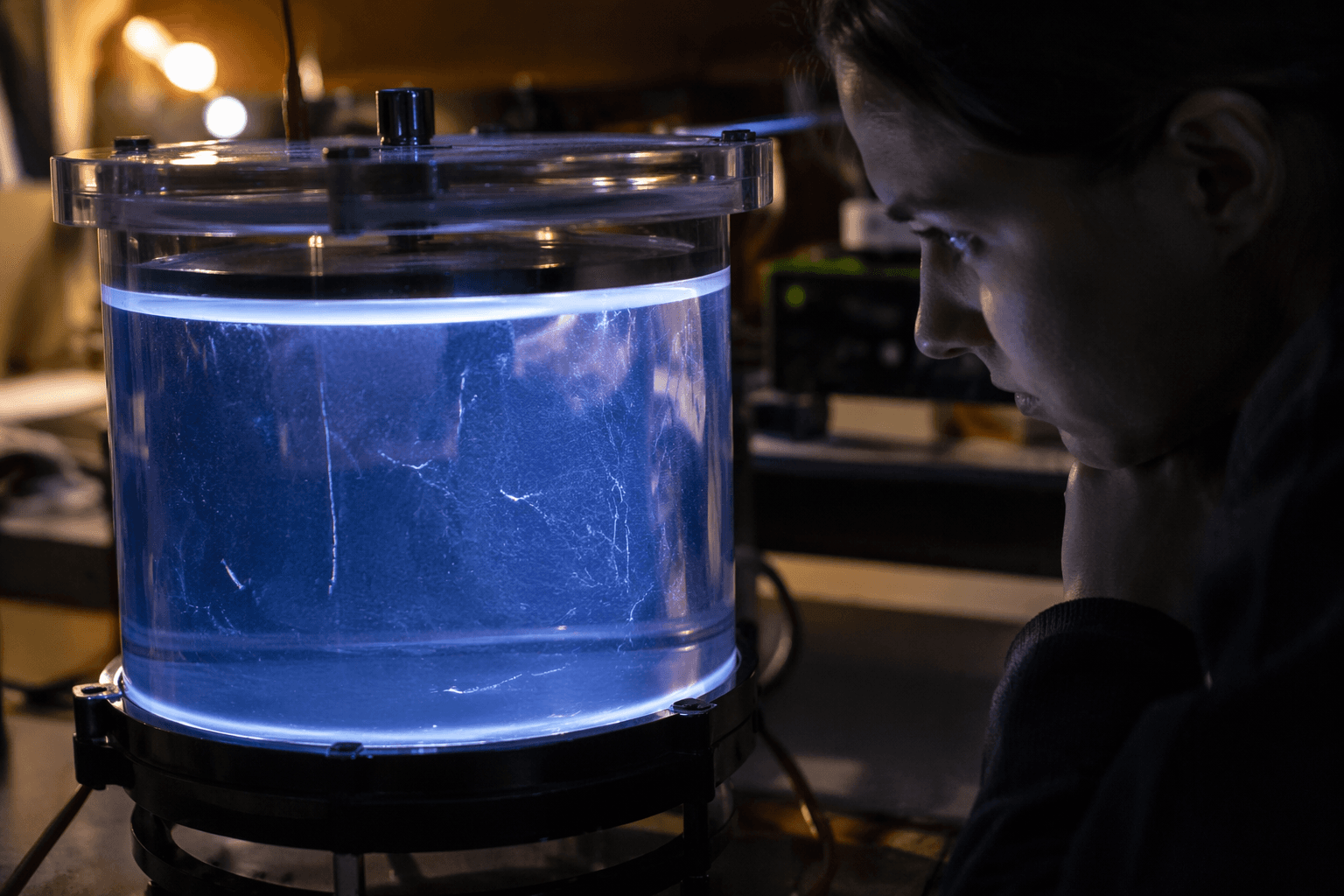
A cloud chamber is where nuclear science stops being abstract and starts moving across a black stage in thin white streaks. One sealed box, one cold plate, and a wash of alcohol vapor can turn cosmic rays, natural background radiation, and a weak radioactive source into something you can actually watch.
How the chamber makes the invisible visible
The physics is straightforward and that is part of the charm. Alcohol vapor is cooled until it sits just below the point where it wants to condense. When an energetic particle passes through, it leaves a trail of ions behind it. Those ions become nucleation sites, and tiny droplets form along the path, sketching out the particle’s route in real time.
1. The chamber is prepared with a clean vapor environment and a strong temperature gradient.
2. A particle crosses the supersaturated region and ionizes the air.
3. Droplets condense on the ion trail.
4. The track appears as a visible line, wisp, or curve under good lighting.
That basic sequence is why cloud chambers remain one of the most accessible hands-on demonstrations in nuclear science. They turn an invisible event into a visible one fast enough to hold a room’s attention.
What makes a good tabletop build
The best viewing setups keep the design simple and the conditions stable. Builders usually rely on a black interior to cut glare, a metal cold plate to hold the temperature drop, and a bright side-light or LED strip aimed at a low angle so the droplets catch the light cleanly. Isopropyl alcohol is the common choice because it vaporizes readily and produces strong tracks.
A dark room helps more than most first-time builders expect. A plain background gives the eye nowhere else to go, so the chamber’s fine lines stand out, and once the system settles, the tracks become easier to read. Educational and research examples of diffusion cloud chambers using methanol or isopropyl alcohol report that visible tracks can appear within minutes once thermodynamic equilibrium is reached. One simple educational diffusion chamber reported alpha tracks about 5 cm long after roughly five minutes.
A weak americium-241 source is commonly used in classroom-style demonstrations, and the setup is often paired with careful discussion of safe handling, known materials, and distance from the source. The Centers for Disease Control and Prevention advises maximizing distance from a radioactive source to reduce dose, which is the rule that keeps even small demonstrations grounded in real radiation safety.
How to read the tracks
The real payoff comes when the chamber starts teaching pattern recognition. Alpha particles usually leave thick, short tracks because they ionize strongly and lose energy quickly. Beta particles tend to leave thinner, more erratic traces, with more scattering as they move through the vapor. Cosmic-ray muons can show up as long, straight lines that cut through the chamber from top to bottom.
That visual difference matters because it links detector behavior to particle behavior in a way textbooks rarely do. Once the tracks appear, the chamber becomes a live demonstration of ionization, shielding, penetration, and detector design. It also gives newcomers a memorable way to distinguish particle types without leaving the tabletop.
- Thick, short streaks usually point to alpha particles.
- Thin, wandering lines usually fit beta particles.
- Long straight tracks often signal cosmic-ray muons.
The chamber also invites a practical conversation about particle range. National Institute of Standards and Technology tables give stopping-power and range data for electrons, protons, and helium ions, including alpha particles, which helps connect the visible track length to how far each particle can travel in air or matter.
Why the chamber still wins over abstract explanations
The cloud chamber’s staying power is not just about nostalgia. It is one of the few nuclear-science tools that immediately rewards curiosity with a visible result. For school groups, museum volunteers, amateur science clubs, and home experimenters, that matters. The chamber does not ask a newcomer to trust an invisible process on faith; it puts the process on display.
That visibility is especially useful because radiation is already part of everyday life. The U.S. Environmental Protection Agency says natural sources contribute over half of the average annual radiation exposure in the United States. It identifies cosmic rays, radon, and naturally occurring radioactive materials as major contributors, and it says radon is the single greatest environmental source of radiation exposure for most people. The agency recommends that all homes and schools be tested for radon, which makes the conversation around a cloud chamber feel immediate rather than theoretical. Radon is a colorless, odorless, tasteless, invisible gas produced by the decay of naturally occurring uranium in soil and water, and the EPA says exposure to it is the second leading cause of lung cancer after smoking.
That link between a tabletop track and real-world radiation is what keeps people leaning in. The chamber turns a subject many people fear or ignore into something they can examine safely, slowly, and with purpose.
From Wilson’s first chamber to modern show-and-tell
The chamber’s history is as important as its display value. C. T. R. Wilson began developing the idea in the 1890s, and after his primitive chamber was exposed to X-rays in early 1896, the concept was strongly supported. He built the first practical cloud chamber in 1911, and he later shared the 1927 Nobel Prize in Physics with Arthur Holly Compton for a method that made the paths of electrically charged particles visible by condensation of vapor.
Wilson’s work quickly moved beyond a laboratory curiosity. Early chamber images helped reveal individual alpha and beta particles and electrons, and later research by Patrick M. S. Blackett pushed cloud chambers deeper into nuclear physics and cosmic-ray studies. Cloud-chamber photographs also contributed to the first evidence for strange particles, which is part of why the device still carries real scientific weight, not just educational charm.
That long line from Wilson’s first practical chamber to today’s classroom build explains why the device still works so well. A cloud chamber gives nuclear science a visible voice: a quiet box, a cold surface, and a particle trail that appears just long enough to make the invisible feel real.
This article was produced by Prism’s automated news system from verified source data, official records, and press releases, then run through automated quality and moderation checks before publishing. The system is built and supervised by the people who set the standards it runs under. Read our full AI policy.
Did this article answer your question?