EAST Tokamak Sustains Stable Fusion Plasma for 60 Seconds
EAST held a fusion plasma steady for about 60 seconds while shutting down edge bursts, a key step toward walls that can survive reactor-scale heat.
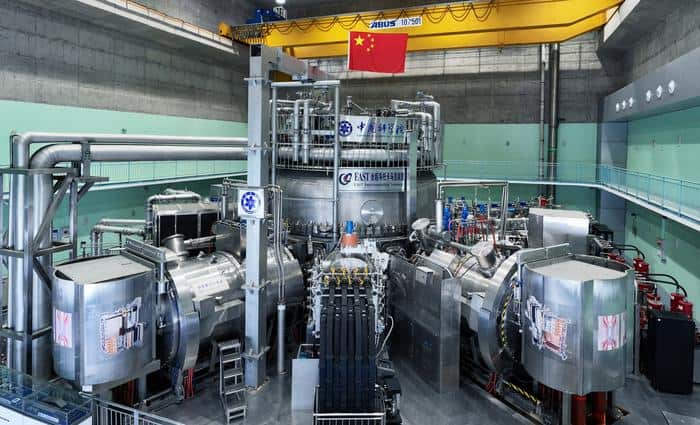
A tokamak in Hefei, China, just pushed fusion’s hardest tradeoff a little farther toward the winning side. On EAST, Xu Guosheng’s team held a plasma in a stable, high-confinement state for about 60 seconds while eliminating edge-localized modes and cutting the heat load aimed at the machine’s walls.
The result, published in Physical Review Letters on March 23, 2026, came from a regime the researchers named the Detached divertor and Turbulence-dominated Pedestal, or DTP, regime. What made it stand out was not only the duration, but the combination: partial divertor detachment, ELM-free H-mode, and strong pedestal performance all held together in a metal-wall tokamak.
The team at the Institute of Plasma Physics, Hefei Institutes of Physical Science, Chinese Academy of Sciences used feedback-controlled seeding of a light impurity gas to set up the plasma state. That helped create partial detachment in the divertor, where the exhaust load is supposed to be managed, while keeping the edge in a high-confinement mode without the usual bursty ELM damage that can slam reactor surfaces with sudden heat.
The paper says the key mechanism was a subtle one. Partial detachment, paired with a closed divertor geometry, trapped and pumped neutral particles in the divertor region. That reduced pedestal cooling from recycling neutrals and the seeded impurities, pushed up the pedestal temperature gradient, and triggered high-frequency broadband turbulence. Gyrokinetic simulations identified that turbulence as a temperature-gradient-driven trapped electron mode, or e-TEM, which carried particles and heat outward, limited pedestal pressure buildup, and suppressed ELMs. In practical terms, the plasma stayed stable while the heat flux to the divertor plates dropped sharply.
That balance matters more than any single temperature headline. ITER says the deuterium-tritium reaction remains the most achievable and efficient fusion fuel cycle, but it also stresses that a power plant needs very high temperature, sufficient density, and enough confinement time to work. It also notes that about 80 percent of fusion energy is carried by neutrons, which heat the reactor walls. If the edge can be stabilized without sacrificing confinement, the machine becomes easier to protect, and easier to imagine as a commercial system.
EAST has been building toward this point. In 2024, it reported reproducible 403-second H-mode plasmas, and in January 2026 it showed that small 3D magnetic perturbations could suppress edge instabilities while supporting internal transport barrier formation. The new DTP regime ties those threads together more tightly than before, and in a metal-wall environment, that is the kind of progress fusion has been chasing for decades.
Know something we missed? Have a correction or additional information?
Submit a Tip