First measurement of tellurium-104 alpha decay confirms superallowed theory
Tellurium-104 has been seen alpha-decaying in 7.2 nanoseconds, the first direct proof of a long-predicted superallowed mode near tin-100.
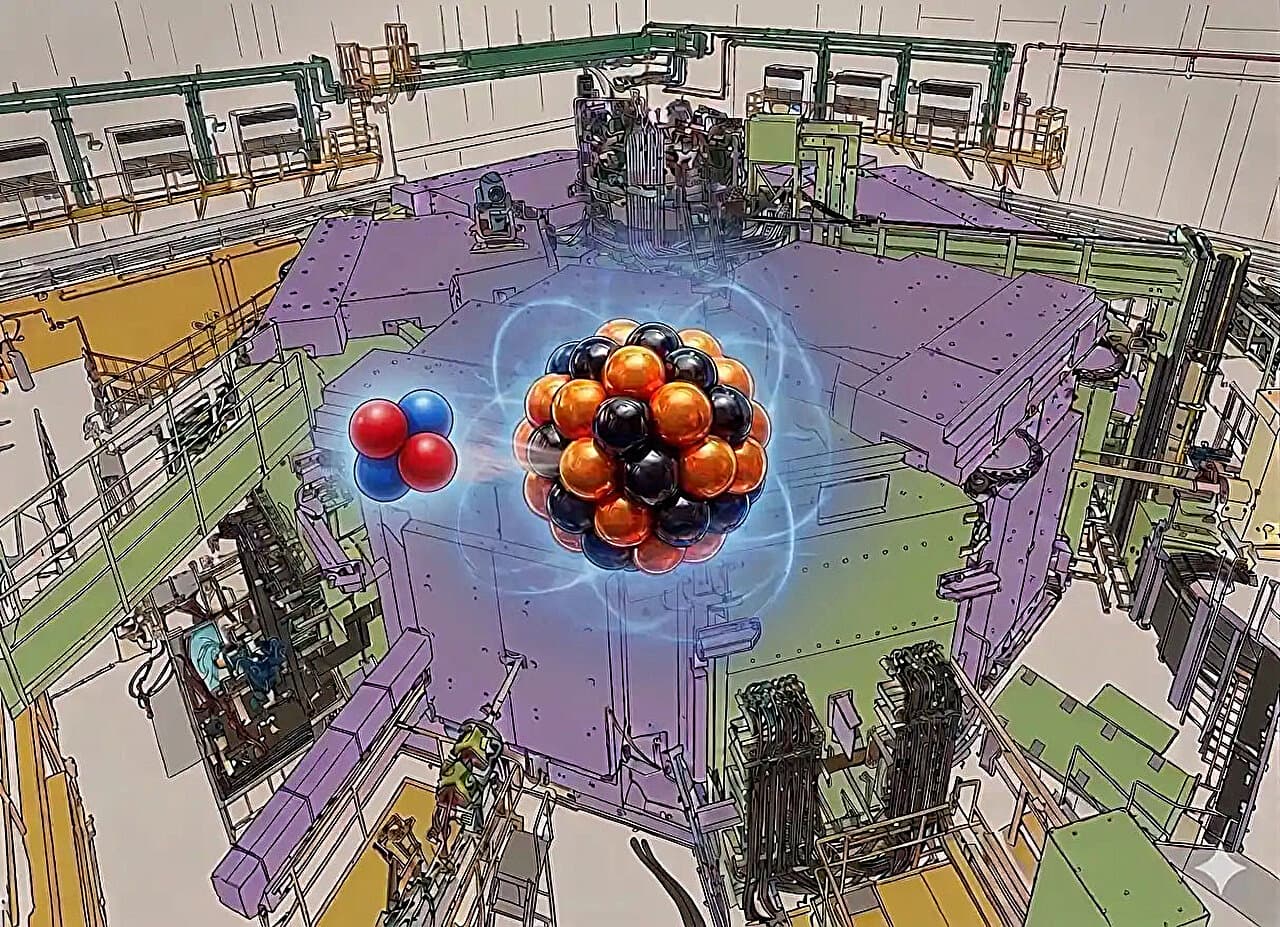
Tellurium-104 decayed by alpha emission in just 7.2 nanoseconds, the first direct observation of the long-predicted superallowed mode near doubly magic tin-100. The result gives 104Te the highest deduced alpha-particle formation probability known and makes it the fastest known ground-state alpha-emitting nucleus.
Researchers produced the decay chain at RIKEN’s Radioactive Isotope Beam Factory in Japan, where four coupled cyclotrons accelerated xenon-124 into a beryllium target. That reaction created xenon-108, which decayed to tellurium-104 and then to tin-100, a sequence that had to be tracked under extreme timing pressure because both xenon-108 and tellurium-104 survive only nanoseconds.
The Nature paper, published May 27, 2026, lands on a nucleus that nuclear physicists treat as a benchmark: 100Sn, with its closed proton and neutron shells. For more than 125 years, alpha decay has been studied in detail, yet how an alpha particle actually forms inside a heavy nucleus has remained unsettled. Tellurium-104 sits in the exact region where decade-old and even 1960s-era predictions pointed to an unusually strong, or superallowed, alpha-decay branch. Earlier neutron-deficient tellurium emitters gave the region that label.
The alpha-particle formation probability in 104Te is about twice that of known nuclei. Robert Grzywacz of the University of Tennessee said the result strengthens the case that tellurium-104 is the definitive test of alpha preformation near 100Sn and helps address “a century-old question” about where alpha particles come from inside nuclei.
This article was produced by Prism’s automated news system from verified source data, official records, and press releases, then run through automated quality and moderation checks before publishing. The system is built and supervised by the people who set the standards it runs under. Read our full AI policy.
Know something we missed? Have a correction or additional information?
Submit a Tip_64496_89439.jpg&w=1920&q=75)