First working nuclear clocks open a new era in precision timekeeping
Two teams finally built working nuclear clocks, moving thorium-229 from theory to devices that could spot tiny shifts in constants and sharpen navigation.
Two research teams have built the first working nuclear clocks, turning thorium-229 from a long-promised idea into a device that ticks on a nuclear transition instead of the electron shell. The clocks point toward a reference that could be more compact and more robust than the best atomic clocks, while also being sensitive enough to probe tiny shifts in fundamental constants and hidden dark-matter signals.
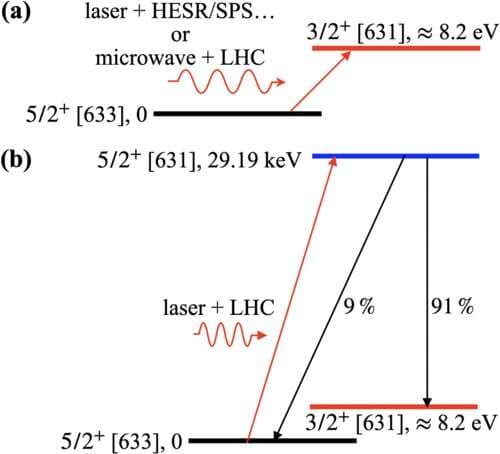
The leading isotope is thorium-229, whose isomeric transition is unusually low in energy, about 8 eV, or vacuum-ultraviolet light near 148.382 nm. That low transition energy is what makes laser driving possible, and it is also what makes the nucleus usable as a metrology reference. Because the nucleus is much smaller than the surrounding electron cloud, it should be less exposed to electromagnetic noise that can disturb ordinary atomic clocks.
The road to this result began with a 1976 conjecture about the low-energy 229Th isomer. For almost 50 years, the field moved through nuclear spectroscopy before laser-based approaches became practical, and in 2012 a single-ion 229Th3+ nuclear clock was proposed with total fractional inaccuracy approaching 1×10^-19. A major step came in September 2024, when researchers directly excited the 229Th transition in solid-state CaF2 using a vacuum-ultraviolet frequency comb. That experiment brought together an ultraviolet laser and an optical frequency comb, the key ingredients of a nuclear clock.
Since then, the work has moved from partial demonstrations to operating devices. Solid-state thorium-229 nuclear clocks open new opportunities in precision metrology and fundamental physics. The clocks could bring practical gains in GPS, navigation without GPS, faster internet speeds, more reliable network connections and more secure digital communications. The same sensitivity that could steady clocks could also make them useful for dark-matter searches and for checking whether the constants of nature really stay constant over time.
This article was produced by Prism’s automated news system from verified source data, official records, and press releases, then run through automated quality and moderation checks before publishing. The system is built and supervised by the people who set the standards it runs under. Read our full AI policy.
Did this article answer your question?