Gravitationally lensed galaxy Shadow Blaster linked to high-energy neutrino
A lensed galaxy 11 billion light-years away is now the strongest suspect for IceCube’s 2021 neutrino IC 210922A. Shadow Blaster’s magnified starburst gives the case its best evidence yet.
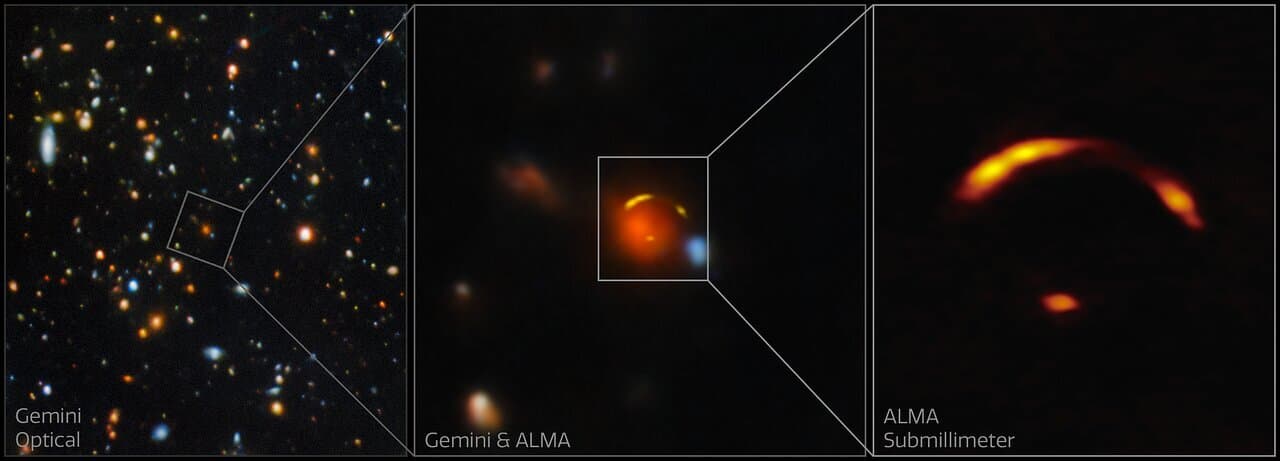
A galaxy nicknamed Shadow Blaster has become the sharpest lead yet in one of IceCube’s long-running cosmic mysteries. The object, cataloged as JCMT04020424, sits about 11 billion light-years away and only came into focus because a foreground galaxy acted like a natural magnifying glass, bending its light into arcs.
The trail began with IceCube event IC 210922A, a high-energy neutrino detected on September 22, 2021 at 18:17:20.948 UT from the direction of Eridanus. Follow-up work led by Yuji Urata, with colleagues including Kuiyun Huang, Bunyo Hatsukade, Shigeo Kimura, Yusuke Miyamoto, Hiroshi Nagai, Kouichiro Nakanishi, Mansi Kasliwal and Robert Stein, tied that neutrino to JCMT04020424, a quadruply lensed dusty star-forming galaxy at redshift z = 2.988. The source lies inside the 90% containment region for the IceCube event, which is the first gate in any credible identification.
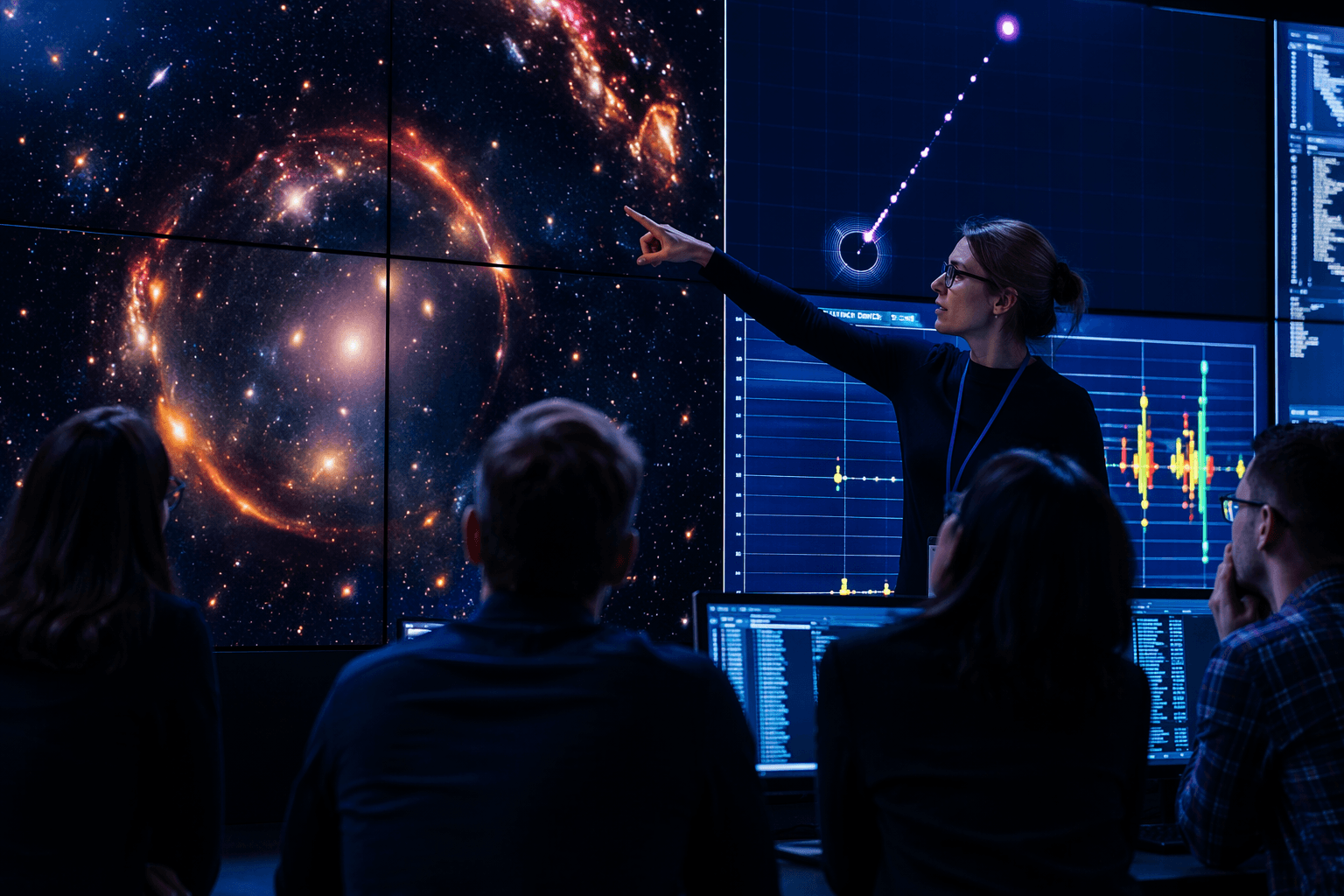
The evidence chain strengthened when Gemini North, the James Clerk Maxwell Telescope, the Submillimeter Array, ALMA and NASA’s Neil Gehrels Swift Observatory all pointed at the same patch of sky. ALMA imaging and lens modeling resolved a highly magnified, compact starburst, and the galaxy’s infrared output appears to reach trillions of times the Sun’s luminosity. At the same time, Swift/XRT observations and long-term Swift/BAT monitoring found no compelling X-ray counterpart, and no bright gamma-ray source has turned up above current sensitivity limits. That absence matters: it leaves the dusty starburst, rather than an obvious high-energy jet source, as the most plausible electromagnetic partner.
The case is persuasive, but still cautious. The study puts the chance-coincidence probability for such an extreme submillimeter source at less than about 1%, a low enough number to make astronomers sit up and take notice without calling the mystery closed. In a field where many neutrino alerts still end without a clean match, that is a serious step forward. The paper argues that compact, gas-rich starbursts at cosmic noon, the epoch when star formation peaked in the universe, can contribute meaningfully to the diffuse high-energy neutrino background even if any single galaxy is only one piece of the puzzle.
For IceCube, whose real-time alert system has been running since 2016, the result fits a broader pattern: only a small number of neutrino sources have been pinned down with confidence, and the rest of the sky still reads like a mostly unsolved ledger. Shadow Blaster does not solve that ledger by itself, but it shows how the next clue may arrive, not from a neutrino alone, but from the way a distant galaxy’s lensed light bends the case into view.
This article was produced by Prism’s automated news system from verified source data, official records, and press releases, then run through automated quality and moderation checks before publishing. The system is built and supervised by the people who set the standards it runs under. Read our full AI policy.
Did this article answer your question?