India's Prototype Fast Breeder Reactor Achieves First Criticality at Kalpakkam
India's PFBR went critical at 8:25 PM on April 6, making India only the second nation after Russia to reach this milestone, backed by thorium reserves that could power the country for 60,000 years.
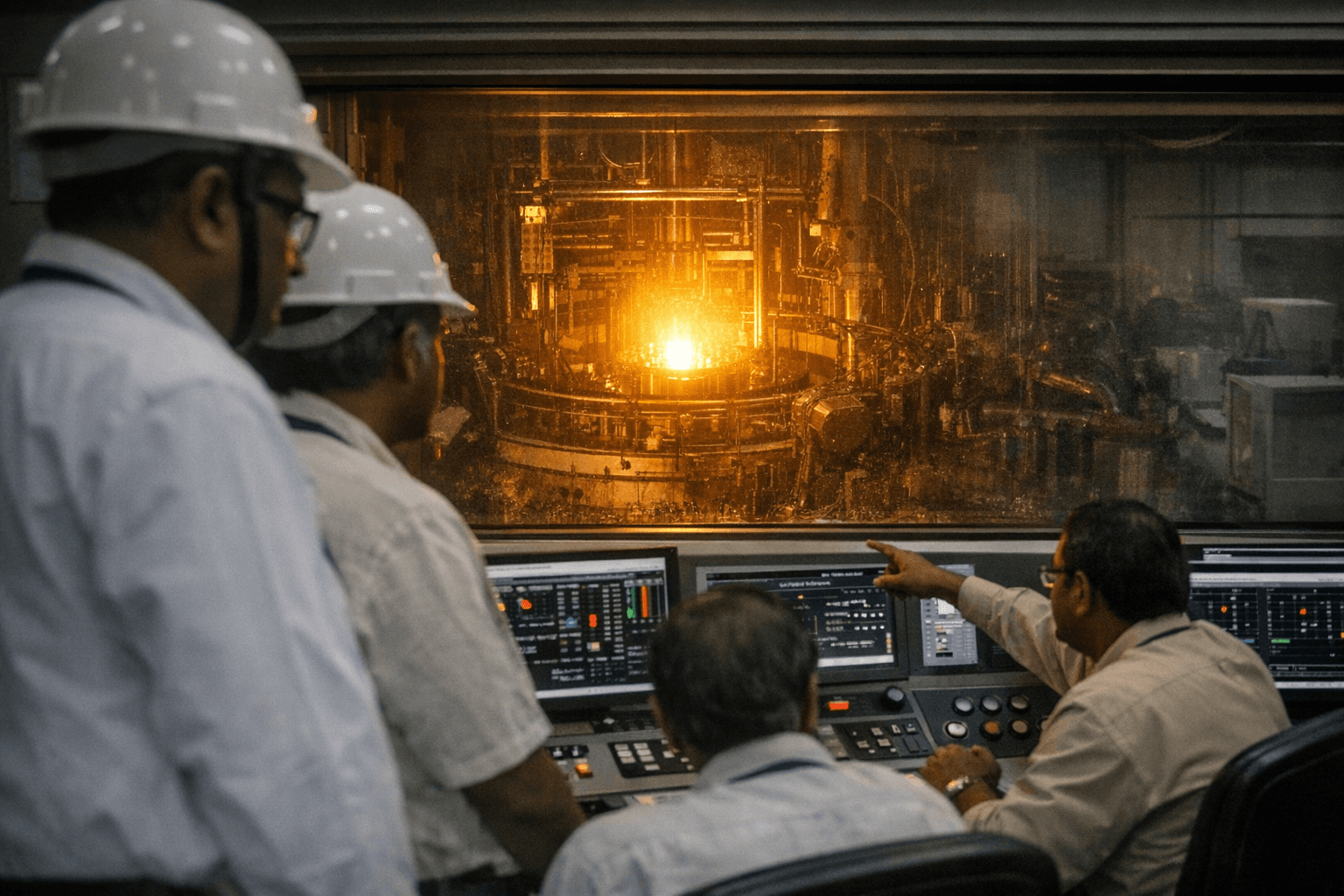
Criticality is the threshold where a reactor no longer needs an external neutron source to sustain itself: fission feeds fission in a controlled, self-perpetuating chain. The PFBR crossed that threshold at exactly 8:25 PM on April 6 at Kalpakkam, Tamil Nadu, confirmed by Dr. Ajit Kumar Mohanty, Secretary of the Department of Atomic Energy, who witnessed the event alongside IGCAR Director Shri Sreekumar G. Pillai and BHAVINI CMD-In-Charge Shri Allu Ananth. First criticality is not full power, and it is not grid connection. But it proves the physics, and in India's case, a very specific and long-deferred set of physics.
What the PFBR actually enables is the crux. Running on uranium-plutonium mixed oxide fuel, the reactor wraps its core in a blanket of uranium-238. Fast neutrons, unsoftened by any water moderator, convert that fertile U-238 into fissile plutonium-239, potentially breeding more fuel than the reactor consumes. Extend that blanket to thorium-232 and those same fast neutrons produce uranium-233, the fissile feedstock for Stage 3 of India's three-stage programme: large-scale thorium reactors. That pathway matters because India holds roughly 25% of the world's known thorium reserves but only 1-2% of global uranium, and currently imports more than 70% of the uranium its existing fleet requires. Physicist Homi J. Bhabha conceived this three-stage strategy in the 1950s precisely because he understood that arithmetic. India's thorium reserves, fully exploited, could theoretically power the country for 60,000 years.
The global fast reactor landscape is small but growing fast. Russia has operated commercial fast breeders since the BN-600 at Beloyarsk came online in 1980; its successor BN-800 reached full commercial power in 2016, delivering 789 MWe from the same Ural Mountains site, and Rosatom is advancing the BN-1200. China's CFR-600, a 600 MWe sodium-cooled demonstration reactor at Xiapu, began initial operations in 2023 with a second unit expected to follow in 2026. The PFBR at 500 MWe competes on comparable scale, but its three-stage fuel-cycle logic, built around India's specific resource profile rather than borrowed wholesale from Russian or Chinese programs, gives Kalpakkam a strategic distinctiveness. The FBTR, a smaller research reactor co-located at the Kalpakkam site, has been running for roughly 38 years and gave India the sodium-cooling operational experience that underpins the PFBR design.
The road to this criticality was punishing. IGCAR's design work dates to the 1980s; construction by BHAVINI began in 2004 against a September 2010 completion target. More than 15 years of technical delays followed. Core loading began in March 2024, new issues emerged, and AERB formally cleared the First Approach to Criticality only in July 2024. Final fuel loading commenced October 18, 2025, after AERB completed its safety review. Project costs escalated from an original estimate of approximately Rs 3,492 crore to around Rs 8,181 crore, equivalent to roughly $900 million USD, according to India's Parliamentary Standing Committee on Science and Technology. Over 200 Indian industries, including MSMEs, contributed components and fabrication; MOX fuel came from the Advanced Fuel Fabrication Facility at BARC's Tarapur campus, with BHEL providing key construction equipment.
Prime Minister Narendra Modi called it "a decisive step towards harnessing our vast thorium reserves in the third stage of the programme," while Congress leader Jairam Ramesh, a repeat visitor to the Kalpakkam facility, described it as "the result of decades of dedicated and determined effort."
The headline is criticality. The milestones that actually matter come next: phased power ascension through low-power physics experiments, AERB safety validation at progressively higher output, and finally grid synchronization. Sustained operation at rated load is the metric that proves commercial-scale fast breeding at full fidelity. A clean run through those gates clears the path for larger 600 MWe fast breeders at Kalpakkam and across India, and puts Stage 3, thorium, and 60,000 years of domestic fuel supply within reach of being more than a number on a planning document.
This article was produced by Prism’s automated news system from verified source data, official records, and press releases, then run through automated quality and moderation checks before publishing. The system is built and supervised by the people who set the standards it runs under. Read our full AI policy.
Did this article answer your question?