Jefferson Lab finds nuclear shell structure shapes proton-neutron pairing
Jefferson Lab found proton-neutron pairing follows nuclear shell structure, not just neutron excess, in calcium-40, calcium-48 and iron-54.
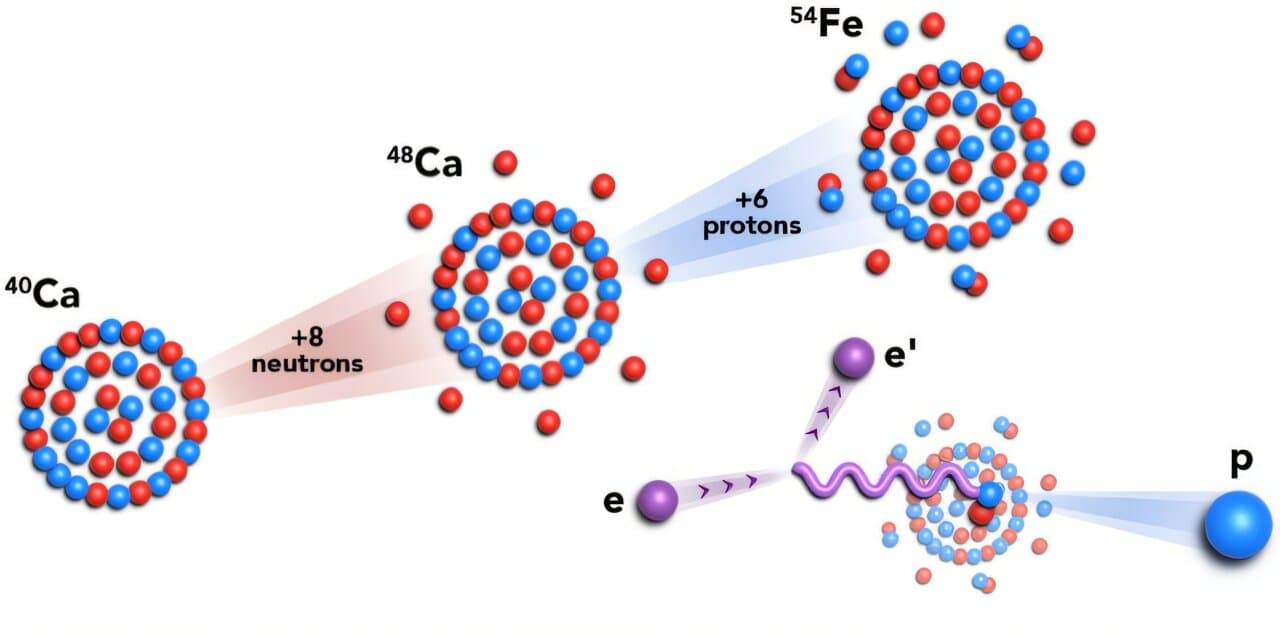
Inside the nucleus, pairings do not follow a simple head count. In a Jefferson Lab experiment that pushed high-energy electrons through calcium-40, calcium-48 and iron-54, physicists found that proton-neutron short-range pairing depended far more on the nucleus’s quantum shell structure than on the raw proton-to-neutron ratio.
The result, reported online June 3, 2026 in Nature, came from a 30-physicist collaboration at the U.S. Department of Energy’s Thomas Jefferson National Accelerator Facility in Newport News, Virginia. Using electron scattering in Hall A to knock out protons and probe the nucleus directly, the group compared calcium-40, with 20 protons and 20 neutrons, calcium-48, with 20 protons and 28 neutrons, and iron-54, a magic nucleus with a filled neutron outer shell. That mix of “magic” and doubly magic systems gave the team a way to separate mass, proton count, neutron count and orbital structure, and it exposed a rule that earlier measurements had blurred: pairing is shaped by where nucleons sit in the shell model, not just by how neutron rich a nucleus is.

That finding is the surprise. Earlier work had suggested that neutron-rich nuclei might simply contain more proton-neutron pairs. The new data say the story is subtler, and that the occupied orbitals matter enough to change which nucleons are most likely to lock together at very short distances. In other words, the nucleus is not just a crowded sphere of matter. It is a structured quantum system, and that structure reaches all the way down to the brief, intense interactions called short-range correlations.
Those SRC pairs are no side note. Jefferson Lab says they make up about 20% to 25% of nucleons in medium-to-heavy nuclei, account for essentially all nucleons above the nuclear Fermi momentum, and carry most of the kinetic energy inside nuclei. The density inside a correlated pair is about five times higher than average nuclear matter. Earlier Jefferson Lab work found neutron-proton pairs dominate proton-proton pairs by about a factor of 20, and the CaFe program was designed because about 70% of nucleons are described well by mean-field orbitals while the rest are governed by correlations that older measurements could not cleanly separate.
That is why this new rule matters beyond calcium and iron. It should sharpen nuclear models used to predict structure more reliably, and it could also reshape how physicists treat dense matter, from the EMC effect to neutrino-nucleus scattering, nuclear symmetry energy and even neutron-star matter. The nucleus just got a better rulebook, and the next step is making the rest of nuclear theory read from it.
This article was produced by Prism’s automated news system from verified source data, official records, and press releases, then run through automated quality and moderation checks before publishing. The system is built and supervised by the people who set the standards it runs under. Read our full AI policy.
Did this article answer your question?