LLNL captures first stages of runaway hydrogen-uranium corrosion
LLNL watched uranium hydride begin forming in real time, exposing the first blisters and cracks that can drive storage failures, corrosion and ignition risk.
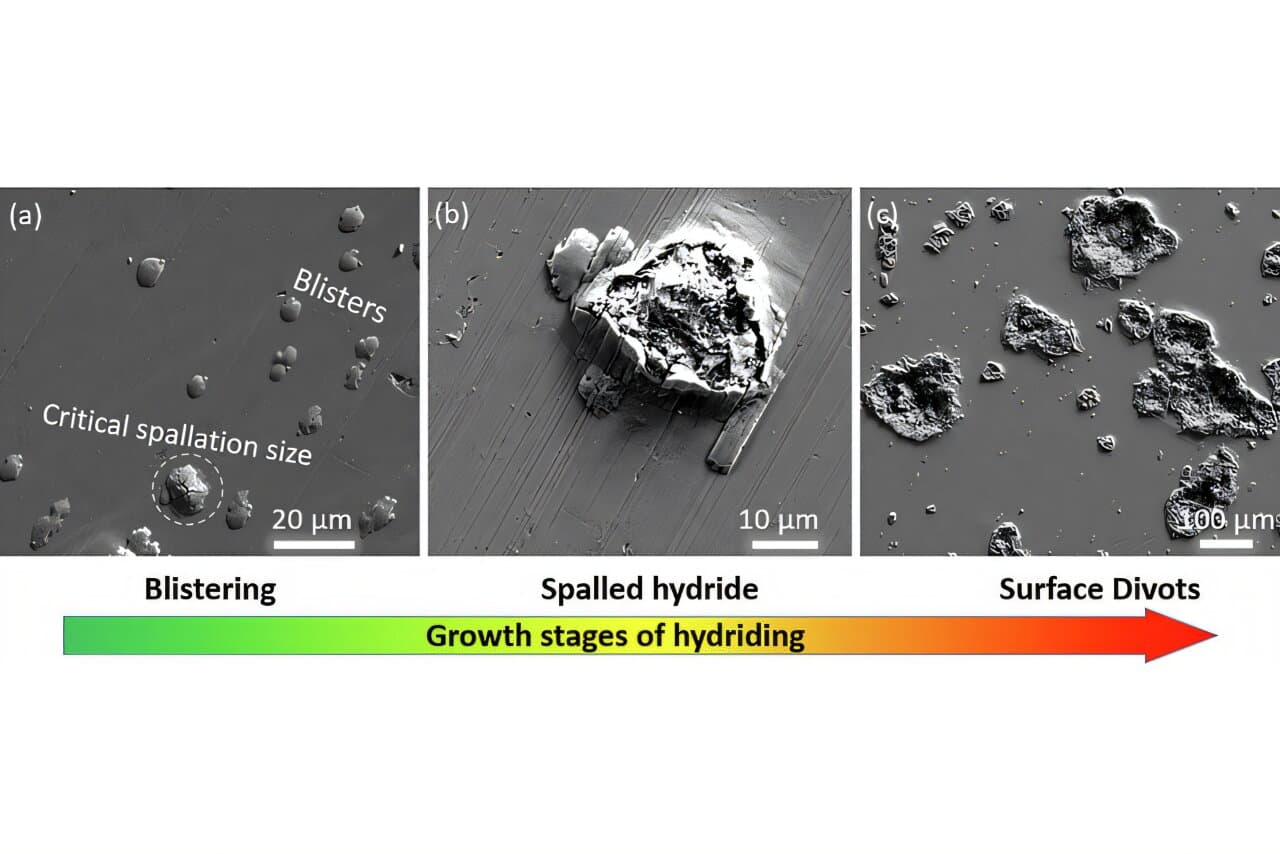
Catching the first moments of hydrogen slipping into uranium metal could sharpen the models engineers use to predict storage failures, corrosion and safety hazards. Lawrence Livermore National Laboratory researchers say they have now seen that opening act directly, watching the surface blister, rupture and shed uranium hydride powder instead of only studying the reaction after it was already underway.
The study, Early-stage uranium-hydrogen corrosion kinetics and mechanism, was received on October 13, 2025, accepted on January 27, 2026 and published on February 5, 2026 in npj Materials Degradation. LLNL used white-light interferometry to repeatedly scan the uranium surface during blistering without touching or destroying the sample, then paired that view with focused ion beam serial-sectioning tomography to characterize different stages of hydriding. The result was a clearer picture of a reaction that has long been known in pieces but not fully pinned down at the moment it begins.

What the team saw matches the familiar runaway corrosion cycle, but with a sharper look at the start. Hydrogen adsorbs, dissociates and diffuses into uranium, then hydride forms beneath the surface, expands and pushes up a blister. Once the surface ruptures, powder is released and fresh metal is exposed, which allows the process to accelerate. The new analysis also showed hydride blisters forming in unexpected places and spreading sideways through a shallow surface region, not simply driving straight into the bulk.
That matters because the earliest stage has been difficult to measure directly. The paper says the mechanism lacked a unified understanding because existing methods did not have enough temporal and spatial resolution to capture the first events. Nature Index has described the broader chemistry as sensitive to temperature, pressure, microstructure and surface condition, with uranium hydride formation tied to volume expansion, brittle layers and pyrophoric risk in air. Older studies had already pointed to very thin hydride layers at the oxide-metal interface, but LLNL says this work finally brings continuous observation to the part of the reaction that had remained hidden.
The practical stakes run well beyond the laboratory. Fusion systems need materials that can survive harsh chemical and radiation environments, hydrogen storage systems need to avoid unexpected degradation, and uranium fuel stored for decades has to remain predictable and stable. LLNL says the new measurements should lead to more predictive and physically grounded models of uranium degradation, replacing assumptions with observed behavior.
The result also fits the laboratory’s broader mission. Less than four years after LLNL’s fusion ignition milestone at the National Ignition Facility on December 5, 2022, the lab is now turning that same attention to the chemistry of failure at the materials surface. In uranium corrosion, seeing the first blister form is the difference between guessing at the damage and knowing where the cycle begins.
This article was produced by Prism’s automated news system from verified source data, official records, and press releases, then run through automated quality and moderation checks before publishing. The system is built and supervised by the people who set the standards it runs under. Read our full AI policy.
Did this article answer your question?