Neon-20 shape leaves fingerprint in high-energy collision debris
Neon-20’s bowling-pin shape now shows up in collision debris, giving physicists a cleaner handle on flow in oxygen and neon smashups.

Neon-20’s prolate, bowling-pin-like shape is no longer just a detail for nuclear-structure papers. New calculations and measurements show that it leaves a measurable imprint in the particle spray from very high-energy light-ion collisions, even when the nuclei are as small as oxygen and neon.
The key comparison is oxygen-16 against neon-20. Oxygen-16 is relatively round, while neon-20 is predicted to be strongly elongated. Using ab initio nuclear structure inputs, including projected generator coordinate method and nuclear lattice effective field theory calculations, paired with event-by-event hydrodynamic simulations, the researchers showed that neon-20’s geometry amplifies elliptic flow relative to oxygen-16. That matters because flow harmonics such as v2 and v3 are where the shape of the initial nucleus gets converted into the final-state particle pattern. In practical terms, the comparison gives experimenters a cleaner way to separate genuine geometry effects from the uncertainties that usually cloud heavy-ion modeling.
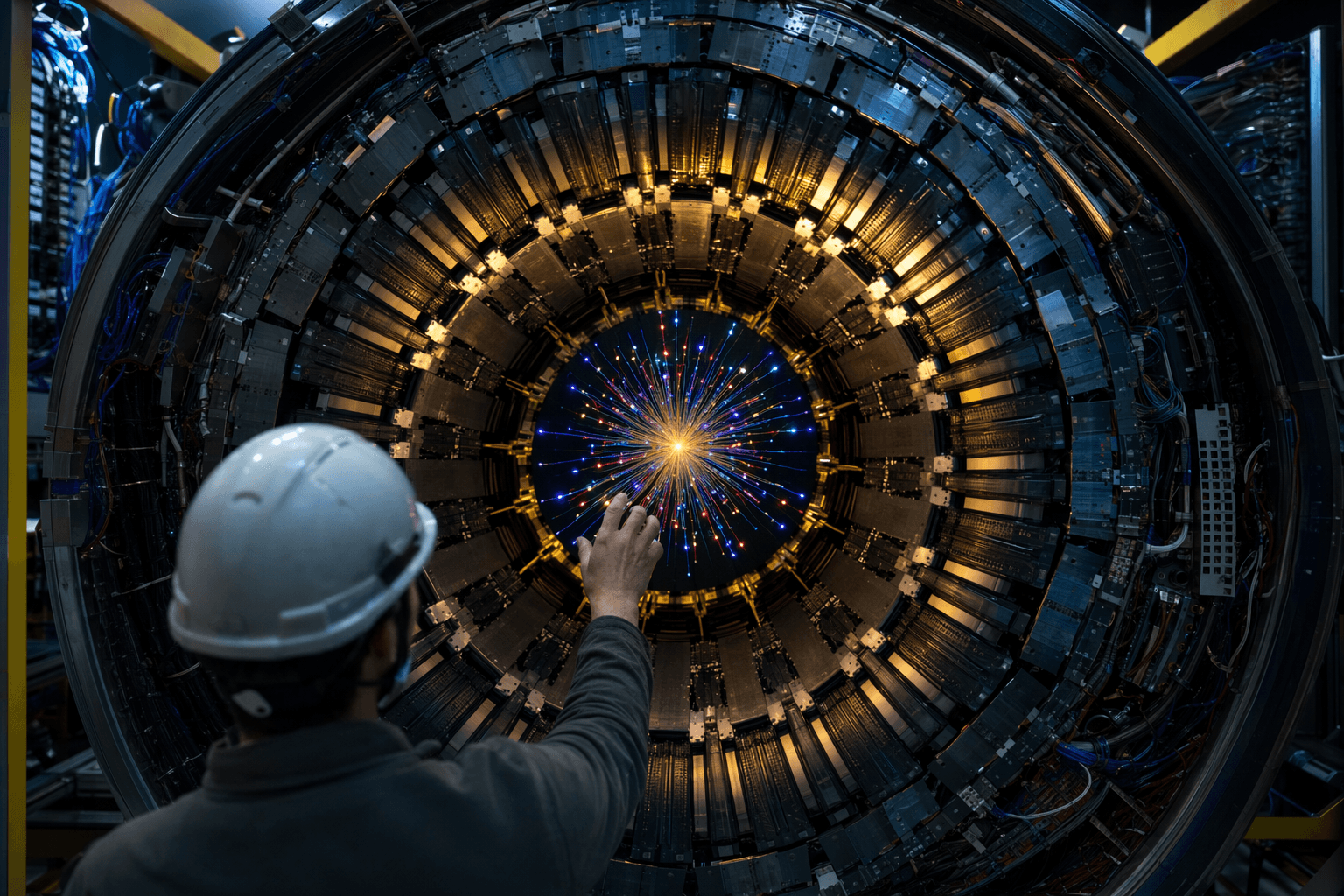
The new light-ion data came from the Large Hadron Collider’s first dedicated run with light nuclei, carried out over about six days from late June to early July 2025 at 5.36 TeV per nucleon pair. ATLAS, ALICE, CMS and LHCb all recorded data, and ATLAS later reported the first measurements of elliptic flow in oxygen-oxygen and neon-neon collisions in the fall of 2025. Those measurements showed sizeable elliptic and triangular flow, with the signal depending strongly on whether the impacts were glancing or head-on. That centrality dependence is exactly what nuclear-structure theorists hoped to see if geometry was really making it through to the debris.
The result pushes light-ion collisions into the same conversation as heavier xenon-xenon and lead-lead systems, but with a sharper experimental handle. The U.S. Department of Energy Office of Science highlighted that the new neon-20-neon-20 and oxygen-16-oxygen-16 results appear to confirm several key predictions, while the broader comparison between oxygen and neon gives scientists a better baseline for probing whether tiny collision systems can create quark-gluon plasma. For a field that has long fought to untangle shape, fluctuations and final-state flow, seeing a nucleus’s internal outline in the debris is a useful kind of surprise.
This article was produced by Prism’s automated news system from verified source data, official records, and press releases, then run through automated quality and moderation checks before publishing. The system is built and supervised by the people who set the standards it runs under. Read our full AI policy.
Did this article answer your question?


