Neutron activation analysis turns research reactors into precision tools
Neutron activation analysis lets a reactor read trace elements through gamma rays, powering forensic work, art authentication, and heritage science.
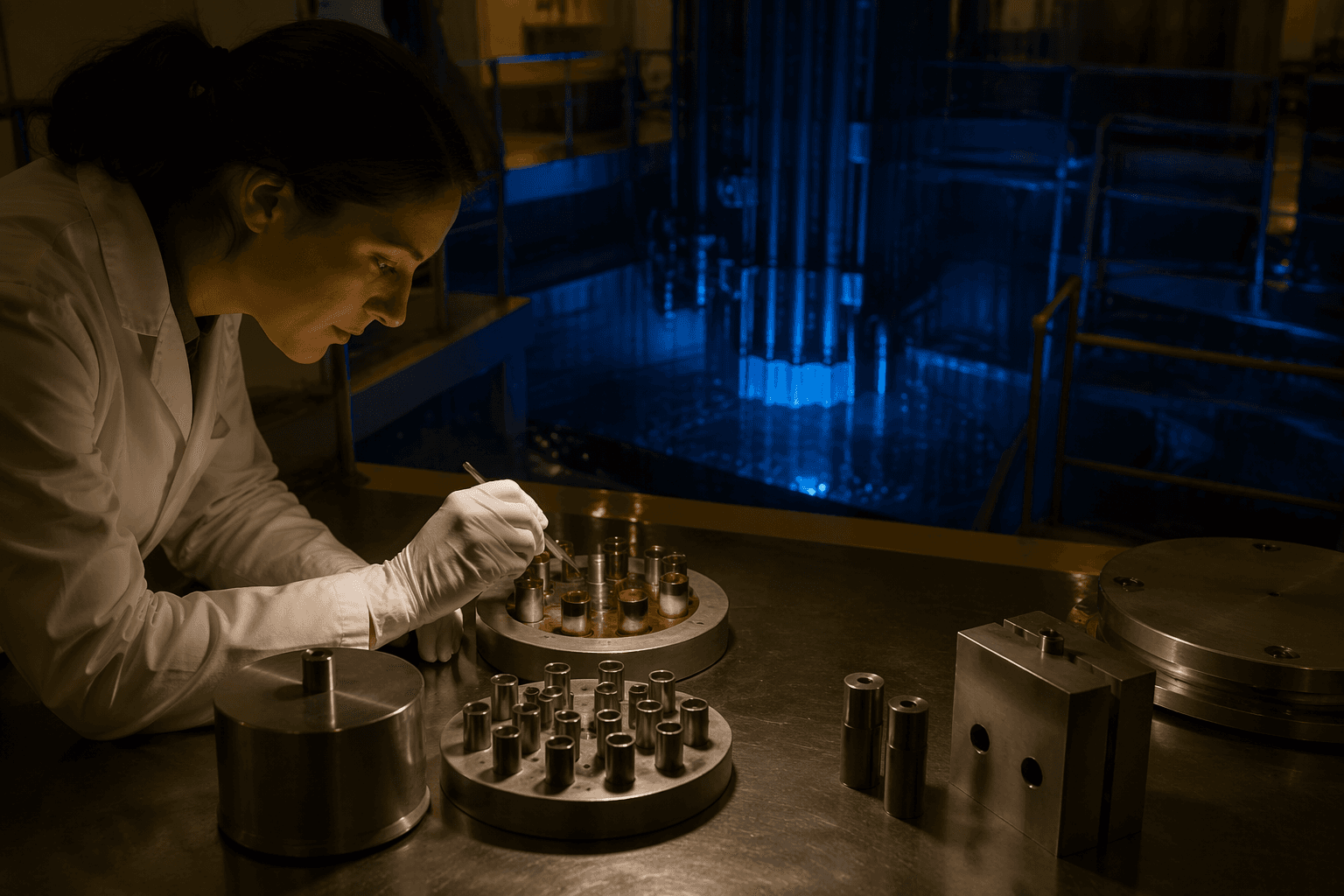
A sample goes into a research reactor, neutrons make select nuclei radioactive, and the decay radiation reveals what was there before irradiation. That same setup can expose residue in a courtroom, authenticate a pigment in a painting, or separate a real ceramic fragment from a clever copy.
How NAA turns neutrons into evidence
Neutron activation analysis is a qualitative and quantitative method that identifies elements by the characteristic radiation from radionuclides formed when a material is irradiated by neutrons. In practice, the sample is exposed to a neutron flux, certain nuclei capture neutrons, and the resulting radioactive decay leaves an elemental fingerprint behind. Because the readout comes from gamma radiation rather than destructive chemistry, the technique is generally non-destructive and can reach detection limits in parts per billion.
That sensitivity is why NAA keeps its place in reactor work. In the IAEA’s accounting, next to education and training, it is the most widely used application of research reactors. The method is not tied to a single neutron field either: thermal, epithermal, and fast-neutron reactions all matter, and activation probabilities change with target nuclide and neutron energy. In that context, the older activation cross-section tables still matter, because the cross section is the probability that a nucleus will undergo a specific reaction, usually expressed in barns, where one barn is 10^-24 square centimetre.
Why research reactors are the workhorse
Research reactors are usually the best neutron source for NAA because they deliver steady flux in a controlled setting. Even reactors operating at roughly 10 to 30 kW thermal can provide enough neutron flux for selective applications, and they do it with lower setup costs than neutron-scattering instruments. That makes NAA unusually practical for labs that need a precise elemental assay without building a giant dedicated beamline.
In instrumental neutron activation analysis, samples are often sealed in polyethylene, then irradiated in a reactor core or a pneumatic tube. At the NIST Center for Neutron Research, the reactor positions used for INAA can provide neutron fluence rates of about 1 × 10^14 cm^-2 s^-1 and 3 × 10^13 cm^-2 s^-1, enough to drive the activation step that makes the analysis work.
A method that started before reactors were practical
NAA has roots in the early nuclear chemistry era. George de Hevesy and Hilde Levi pioneered the method in 1936, after the neutron was discovered in 1932. It did not become a practical analytical tool until the 1940s, when the nuclear reactor gave scientists a high-intensity neutron source that could be used repeatedly and predictably.
Hevesy and Levi did the first work with a radium-beryllium neutron source, including measurements of activated dysprosium, but the reactor era turned a clever laboratory trick into a routine measurement platform.
Where it has earned a courtroom record
Forensics is one of the sharpest examples of what NAA can reveal that ordinary lab techniques often miss. The first U.S. court case involving forensic activation analysis took place in March 1964, and a General Atomic Division report described a highly reliable method for detecting gunshot residues on the gunhand of a person who had recently fired a gun.
The appeal is the combination of sensitivity and elemental selectivity. High-flux NAA can detect minute residues and trace contaminants without grinding a specimen into submission, which is why later forensic reviews kept returning to the technique for crime-scene work.
Why conservators and curators care
In cultural heritage work, the object itself is often too valuable to sacrifice. Nuclear science is used to study and preserve paintings, clothing, musical instruments, statues, arms and armour, Egyptian mummies, and even an ancient wooden ship. For those objects, the key advantage is obvious: NAA can reveal elemental composition while keeping the object intact.
Instrumental NAA is especially useful for sub-sampled material such as pottery sherds or ochre, and in some cases for small whole artifacts such as coins. A 2025 review found neutron techniques especially available for non-invasive characterization of metal, ceramic, and stone objects because neutrons penetrate deeply into material.
What the measurement cycle looks like
Samples are irradiated, then measured with high-resolution gamma spectroscopy, and the timing depends on the half-lives of the radionuclides created in the reactor. Measurements for short half-life radionuclides are often taken about two to seven days after irradiation and again about three weeks later.
That staggered schedule lets analysts catch different element groups as their activity peaks and fades. It is one reason NAA remains so useful in mixed matrices, from soil and mine samples to pigments and residues.
The hidden engine behind the result
NAA also sits inside a wider nuclear-data ecosystem. Every activation measurement depends on reaction probabilities, neutron energies, and evaluated cross-section data, which is why the technique links naturally to reactor physics and shielding work. The IAEA’s nuclear data libraries exist for exactly that reason: to make neutron-induced reactions measurable, comparable, and useful across applications.
This article was produced by Prism’s automated news system from verified source data, official records, and press releases, then run through automated quality and moderation checks before publishing. The system is built and supervised by the people who set the standards it runs under. Read our full AI policy.
Did this article answer your question?